
Spain’s migrant crisis has opened another sharp clash within the European Union. Italy, according to the official version, has requested the suspension of the Schengen agreement with Spain, putting Madrid under political pressure at a time when member states are clearly divided in their positions on border management.
Rome shifts the pressure onto Madrid
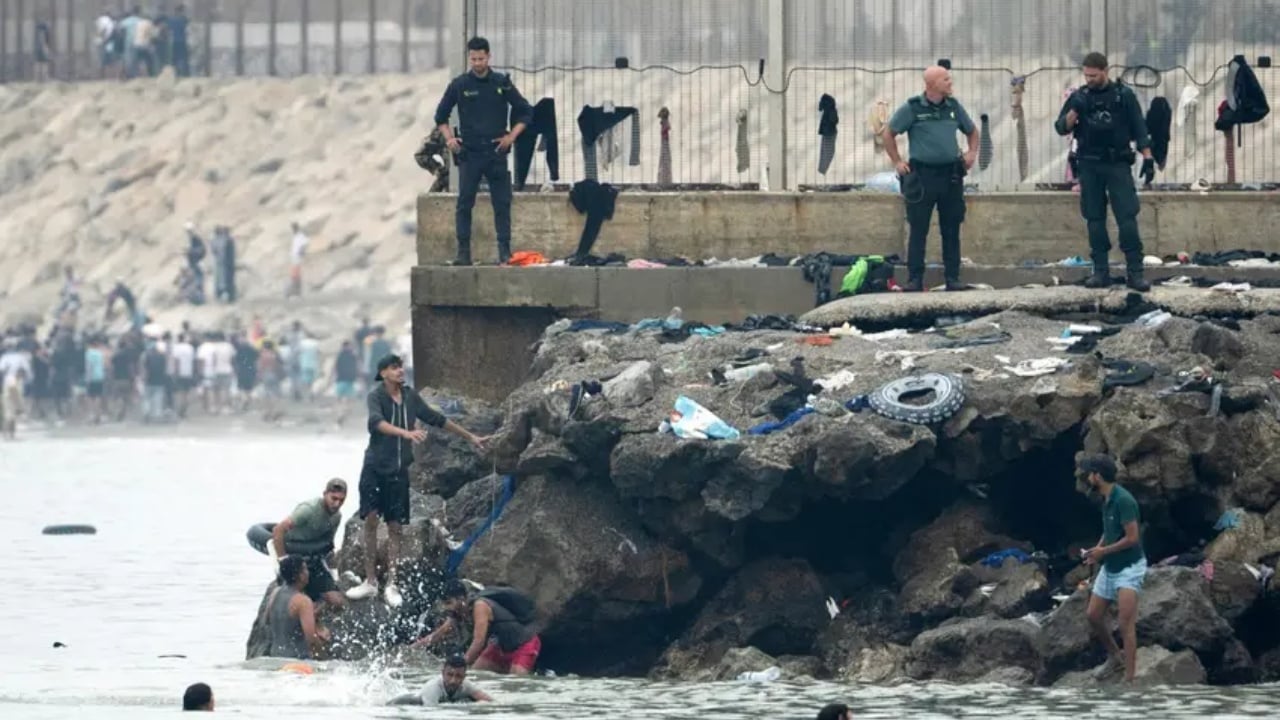
According to the information made public, Spain is facing a heavy wave of migrant arrivals, with around 60,000 people from Morocco crossing into the Spanish enclave within 24 hours.
Italian Prime Minister Giorgia Meloni has held the Spanish government responsible for the situation and has pushed forward the suspension of Schengen with Spain. This stance shifts the crisis from the border to the EU’s political table, where the issue of migration is once again being used as a test of strength between governments.
Several EU states line up behind tough measures
Poland, Finland, Sweden, Denmark, the Czech Republic and other countries have asked the European Union to consider all options for the crisis in Spain, including the suspension of Schengen.
According to this position, political responsibility is being placed on Pedro Sanchez’s government. This shows that the debate is no longer limited to the practical management of the border, but is turning into an open confrontation over the political burden of the crisis.
Brussels and European leaders call for border control
European Commission President Ursula von der Leyen described the scenes coming from Ceuta as unacceptable. She said that entries into the union’s territory must respect the rules and that dangerous crossings must be stopped immediately.
Von der Leyen also announced that she had tasked two commissioners with supporting control of the situation in Spain. Meanwhile, German Chancellor Friedrich Merz and French President Emmanuel Macron expressed solidarity with Madrid, but also stressed the need to restore control at the border.
Sanchez hits back amid a divided Europe
Facing calls for punitive measures against Spain, Prime Minister Pedro Sanchez responded with a political message to the critical countries.
“Solidarity and empathy are optional, respect for the treaties of the European Union is not,” he said, opposing calls for Spain’s suspension from the Schengen agreement.
The clash once again highlights an EU divided into two camps: one seeking immediate tightening and restrictive measures, the other defending respect for the treaties and avoiding rushed decisions with political and institutional consequences.
The debate over migration is once again becoming a major test of the European Union’s cohesion.
At the center of the crisis is not only the Spanish border, but also the willingness of member states to act together without turning every migratory wave into a new political conflict within the union.