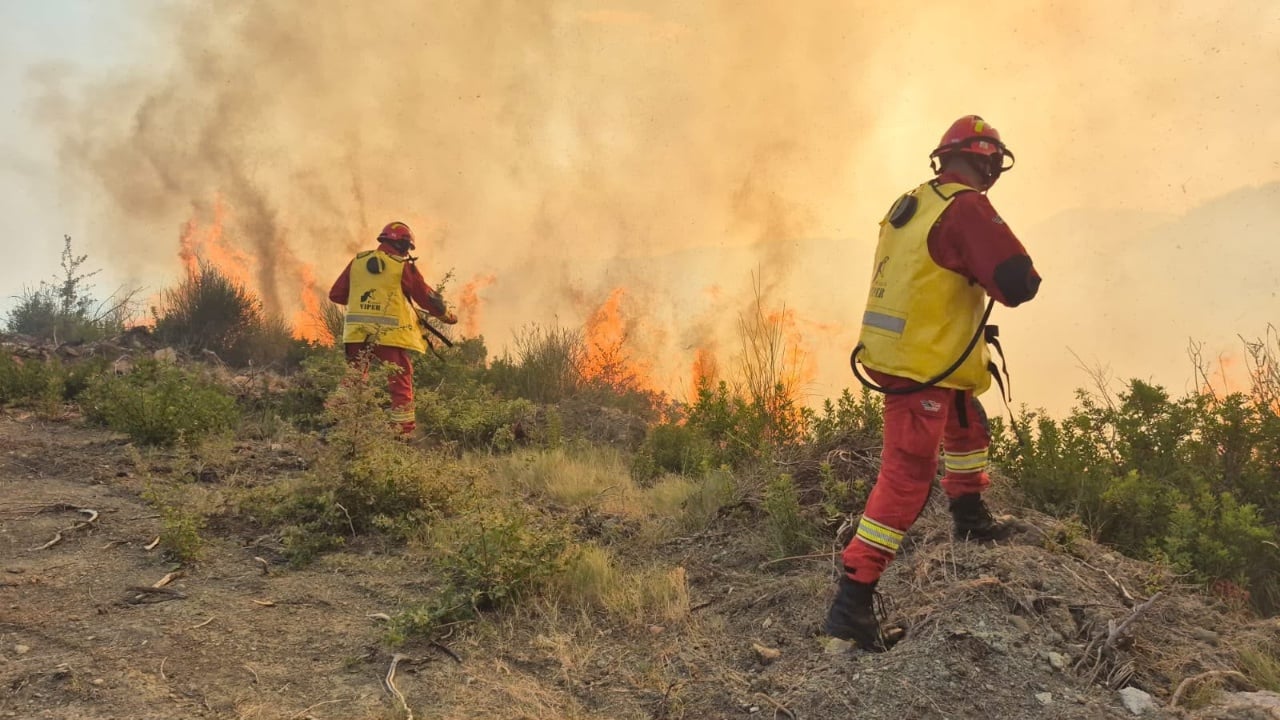
Official figures show 13 fire hotspots reported across the country, while 10 of them remain active. According to the Ministry of Defense, the main focus of operations remains in Lura and on Mount Dajti, while authorities say there is so far no risk to inhabited areas.
Latest toll from the authorities
The Ministry of Defense said that of the 13 fire hotspots reported in recent hours, 10 remain active, 2 are under control and 1 has been fully extinguished.
The official version presents a manageable situation in several counties, but the spread of the fires across several parts of the country shows that pressure on emergency structures remains high.
Lura remains the most problematic point
One of the largest field operations is under way in Lura, Dibër. According to official data, 200 municipal personnel, 50 members of the Armed Forces, 15 State Police officers, 18 volunteers, 2 firefighting vehicles and 2 Air Tractor aircraft have been deployed in the operation.
Authorities say the fire has been brought under control in the segment near homes and that there is currently no reported danger to inhabited areas. However, the fact that this hotspot continues to be considered among the most serious shows that the situation on the ground remains delicate.
Dajti, Priska and Farka under constant monitoring
In Tirana, work is continuing on Mount Dajti, where according to the official report 9 ADZM personnel and 2 Armed Forces helicopters have been engaged.
Meanwhile, in Priska and Farka, 30 MZSH personnel with 6 vehicles are operating. Authorities consider the situation in this area to be under control and without risk to homes, but the hotspot remains under operational monitoring.
Bulqiza and Kruja, interventions from the ground and the air
The hotspot in Qafë Helmes, on the Bulqizë-Selishtë road axis, also remains active. According to the institutions, part of it has been brought under control by operational forces.
In Kruja, ground and air interventions have been concentrated on the hotspots in Abazes and Zidoll. During the day, aerial support from the Armed Forces was used, while in Zidoll, after the helicopter intervention, the situation is reported to have normalized and work is continuing on isolation and full extinguishing.
Other hotspots in several counties, rainfall helps in two areas
In Gjirokastër, Lezhë, Elbasan and Shkodër, work continues to control and monitor the remaining hotspots.
In Përmet and Qukës, rainfall has helped normalize the situation. Meanwhile, in Paulesh of Peqin, the hotspot has been fully extinguished.
According to the official report, none of the identified areas currently presents a risk to inhabited zones.
Although the official toll does not speak of a direct threat to homes, the high number of active hotspots and the deployment of aerial assets show that the situation remains serious in several parts of the country.
The main burden of operations is being carried by the Lura and Dajti areas, where the fires continue to require concentrated intervention from several structures at once.