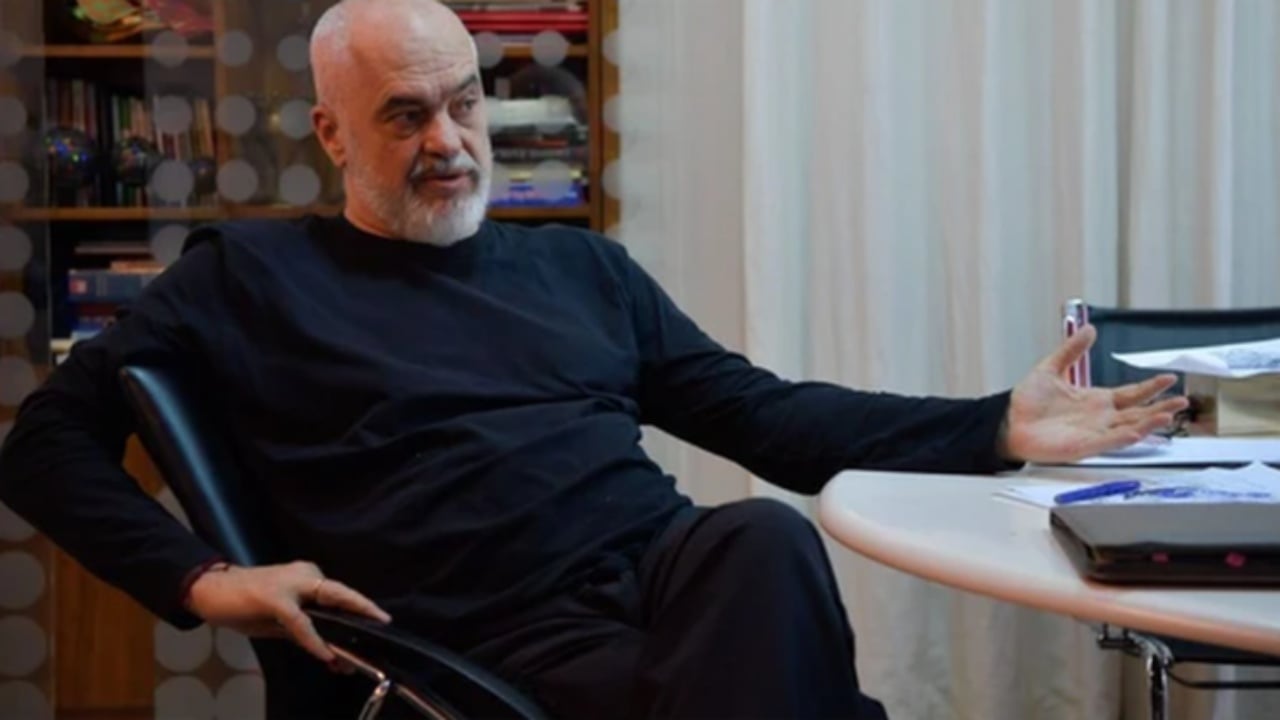
Prime Minister Edi Rama has defended the government’s line on the protests and the project in Zvërnec, sending a clear signal that there will be no retreat. In an interview with British media outlet UnHerd, he portrayed the latest protests as more politicized than those in June, while linking the online debate to algorithms and to content that, according to him, is produced outside Albania.
The protests, according to Rama, are no longer like they were in June
Rama drew a clear distinction between the protests in June and those of recent days. According to his version, the current protest has a stronger political composition and is driven mainly by small opposition forces, both from the left and the far right.
Unlike that, he presented the June protests as broader, with participation also from citizens who had voted for the Socialist Party. The prime minister insisted that the people who have now taken to the streets are not the same as those who protested in June.
Pride in a peaceful protest, but also an effort to frame it politically
In the interview, Rama said he was proud that the protests had taken place without violence and without injuries, presenting this as a sign of a normal European country where the right to protest is respected.
At the same time, he sought to place the protests within a narrow political framework, suggesting that the government is trying to downplay the civic dimension of the dissatisfaction that has emerged on the ground.
Algorithms, social networks and content from abroad
A significant part of the interview was devoted to the role of social media. Rama claimed that algorithms have had a significant impact on the mobilization of protesters and that a high percentage of online content about the protests is produced outside Albania.
He also linked the amplification of the debate to the name of Jared Kushner, the Trump administration and figures connected to this project, suggesting that these topics resonate more strongly within the logic of social media platforms.
Zvërnec is not being removed from the government’s table
The clearest political point of the interview was the position on Zvërnec. Rama indicated that the government has no intention of giving up the project, despite the opposition and protests it has faced.
According to him, there will be consultation with interested parties, but without discussing stopping the project. He expressed confidence that in the end the initiative would prove successful.
This wording leaves open only the procedural side of the debate, while the political decision on the project itself appears to have already been upheld by the government.
Accusations over crime, a “narco-state” and issues within the Socialist Party
Asked about opposition accusations of links between the government and organized crime, including claims of meetings with people suspected of drug trafficking, Rama rejected the accusations and called for concrete evidence.
He also rejected labeling Albania a “narco-state,” arguing that, in his view, the country has never fought corruption and crime more strongly than in recent years. To support this claim, he also referred to Albania’s progress in the process with the European Union.
At the end, Rama avoided commenting on criticism from Elisa Spiropali and on the possibility of divisions within the Socialist Party, calling it an internal party matter. He also said he does not see the protests as a threat to his political legacy and that he no longer feels the need to prove anything politically after 13 years in power.
The interview confirms two messages the government is trying to maintain in parallel: to formally recognize the right to protest, while at the same time presenting the discontent as a product of political actors and social media dynamics.
On Zvërnec, the signal remains the same: consultation yes, suspension no. And that is precisely where the main point of public confrontation remains.