
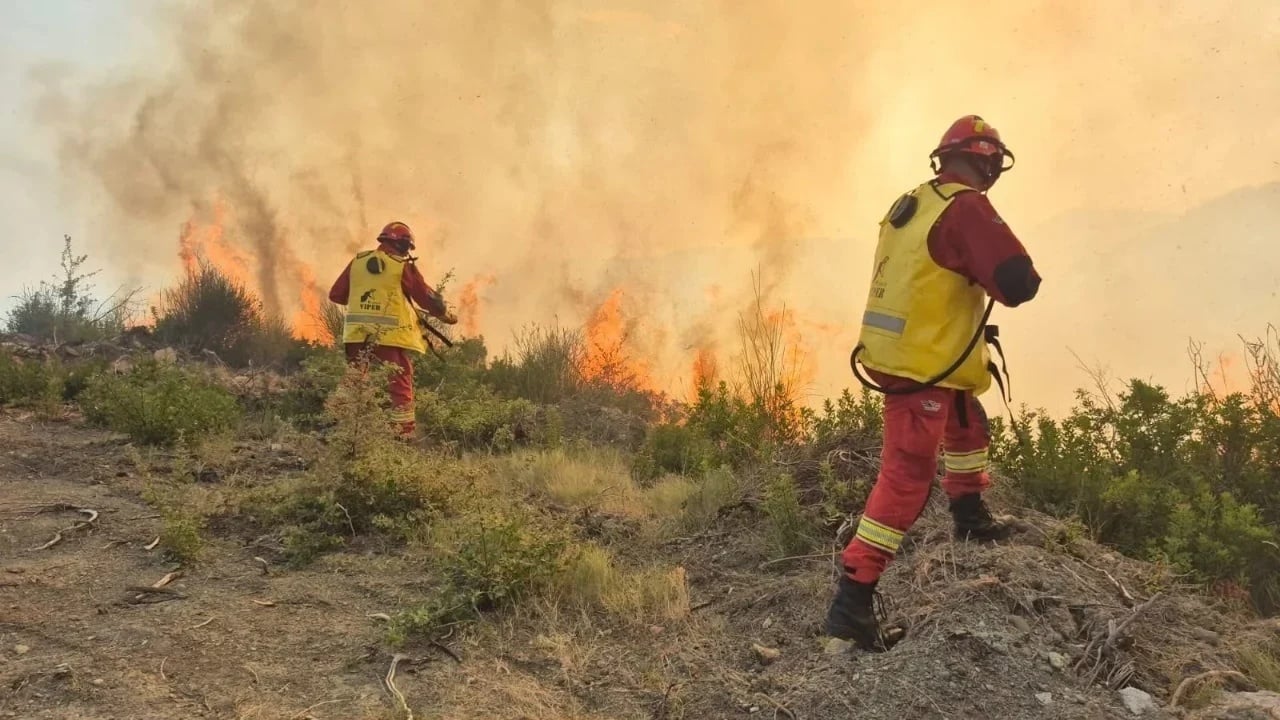
The wildfire situation remains problematic in several areas of the country. According to the Ministry of Defense, 21 fire outbreaks were reported in the last 24 hours, while 6 of them remain active and 7 others are being kept under surveillance. The official toll speaks of hundreds of personnel on the ground, but at some critical points operations are being constrained by difficult terrain and the reactivation of flames.
Official toll for the last 24 hours
The official version published by the Ministry of Defense says that 354 operational personnel and 24 firefighting vehicles have been engaged in managing the situation. They were joined by 155 members of the Armed Forces, 3 firefighting vehicles, 1 heavy excavator, 3 helicopters and 2 Air Tractor aircraft.
Institutions claim that the focus of interventions is isolating active fire outbreaks, preventing reactivations and protecting inhabited areas, while the situation is presented as improved at some of the most problematic points. Nevertheless, the presence of several still-active outbreaks shows that the risk has not been eliminated.
Dajti and Bulqiza, two of the areas where operations continue
On Mount Dajti, the operation is continuing with the support of 30 members of the Armed Forces. According to official data, one day earlier 25 firefighters, 5 staff from the protected areas administration, 30 military personnel and air assets were engaged in this area. So far, it is reported that there is no risk to inhabited areas.
At Qafa e Helmesit, in Bulqiza, the fire was reactivated today in two outbreaks in a dense pine forest. To bring the situation under control, 11 members of the firefighting service have been engaged, showing that even where the flames are considered contained, the risk of their return remains real.
Mirdita and Puka, active outbreaks and areas under monitoring
In Shtuf, Mirdita, the outbreak remains active, but with low intensity. Local authorities are monitoring the situation, without giving a clear timeframe for complete extinguishing.
In the Shtanë-Tenë area of Mirdita, the situation appears more stabilized. Today, 6 firefighters, 6 forestry service workers and 15 municipal personnel are working there, while according to the official report there is no risk to homes.
In Prozhem, Puka, the fire remains active in forested areas. The operation is being handled by local structures and 30 members of the Armed Forces. According to the authorities, there is currently no risk to homes, while in Gjegjan, Gojan i Vogël and Gojan i Madh the situation has been isolated or extinguished and is being kept under observation.
Mount Çika, difficult terrain remains an obstacle
One of the most difficult areas for intervention remains Mount Çika, above Palasa. There, the outbreak continues on steep and inaccessible terrain, while today’s operation for final extinguishing is being supported by 2 Air Tractor aircraft.
It is precisely in these areas, where intervention from the ground is limited, that the success of the operation depends significantly on conditions in the field and on air support. Wind and rugged relief continue to be factors that complicate full control of the flames.
The National Civil Protection Agency says it is monitoring the situation across the entire territory in coordination with prefectures, municipalities and other civil protection structures.
Beyond declarations of full readiness, the toll of several outbreaks still active and reactivations in certain areas shows that the situation remains fragile and dependent on the response on the ground.