
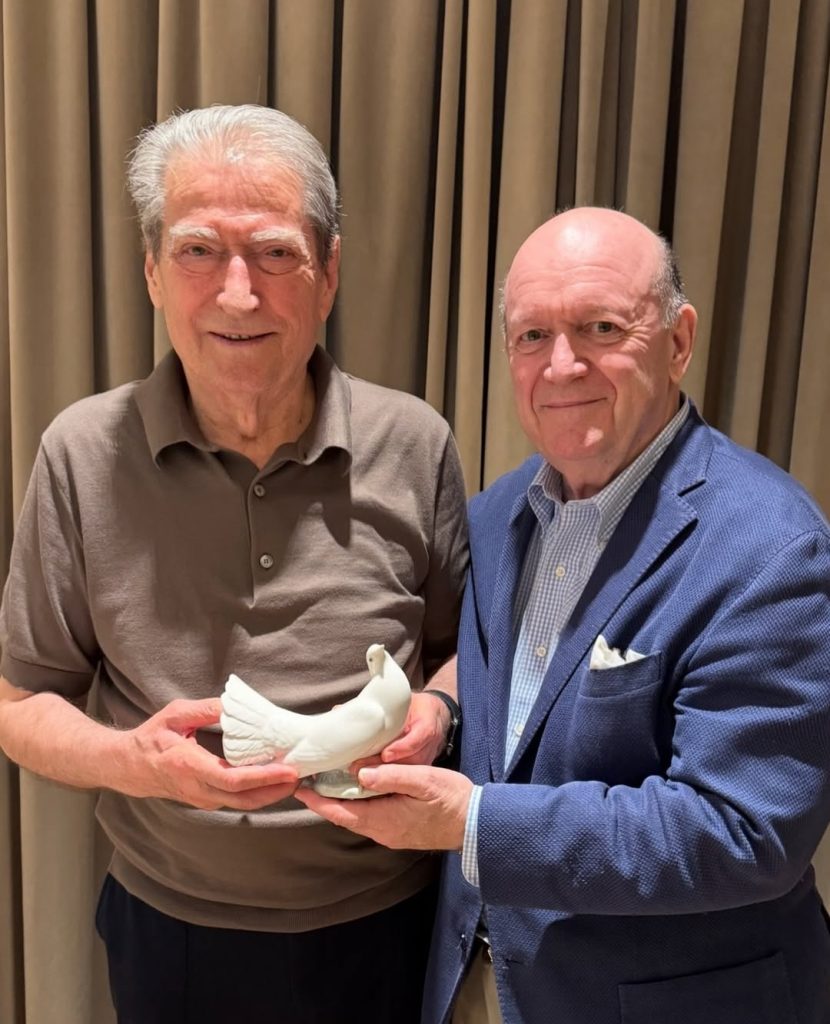
A meeting recently held in Tirana raises interesting questions about the debate over the creation of the so-called Sovereign State of the Bektashi Order.
Christopher S. Hyland, the American serving as the Bektashi World Headquarters’ special envoy for North America and one of the figures promoting the new state project internationally, has revealed that he dined with former prime minister and Democratic Party leader Sali Berisha.
According to Hyland himself, the dinner took place at Berisha’s invitation.
In a post published after his visit to Tirana, Hyland wrote:
“It was a pleasure at his invitation to dine with the former President of Albania Sali Berisha during my recent visit to Tirana.”
So, according to him, it was Berisha who invited him to dinner.
At first glance, such a meeting would not appear to be unusual news. Hyland has had ties for decades to Albanian issues and Kosovo, and has been involved in American politics since the Clinton administration.
But today he also has another role that makes the meeting politically far more interesting.
Hyland is working for the state that Berisha opposes
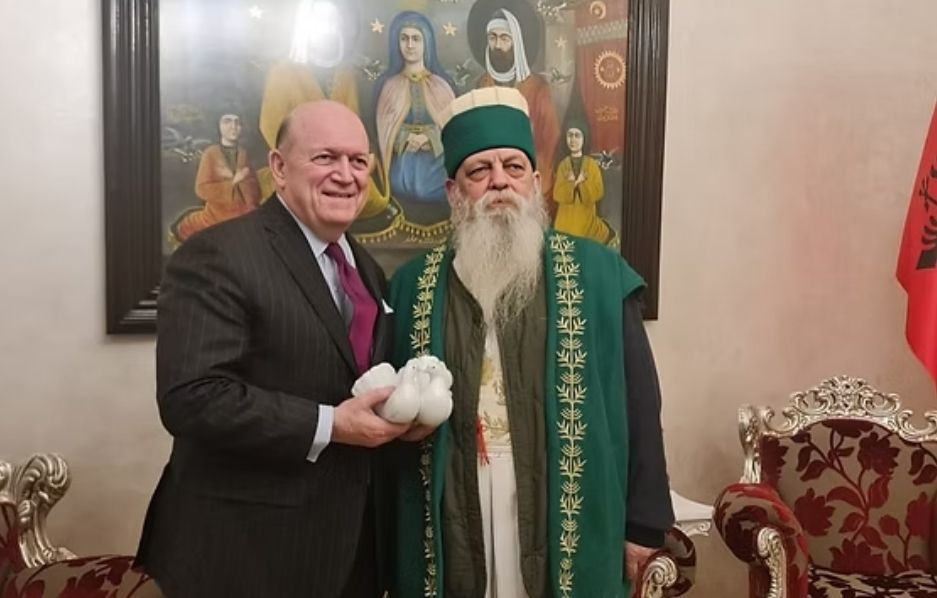
Hyland is presented as the Special Envoy to North America of the Bektashi World Headquarters.
His mission is directly linked to the international promotion of the project to create a sovereign Bektashi entity in Tirana, an idea made public by Prime Minister Edi Rama in 2024.
The project envisages that the territory of the Bektashi World Headquarters in Tirana would gain sovereign status, similar in concept to that of the Vatican.
Hyland does not hide his enthusiasm for the project.
In an interview published by the Dutch newspaper NRC, later republished in Albania, he expressed optimism about its realization and dismissed criticism that the process has not advanced enough.
“How many times have these critics seen a state created? Never. We have never been closer than this. And tomorrow we will again be one step closer,” Hyland is quoted as saying.
But this is precisely where the contradiction arises.
Sali Berisha is one of the project’s strongest political opponents.
The Democratic Party leader has publicly declared that he is against the creation of the sovereign Bektashi state, considering the initiative unconstitutional and harmful to the Albanian model of religious coexistence.
His position should not be confused with opposition to the Bektashi community. On the contrary, Berisha has historically praised the role of the Bektashis in Albania, while his opposition is tied to the creation of a sovereign state within the territory of the Republic of Albania.
So what was discussed over dinner?
That is precisely why the Berisha–Hyland meeting deserves attention.
On one side is the leader of the Albanian opposition, who has publicly declared himself against the creation of the Bektashi state.
On the other side is a special envoy of the Bektashi World Headquarters, who is working to promote internationally that very project.
And, according to Hyland, they dined together in Tirana at Sali Berisha’s invitation.
So far, there is no public information proving that the subject of the Bektashi state was discussed during the dinner. Likewise, the meeting itself does not constitute proof that Berisha has changed his position or that he supports the project.
Hyland has a much longer history of relations with Albanians than his current engagement with the Bektashi World Headquarters. He has been active on the Kosovo issue, worked on Bill Clinton’s presidential campaign, and for decades has maintained political contacts in the region.
Nevertheless, given the function he holds today, the question is unavoidable:
Was the sovereign Bektashi state project discussed during the dinner?
And if so, what did Berisha tell the man who is lobbying internationally for a project that he himself publicly opposes?
Another detail: Hyland appears enthusiastic about Rama
The NRC interview makes the situation even more interesting.
Hyland speaks in extraordinarily positive terms about Prime Minister Edi Rama and the transformation of Tirana, while considering the Bektashi state project part of his vision.
He praises Rama’s art, the capital’s new architecture, and argues that the Bektashi state would place Albania more firmly on the international map.
This puts Hyland, at least on this issue, far from Berisha’s political position.
At a time when Rama is seeking to move the project forward and Berisha says he opposes it, the American working to promote it internationally appears to maintain contacts with both sides.
The dinner does not prove any political agreement and should not be presented as such.
But it does create an entirely legitimate question about political transparency:
What did Sali Berisha and Christopher Hyland talk about?
If the Bektashi state was part of the discussion, the public has an interest in knowing what position was communicated privately to the Bektashi World Headquarters’ envoy by the leader who publicly promises to oppose the project.