
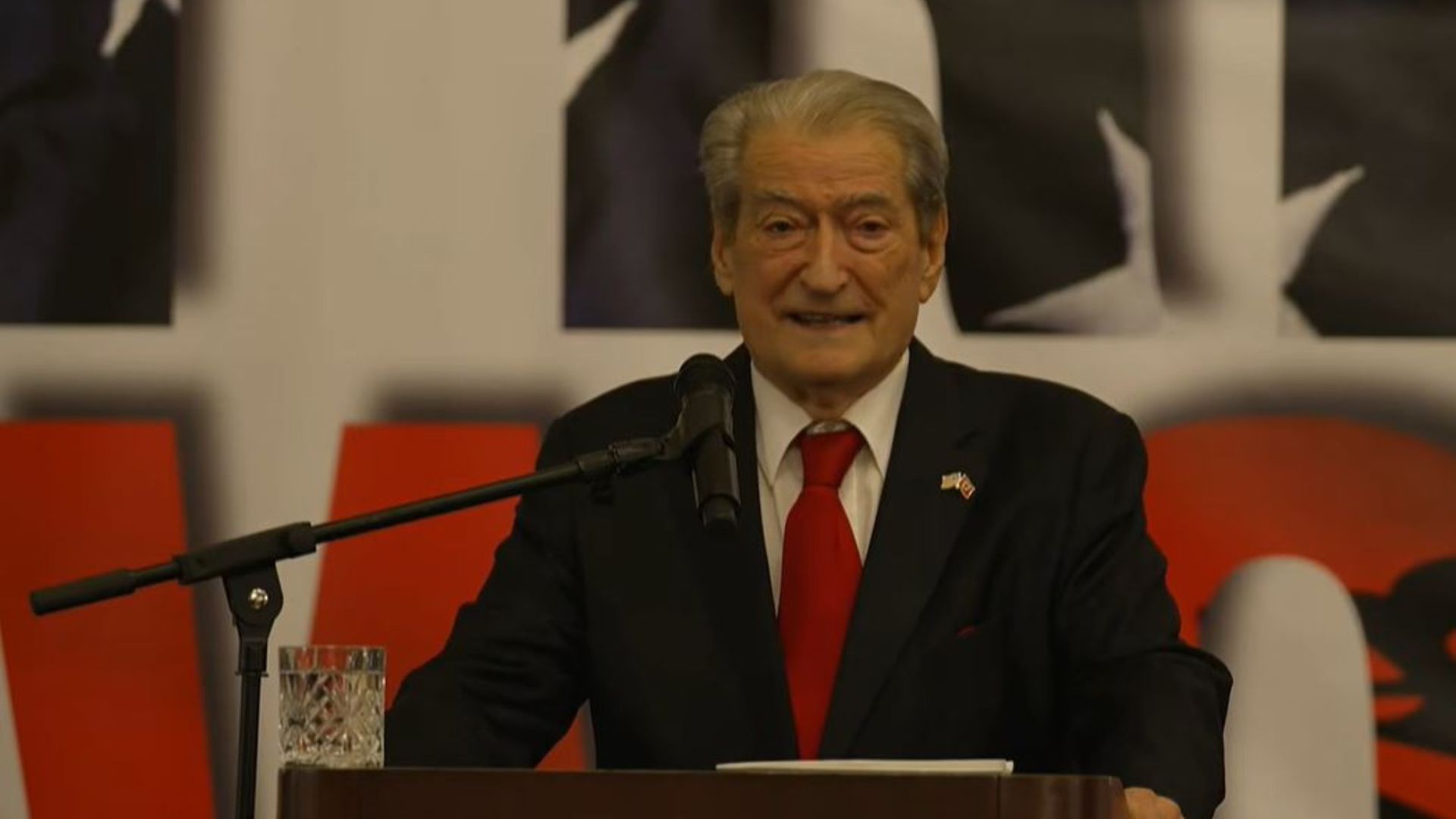
Sali Berisha delivered a speech in New Jersey, where he presented his return to the United States as the overturning of a political injustice rather than a clear institutional rehabilitation. In his remarks, the former prime minister attacked those who, according to his version, constructed the “deceptions” that led to his non grata designation.
Return to the US as a political message
From New Jersey, Berisha described his presence in the United States as a moment that, according to him, many had considered impossible. He said he had been unfairly denied entry at a time when, according to him, he had been out of power for eight years.
Attacks on the authors of the decision
At the center of his speech was the claim that the people who prepared the accusations against him are now “behind bars” and “non grata in their own country.” Berisha did not provide names or further details in this statement, but used the wording to turn the issue into a strong political message for his supporters.
The diaspora at the center of the speech
Berisha praised the Albanian diaspora in the United States, calling it a factor that played an important role in the overthrow of the communist dictatorship in Albania and in support for Kosovo’s freedom. He described the diaspora as the “white fortune” of the Albanian nation, placing it at the center of his political narrative in this public appearance as well.
The narrative of injustice and the clash with the official version
In his speech, Berisha argued that the measure against him did not stem from US values, but from what he called an “anti-freedom” and “anti-nation” agenda. He also mentioned President Donald Trump, referring to the way this political approach has been described, according to him.
Berisha’s statements remain part of his long-standing position against the non grata designation, while in this appearance he chose to present his return to the United States as political proof in favor of his thesis.
His appearance from New Jersey was used by Berisha not simply as a meeting with the diaspora, but as a platform to publicly challenge the narrative that has followed him for years in relation to the United States.
Beyond the triumphalist tone of the speech, his statements remain political claims articulated in service of his internal battle and public image.