
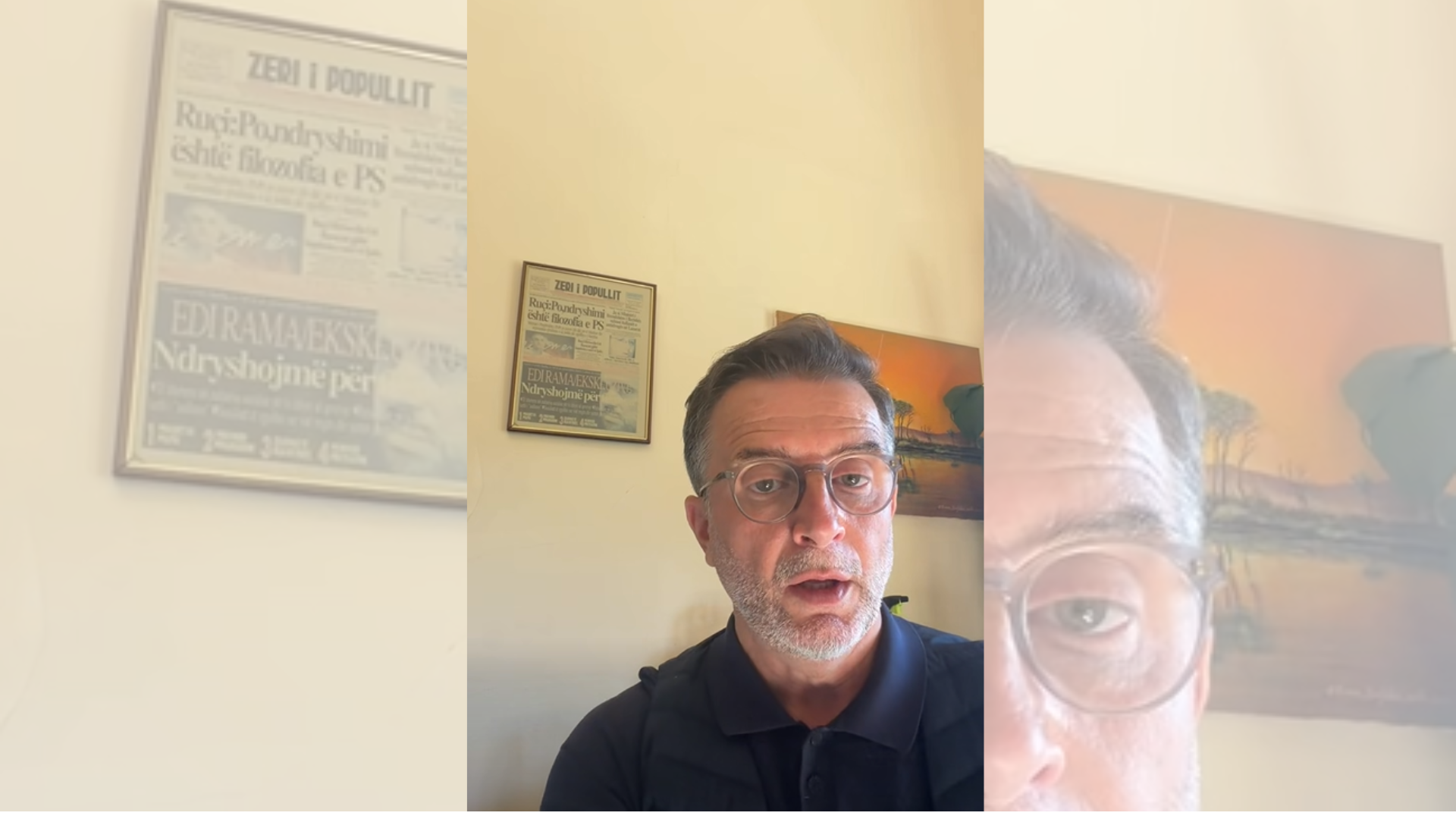
Socialist MP Erion Braçe has clearly distanced himself from the idea of a new territorial division that, in essence, deals only with boundaries on the map. In his reaction, he says local government reform is necessary, but not if it is reduced to an administrative redistribution without addressing the core of local governance.
Open opposition to a map-centered approach
Braçe clarified that he is not against local government reform as such, but against an approach that, according to him, narrows the debate to the map of municipalities. He presents this as a deviation from the main issue: how local units are governed and what real power they have.
In his position, the Socialist MP says the reform should be seen as a need for good governance and not as a technical operation to redraw boundaries. This is a position that calls into question the essence of the initiative if it remains limited to territorial configuration.
Braçe calls for principles, not decision-making based on vote calculations
According to Braçe, a sustainable reform cannot be based on electoral calculations, but on principles and equal criteria for the entire territory. At its core, he opposes the idea that such changes should pass as political decision-making of the moment.
He argues that reforms at this level must be built on the same standards and not on power balances or day-to-day interests. On this point, his criticism directly touches on how a new territorial division may be conceived and pushed forward.
Emphasis on decentralization and resources for municipalities
Braçe wants real decentralization placed at the center of the reform. According to him, the government should transfer more powers, functions, financial resources, taxes, fees and budgets to local government.
This is the core of his opposition: without greater autonomy for municipalities, changing boundaries remains insufficient. If power and money continue to remain concentrated at the top, then the reform, even if called new, risks remaining merely formal.
Political signal from within the majority
Braçe’s position carries weight also because it comes from within the ranks of the ruling majority. He says he does not have a problem with the political cost of the vote when it comes to what he considers the right solution for local governance.
In essence, his reaction exposes serious reservations toward any project that sells reform as a change of map without addressing the concentration of power and the financial dependence of local units. This shifts the debate from administrative borders to the more difficult question: who decides, who finances, and how much real autonomy municipalities have.
Braçe sees local reform as a test of how power is divided on the ground, not as a cartographic exercise. His message is clear: without decentralization, without autonomy and without equal rules, the new map remains temporary and politically debatable.