
After the protest held near the Prime Minister’s Office, a kiosk in Tirana ended up completely burned. In his public reaction, Prime Minister Edi Rama focused on the damage done to one family and, according to his version, linked the incident to the opposition, insisting that what happened had no connection to the students.
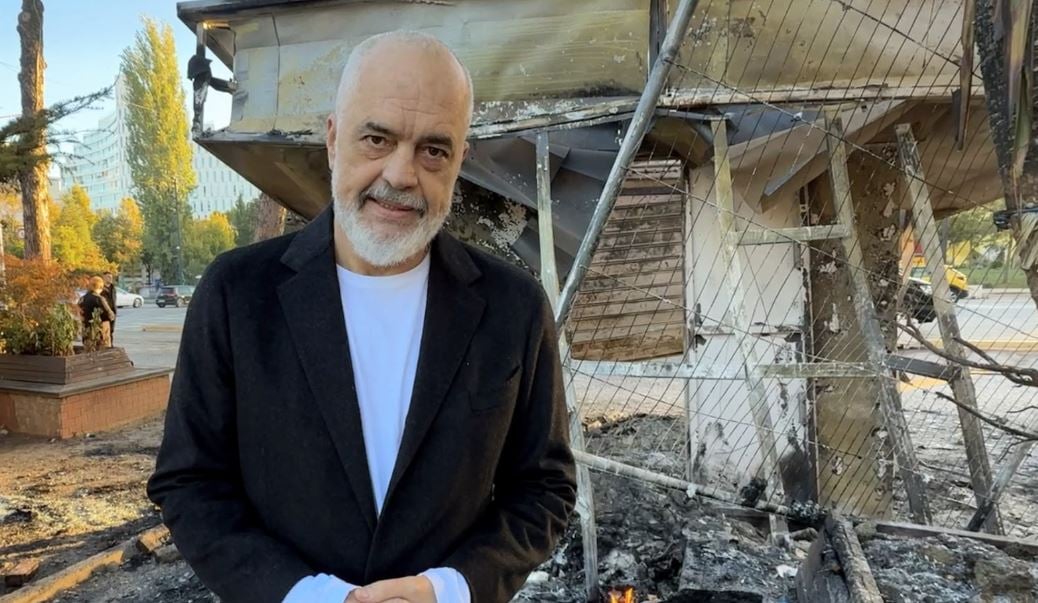
Rama’s reaction after the kiosk was burned
Rama reacted on Facebook shortly after images of the charred business became public. He described the burned kiosk as a blow to the life, work and income of an ordinary family.
In his message, the head of government expressed solidarity with the families who, according to him, are facing similar losses and said the state will stand by them once the situation passes.
Students excluded from the official narrative
A central part of the statement was the separation of the protest from the student cause. Rama claimed that the fire and the violence have no connection to the students, but rather to other actors who, according to him, are using the situation for political confrontation.
This is a clear political positioning by the government, made without presenting in this reaction additional public elements to clarify the concrete responsibilities for the burning of the business.
Political accusations against the opposition
The prime minister went further by presenting the incident as part of an effort that, according to him, has gripped the Albanian opposition by the throat. In the same line, he also raised accusations of inciting minors and attacks on the police.
The statement also used language with strong political overtones, referring to “foreign hands” and sabotage of the country’s path toward Europe. These remain political claims articulated by the head of government at the height of tensions after the protest.
Government message: political and social test
Rama compared the situation with other trials the country has gone through, also mentioning the earthquake as an example of collective mobilization. His message was built on the idea that this crisis, too, will be overcome together.
However, beyond the calls for solidarity, it remains unclear what concrete responsibilities will be determined for the burning of the kiosk and what the full balance of the damage is after the protest near the Prime Minister’s Office.
The incident increases pressure on institutions to clarify the circumstances of the fire and to separate criminal responsibility from political rhetoric.
So far, the strongest reaction has come from the prime minister, who has read the episode as a political clash, not as a development linked to the students.