
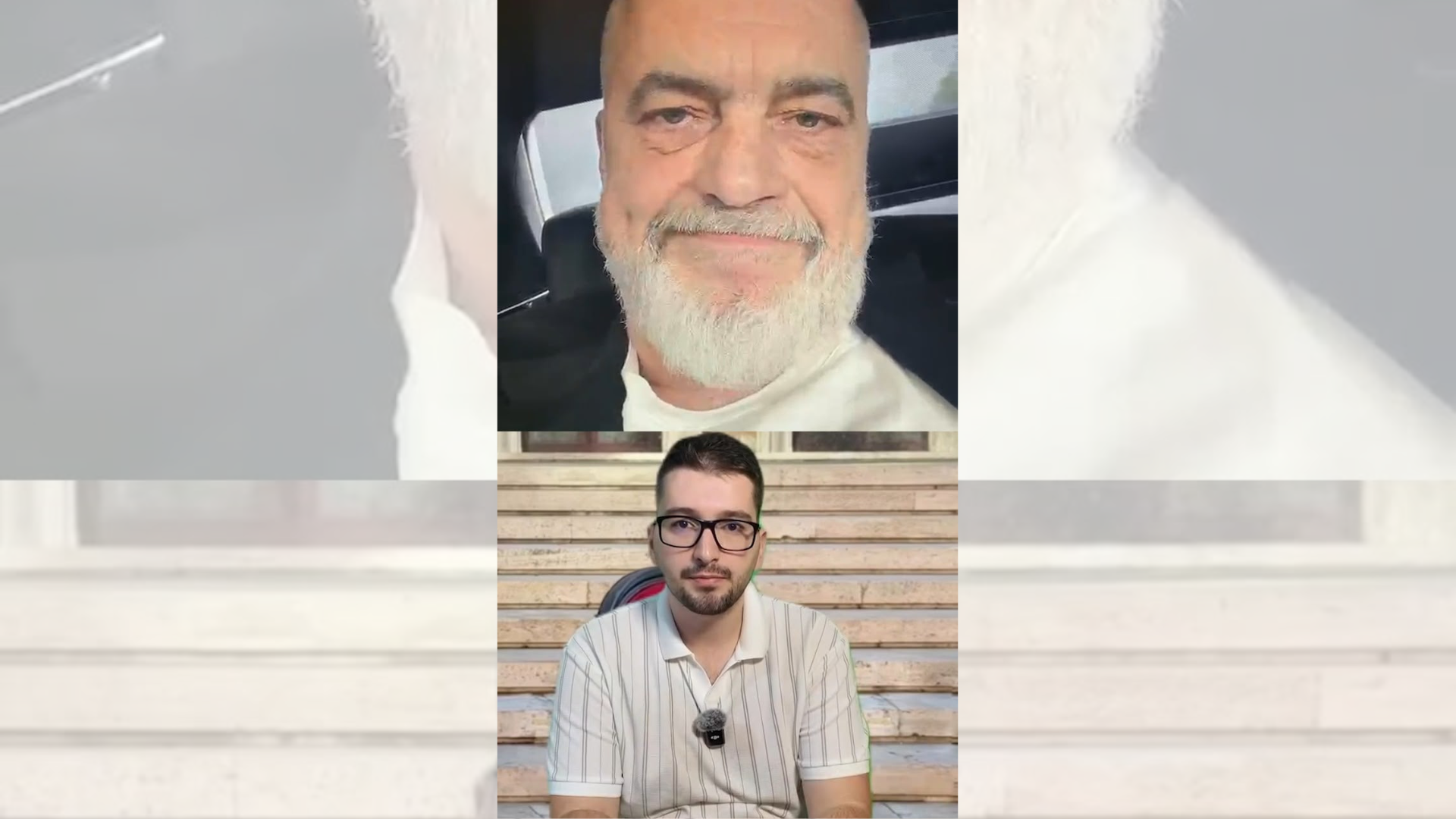
Prime Minister Edi Rama has once again chosen social media to respond to criticism over protests, violence and political accountability. On the way to Budva, where he is taking part in the Summit of Leaders of the Berlin Process, he published an exchange with a protester who confronted him with questions about January 21, police intervention, unfulfilled promises to students and controversial figures in his government.
Clash over violence at protests
At the center of the exchange was the accusation of the use of force against young people at protests. The protester raised questions about rubber bullets, tear gas and the treatment of students, while Rama defended the official version that police reacted after being attacked with stones, fire, pellets, screws and slingshots.
The prime minister claimed that the number of injured police officers was higher than the number of wounded protesters and described as unfounded the claim of police violence against students. Along the same line, he presented the reaction of law enforcement as a practice that, according to him, is used by every police force in a democratic country.
January 21 and political responsibility
The student also pushed the debate toward political responsibility, bringing up January 21 and the way the state responds to protest. Rama answered this part with comparisons to today’s protests, stressing that, according to him, at that time police were not being attacked with Molotov cocktails, stones were not being torn from sidewalks and businesses were not being destroyed.
In another part of his replies, he acknowledged that political responsibility does not disappear behind personal criminal responsibility, but he limited his role to the obligation not to act as a lawyer for anyone from the ruling majority who faces justice. This is a formula that leaves aside the broader question of the standard of political accountability after wrong appointments or repeated crises.
The promises of 2018 and students’ distrust
Another flashpoint was the 2018 student protest. The protester reminded Rama of the distrust toward dialogue and of the promise of the 5% fee, implying that the commitments made at the time have not been fulfilled.
Rama rejected that reading and asked that the university document be examined, drawing a distinction between the many demands of that time and the commitments that, according to him, the government formally undertook. Here too, the core of the debate remains the gap between the official narrative of fulfillment and students’ perception that the dialogue offered did not bring the promised solution.
Government names, SPAK and political protection
Well-known names from the government also entered the discussion when the protester mentioned Belinda Balluku, Arben Ahmetaj and Erion Veliaj as examples that, in his view, fuel public distrust. Rama reacted by presenting this as making accusations without the role of prosecutor or judge.
On the issue of Belinda Balluku, he denied that he had protected individuals from justice and said that in that case justice had been protected from bias. He also brought up the case of former minister Saimir Tahiri, reacting in harsh tones to the use of his name in the debate. Beyond the political counterarguments, the fact that these names keep returning to the discussion shows that the issue of responsibility for selections to office remains open in public opinion.
An invitation to dialogue, on Rama’s terms
At the end of the exchange, Rama invited the protester to a face-to-face dialogue, asking that the debate be conducted with facts and not rhetoric. He tied this invitation to distancing from violence, stones and fire.
The prime minister’s message comes at a moment when those in power are trying to place the emphasis on order and damage, while critics raise questions about the proportionality of force, political responsibility and the credibility of dialogue offered from above. This is precisely where the knot of the conflict lies: not only in what happened in the street, but also in who bears responsibility when public trust has been exhausted.
The exchange published by Rama does not close the debate over the protests; on the contrary, it makes clearer the clash between the official version and the distrust of part of the youth.
When questions about the police, unfulfilled promises and responsibility for appointments in power remain without convincing answers for the public, the call for dialogue risks sounding more like control of the narrative than real accountability.