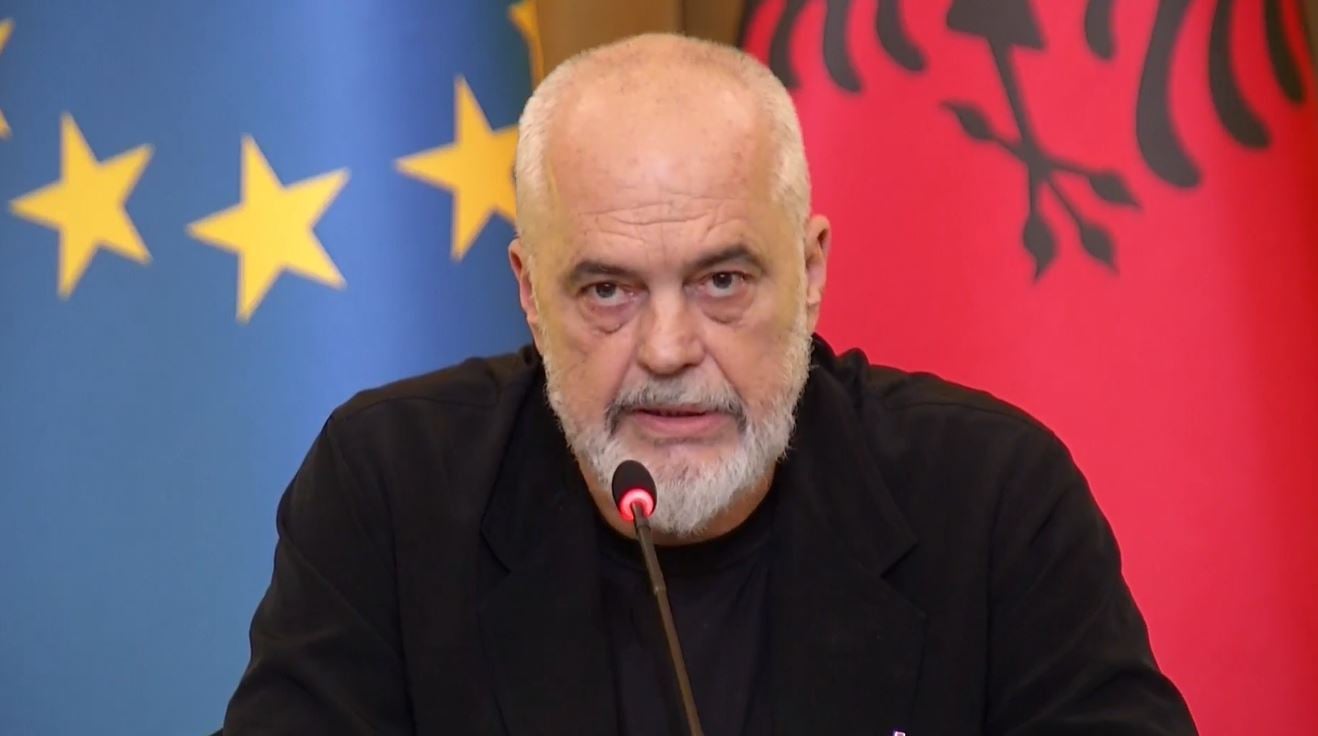
Prime Minister Edi Rama once again used European integration as the محور of his political message before Socialists, arguing that Albania is at a decisive stage and that the European Union’s door will not remain open forever. In his version, the country does not have the luxury of pauses or major political moves that could slow the process.
A political message packaged as a call for the EU
In remarks delivered before Socialists, Rama described Albania as a country that is not moving along an “ordinary road,” where governments can change without consequences for the state’s course. He compared the situation with old democracies, which, according to him, have long-consolidated institutions and can withstand frequent political changes without veering away from the path of the rule of law.
This is an argument the prime minister has used before: political stability is presented as a condition for not jeopardizing the European objective. In essence, the message places the debate not only on integration, but also on the way the government seeks to tie it to continuity in power.
‘The final crossroads’ and the language of urgency
Rama declared that Albania is at the “final crossroads” linking it to the road toward the EU and that, for the first time, the open door of that house “can be seen with the naked eye on the calendar.” With this wording, the prime minister conveyed the idea of a political and historic deadline that must not be missed.
Along the same lines, he added that the EU’s door “does not stay open indefinitely.” This language of urgency aims to reinforce the perception that the country faces a time-limited opportunity, even though it was not accompanied by any new concrete elements regarding the negotiation process.
Integration as a national battle, not only a party one
In his speech, Rama sought to dismiss the reading that this is an effort by the Socialist Party to stay in power, saying it is about “Albania’s battle” to take the place it deserves in the EU.
However, the very way the message was articulated before Socialist structures keeps the political dimension of the statement strong. When integration is presented as a process that cannot withstand internal wavering, the line between national interest and the interest of the governing majority becomes more blurred.
What remains from the statement
From the prime minister’s statement, the main element is the insistence that Albania is at a decisive moment in its relationship with the European Union. He seeks to present this phase as irreversible and costly if the pace is interrupted.
But beyond the metaphors of the open door and the final crossroads, it remains essential that the integration process be measured by standards, reforms and verifiable results, not only by political rhetoric in party forums.
Rama’s statement once again places European integration at the center of the internal political battle, with a tone seeking mobilization and discipline around the government’s course.
Whether this approach will translate into concrete steps for the negotiations or remain mainly a rhetorical instrument depends less on metaphors and more on the real balance of reforms.