
A 20-year-old medical student spoke publicly during the protest outside the Prime Minister’s Office to challenge a post by Prime Minister Edi Rama, in which he was presented only by initials and with the claim that he had a record for the criminal offense of “production and sale of narcotic substances.” The young man said the post referred to him and categorically denied the label.
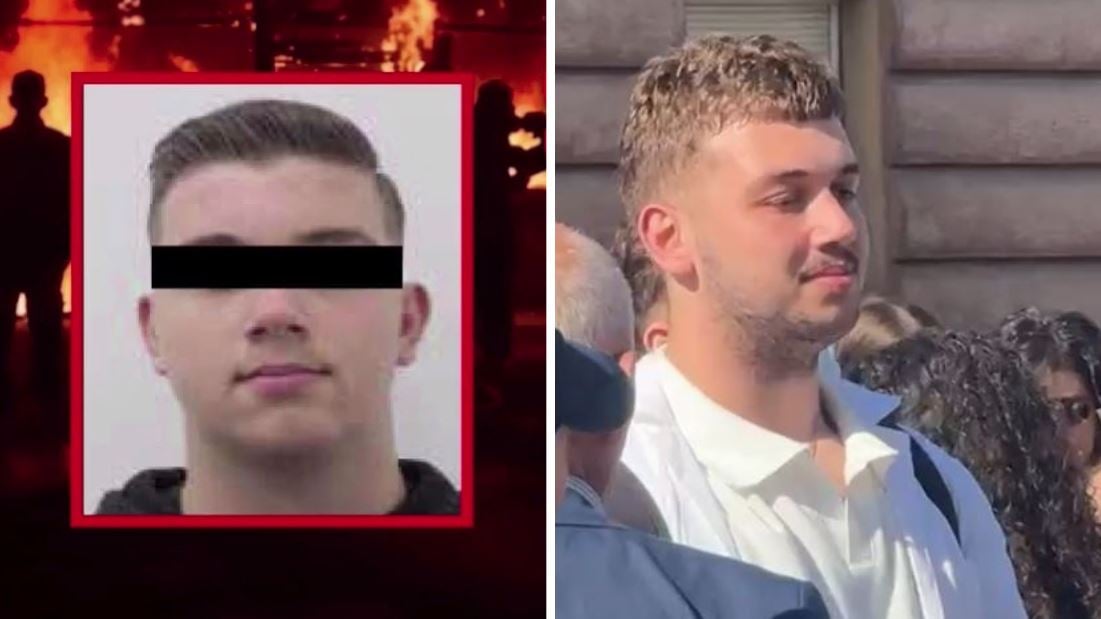
Public identification in the middle of the protest
The young man introduced himself as Joni Sinoymeri, one of the students who joined Friday’s protest outside the Prime Minister’s Office. During the gathering, he removed his surgical mask in front of the cameras and said he was the person the prime minister had published with the initials J.S.
In Rama’s post, the student was accompanied by the caption “Student? No!” It was precisely this portrayal that he challenged publicly, saying he is a student at the Faculty of Medicine at the University of Tirana.
He denies the accusations and highlights his academic profile
The 20-year-old declared that he has no criminal record and emphasized his status as a medical student. He also said that his grade average is 10.00, rejecting the framing that, according to the prime minister’s version, placed him outside the profile of a student.
In his statement to the media, he also reacted to other labels that, according to him, had been attached to him publicly. His position was a direct rebuttal to the way he had been exposed by the head of government.
What he says about being taken to the police station
The student said he had been taken to the police station last Tuesday and that, according to him, he was held for about 7 and a half hours. After that, he said, he was released.
This detail raises further questions about the way his data and image were used publicly, while the young man himself insists that he has no criminal record, contrary to what was implied in the prime minister’s post.
Doubts also over the path of a complaint
Asked whether he would file a complaint, the 20-year-old said he does not know whether he will take such a step. He suggested that he has no confidence in the institutions where he could file a complaint.
His statement places the issue beyond the political clash of the day: when public identification comes from the highest level of the executive, the burden of proving otherwise appears to fall on the citizen himself.
The case has opened a debate over the public exposure of people involved in protests and over the line between political communication and labeling without a court decision.
At this stage, there are two public versions regarding the same person: that of the prime minister and the direct rebuttal of the student who appeared before cameras and spoke with his full name.
Read also:
- Rama confronts student online over the protests and January 21, then invites him to dialogue
- Rama warns of new measures after the protests, from the TIMS list to travel restrictions
- Protest at the Prime Minister’s Office: students reject Rama’s “dialogue” and overturn chairs