
Prime Minister Edi Rama used unusual language in Brussels to describe Albania’s relationship with the EU integration process: praise for the union’s standards and institutional know-how, but also a direct attack on the way European politics, in his view, blocks enlargement.
Between praise for the process and criticism of EU politics
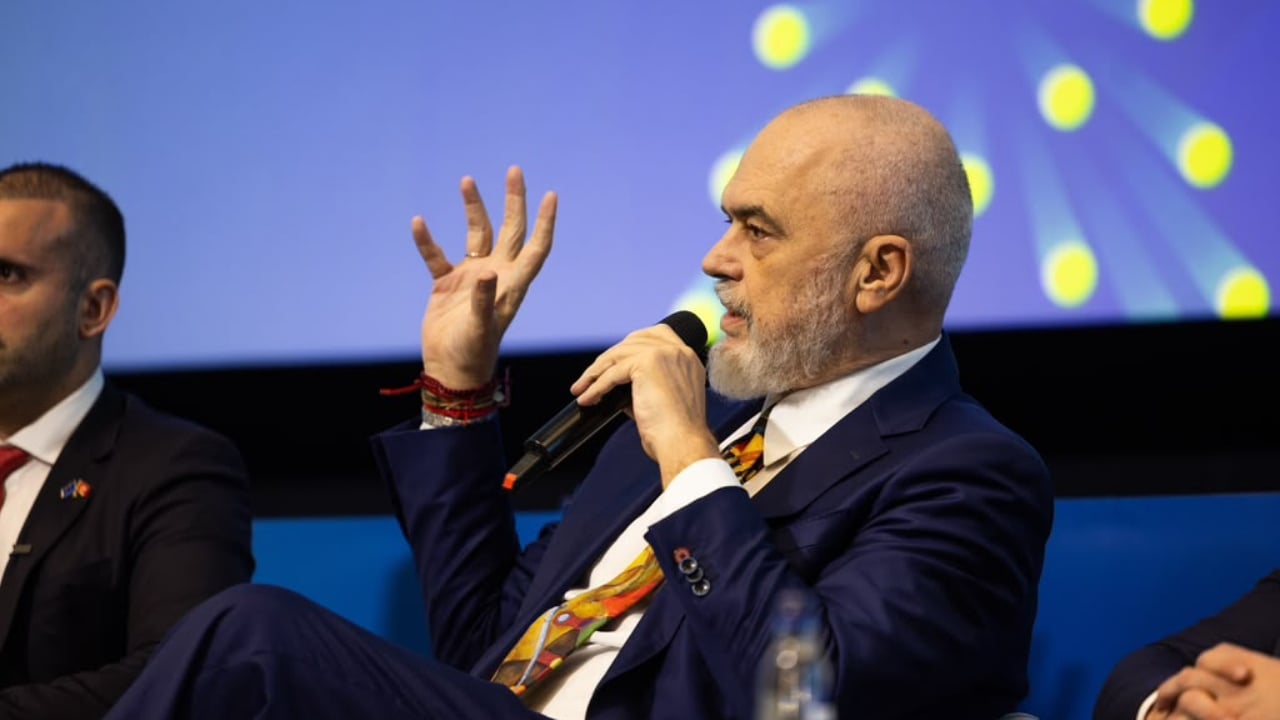
At the “Wider Europe-Strong Europe” forum, Rama said the merit-based process had helped Albania do things that, according to him, it would not otherwise have been able to do. He presented the EU as a source of knowledge for building institutions, but chose strong wording when speaking about Brussels’ pressure on candidate countries.
According to the version made public by the prime minister himself at the forum, “The Commission has the right to torture us,” while the problem, according to him, begins with EU politics, which often derails the process because of clashes among member states. In essence, Rama sought to separate the technical mechanism of reforms from the political decision-making that controls the pace of accession.
Integration as merit, but not as a political guarantee
Rama insisted that Europe does not grant membership without merit and compared any deviation from this principle to getting a driver’s license without knowing how to drive. With this analogy, he defended the idea that reforms are necessary, but suggested that even when they are carried out, the process can be blocked by calculations that have no direct connection to the candidate country’s performance.
This is a message the Albanian government often uses: when it needs to, it presents integration as proof of the success of reforms; when the process stalls, it shifts the blame to the EU’s internal dynamics. From Brussels, Rama maintained both positions at the same time.
Reaction also to the song “Oj Kosovo, Kosovo”
At the same event, Rama criticized the performance of the Serbian nationalist song “Oj Kosovo, Kosovo” during the concert organized at the start of the forum. He said that what happened the day before should not be accepted in silence and raised the question of whether it was a deliberate act or the result of ignorance.
However, he tried to keep that criticism separate from his broader position on Serbia. Rama said he had for years defended the importance of keeping Serbia on Europe’s side, but added that the sooner Belgrade normalizes relations and recognizes the Republic of Kosovo, the better it will be for Serbia itself and for the region.
What he said about the protests in Tirana
Asked on the panel “The Gains of Enlargement: Reform, Investment and Growth” about the impact of the protests in Tirana on the accession process, Rama referred to what he called the “Flamingo Revolution.” He said the protest attracted international attention also because of the “shadow of Donald Trump.”
Along the same lines, the prime minister acknowledged that people have a legitimate right to demand more attention and to ask what they concretely gain from the country’s transformation. The statement sounded like an acknowledgment of public dissatisfaction, even without going into the causes behind it.
Rama’s appearance in Brussels brought a mix of pro-integration rhetoric and complaints about the EU’s own political architecture. His message was clear: Albania must continue reforms, but according to the government, the obstacle does not always come from Tirana.
At the same time, the language used by the prime minister also shows an attempt to politically manage the delay in the European process by sharing the burden between domestic obligations and the blockages produced at the union’s tables.