
The clash over the normative act on gatherings moved once again to Parliament, where Sali Berisha called for its removal from the agenda and questioned the legality of reviewing it after the intervention of the Constitutional Court. The Democratic Party leader presented it as a test of the separation of powers, while accusing the majority of pushing forward a text that, according to the opposition’s version, can no longer be put to a vote in this form.
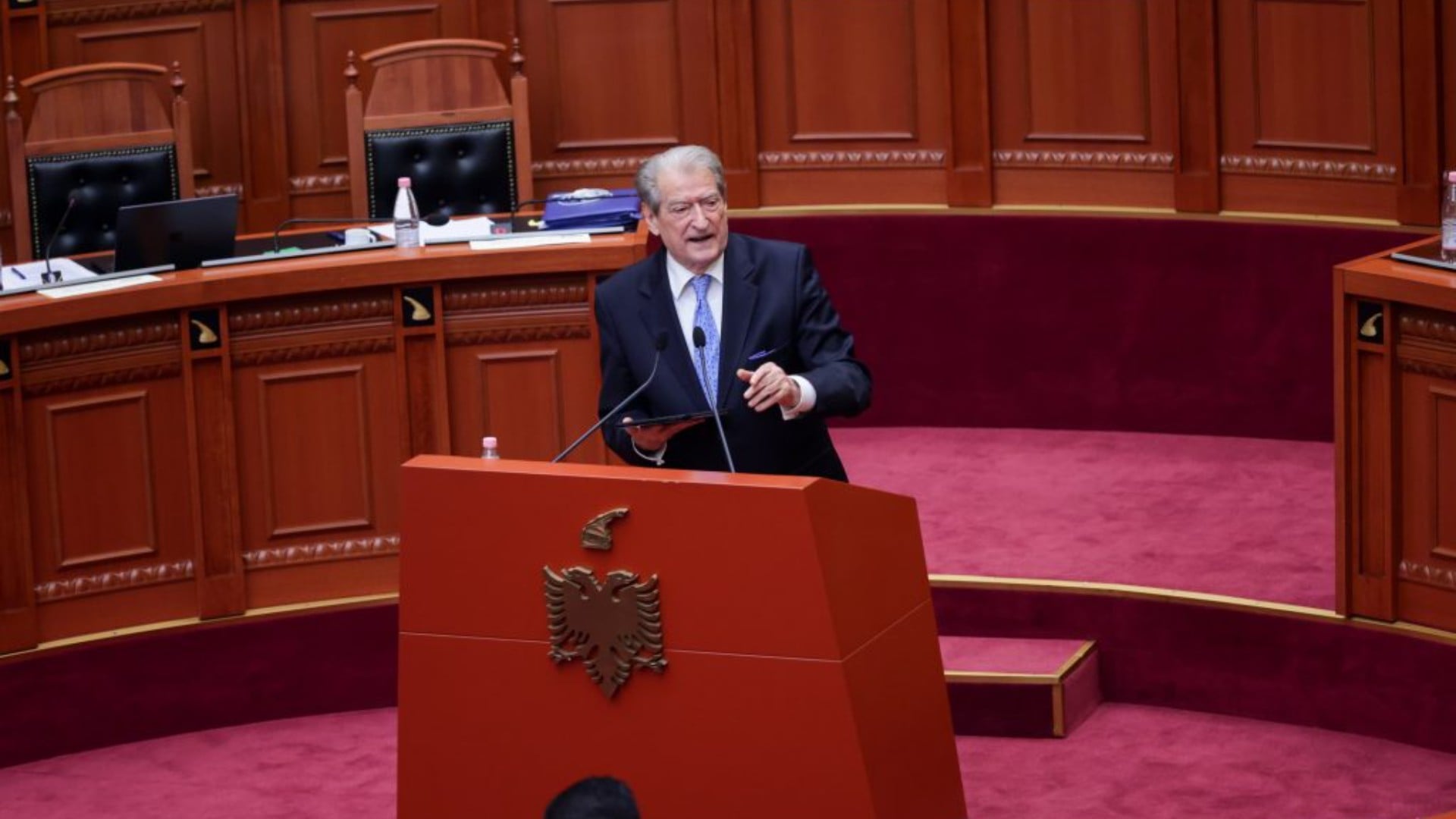
Berisha against the vote on the act in Parliament
From the Parliament podium, Berisha opposed the review and vote on the normative act on protests, after the Constitutional Court partially suspended its implementation.
According to him, Parliament cannot review a legal act suspended by the Constitutional Court, because this would undermine the separation of powers and the independence of the judiciary. In essence, the opposition is using the court’s decision as both a political and legal argument to block the continuation of the parliamentary procedure.
Debate over Parliament’s powers
Berisha argued that Parliament has no right to intervene in the content of a government normative act, but can only approve or reject it in its entirety.
Under this interpretation, after the Constitutional Court suspended part of the act, the document can no longer be treated as something that can be voted on in Parliament. He called for the act to be removed from the agenda, insisting that the legislature must submit to the Constitutional Court’s decision-making.
Political accusations against the majority over the climate around protests
During his speech, the Democratic Party leader broadened the debate beyond the procedural aspect and accused the majority of taking a hostile approach toward protesters.
He warned of consequences from escalating political tension and cited as an example the reporting of a female protester by a majority lawmaker. In this line of argument, Berisha presented the behavior of the government and the majority as a provocation against citizens who are protesting.
Claims over sidewalks and fueling tension
A strong part of Berisha’s statement focused on work on sidewalks in Tirana, which he interpreted as provocative actions toward protesters.
According to him, the raising of sidewalks in some areas of the capital, including the reference he made to the New Bazaar, is not merely urban intervention but an action that could provoke clashes. This is a political accusation articulated by the opposition, while in his statement no evidence was presented beyond the public claim made in the Parliament chamber.
The opposition’s position: the act should be withdrawn
In conclusion, Berisha repeated that the normative act cannot be put to a vote after the Constitutional Court’s decision to suspend part of it.
His message to the majority was direct: remove the act from the agenda and stop, in his view, provocative actions on the eve of protests. The debate brings attention back to how the issue of gatherings is being managed politically and institutionally, at a time when the clash between the government and the opposition is intensifying.
For now, the core of the conflict remains twofold: whether Parliament can move forward with an act affected by the Constitutional Court’s decision, and whether the climate created around the protests is being managed according to constitutional standards or through a logic of force.
In the absence of fuller institutional clarification, the clash risks remaining not only political, but also an open debate over the limits of the power of the government and the majority in relation to constitutional rights.