
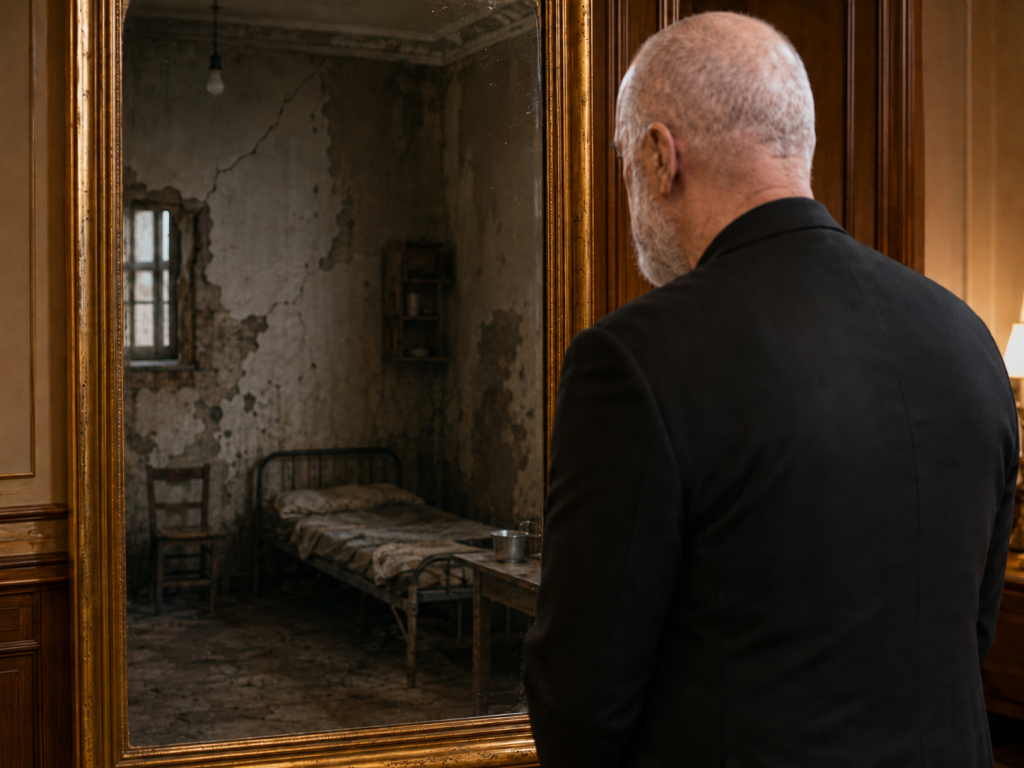
The government has announced the creation of the “PriceWatch Albania” or “Pasqyra Albania” platform, where businesses will be required to report the prices of pasta, oil, sugar, fruit, vegetables and detergents.
The idea has been presented as a tool that will help the state understand where the “abusive link” is that multiplies the price before it reaches the consumer.
In principle, price transparency is positive. But if the government truly wants a “mirror” of the Albanian economy, then it should direct it where the sums involved amount to hundreds of thousands of euros for every Albanian family, not only at the extra 10 or 20 lek on a kilogram of onions.
Let it start with construction.
The economic problem that is changing Tirana’s social structure is not whether potatoes cost 80 or 100 lek per kilogram. It is the fact that a normal apartment is moving toward a value that an ever larger share of citizens cannot accumulate from work income over a significant part of their lives.
The ministry wants transparency? Then this is the “Mirror” it should publish
For every major construction permit in Tirana, citizens should be able to see not only the final price of the apartment, but also the real cost structure.
As a general guide, a low-rise building of 1–2 floors may have a technical cost of around €550–750/m². A 10-storey building may range around €700–950/m², a 15-storey building around €900–1,300/m², while a 30+ storey tower may reach around €1,800–2,500/m² or more, depending on the construction standard.
These are not official rates, nor are they universal figures. The cost varies depending on the foundations, underground works, seismic standard, façade, elevators, installations, energy efficiency, parking, quality of materials and level of finishing.
But this is exactly where the serious question begins.
What does construction really cost?
How much does the land cost?
How much are the taxes?
How much does financing cost?
How many square meters are given to the landowner?
What is the total cost per saleable square meter?
And then: for how much is it sold?
If the government believes margin transparency is important for a pack of pasta, then it should be far more important for an apartment worth €150,000, €300,000 or €500,000.
This is the link that should be analyzed.
Not just the onion.
How much is the square meter selling for?
In Tirana, apartment prices have long since detached from citizens’ average income levels.
With an average price of around €2,100/m², a modest 80 m² apartment costs approximately:
80 × 2,100 = €168,000.
Not a penthouse.
Not a villa.
Not a luxury property in a tower.
An 80-square-meter apartment.
In certain areas of Tirana, prices are much higher, while in the premium segment and in downtown towers, asking prices can run into several thousand euros per square meter.
So while the government is trying to find out why one food product is sold a few lek more expensively in one market than another, in the housing market we have differences of hundreds and thousands of euros per square meter.
And this is not an economic detail.
It is one of the country’s biggest social problems.
€169,000 for an average apartment
If we take an 80 m² apartment priced at €2,116/m², the result is:
€169,280.
Now let us compare that with the average salary.
With a gross salary of around 90,000 lek per month, an average worker generates roughly €10,000–11,000 in gross annual income.
That means an apartment costing around €169,000 is equal to roughly 15–16 years of the entire gross salary of an average worker.
But that calculation works only under one absurd condition: that this citizen neither eat nor dress, pay no utilities, have no children, no car, no rent, no holidays or any other expenses, and devote 100% of salary to the apartment.
With two average salaries in a household, we are still talking about around eight years of the family’s entire gross income, before loan interest and without spending a single cent to live.
In real life, families cannot spend 100% of their income on housing.
If a normal threshold of 30–35% of monthly income for housing is used, the gap between income and the real property price becomes even more dramatic.
This is the affordability the state should be measuring.
The government wants the “link that multiplies the price”? Let it start with construction
If the philosophy of the “Mirror” is to compare the initial price with the final one and understand where the increase happens, then construction is perhaps the most interesting economic laboratory in Albania.
Because here we are not dealing with a difference of 20 lek.
We are dealing with differences of hundreds and thousands of euros per square meter.
And we have a market where housing prices in many areas of Tirana have risen far more aggressively than wages and ordinary living costs.
This does not automatically mean that every difference is “abuse.”
Land prices, taxes, financing, risk, demand, the cost of capital and profit are all legitimate parts of the price.
But if the government wants to analyze the “links,” then it should analyze precisely these.
With methodology.
With data.
With transparency.
Not with slogans.
Onions and potatoes are the easiest part of propaganda
Of course citizens should be able to compare food prices.
But to build a major state narrative around the idea that the citizen will discover where onions are 10 lek cheaper, while an 80 m² apartment in the capital costs around €170,000, is a propagandistic trivialization of the real cost-of-living problem.
The Albanian family is not losing its economic outlook because one supermarket sells detergent 30 lek more expensively than another.
It loses that outlook when two young people with normal jobs and salaries realize that property in the city where they live is moving farther away every year from their purchasing power.
The problem is not only how much food costs today.
The problem is whether a young couple can buy a home.
Whether they can start a family.
Whether they can remain in Tirana.
Whether they can live on their own income without entering into a 25- or 30-year loan that consumes most of that income.
This is the cost-of-living crisis.
Not the photo of the price of potatoes.
If you want a “Mirror,” make it a real mirror
The government should publish a full database for major construction projects.
For each project, the following should be known:
the declared investment cost, total surface area, cost per square meter, land value, taxes, financing costs, average sale price, number of units sold, and the percentage of them financed with bank loans.
And then the most important indicator of all should be added:
What percentage of Albanian families can buy this apartment with their declared income?
Then we would have a platform that produces real economic debate.
Then we could talk about transparency.
Then we could understand whether the market is supported by real income, by lending, by emigration money, by investments or by other sources of financing.
Otherwise, to look for the “abusive link” in onions and potatoes while, in front of us, buildings are rising where an apartment can cost hundreds of thousands or even close to a million euros, is to reduce the public economic debate to a level of banality bordering on the infantilization of the public.
Albanians do not only need to know where potatoes are cheapest.
They need to know why the home they are supposed to live in is becoming unreachable.