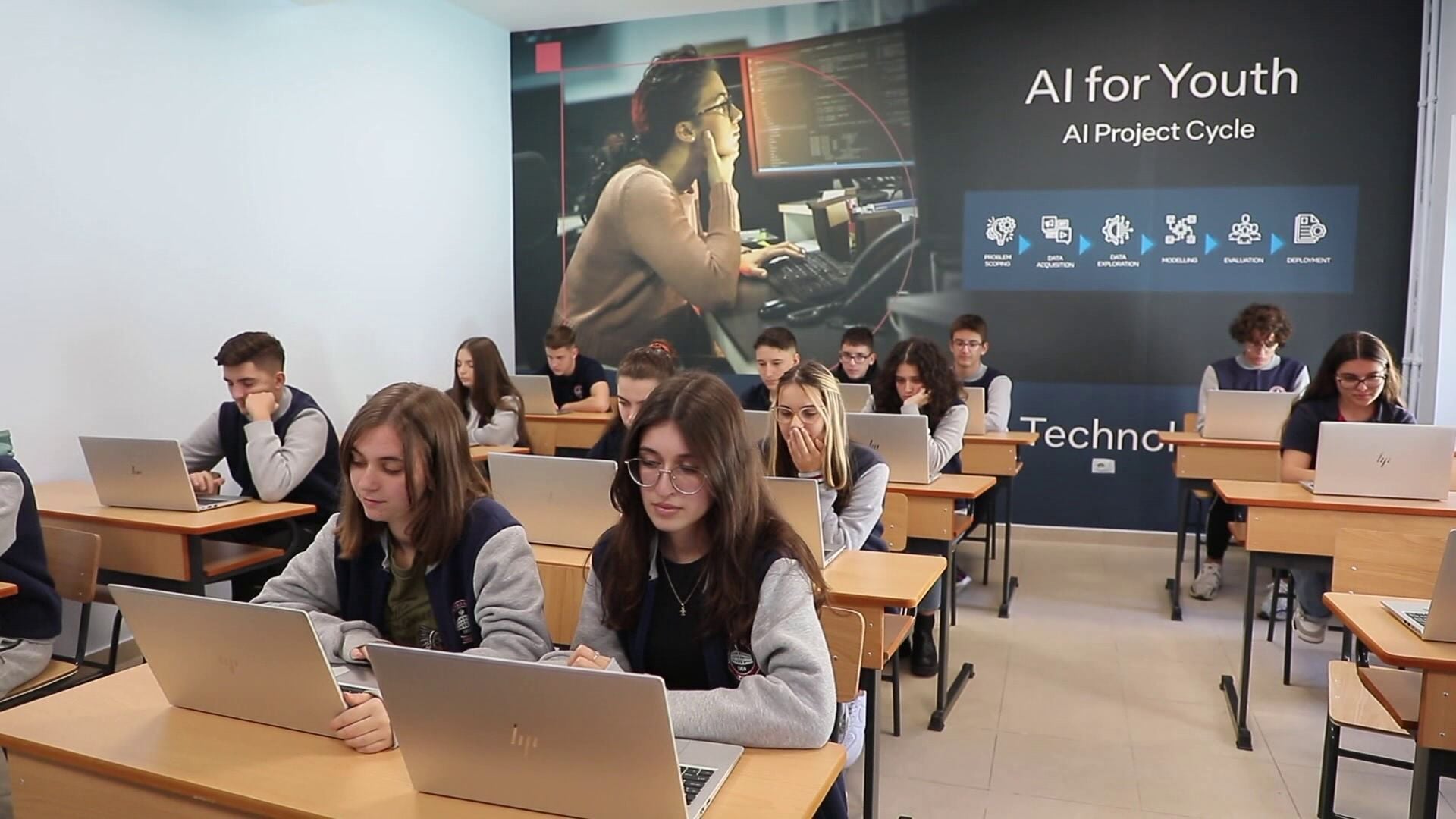
One of the strongest changes of the new school year is coming from the use of artificial intelligence in the classroom. According to the official version, the Ministry of Education has drafted a guide that opens the way for teachers and students to use tools such as ChatGPT, Gemini and Full Fact throughout the entire pre-university system, not only for exercises and projects, but also for elements of assessment.
From exercises to tests and assessment
The document provides that teachers may use artificial intelligence to prepare teaching materials, including exercises, questions, tests and different forms of assessment. The scope of use extends from Albanian language and foreign languages to mathematics, the arts and physical education.
The guide also allows the use of these tools for text translation, correction of language errors and help in lesson planning, with structured prompts according to topic, subject and grade. This brings artificial intelligence much closer to daily school practice than merely as a peripheral support tool.
Institutions present it as support, not replacement
According to education institutions, artificial intelligence should support, not replace, human abilities. The Agency for Quality Assurance in Education argues that these tools can help adapt materials to the different paces, styles and needs of students.
In this logic, AI is seen as a way to simplify explanations, create assignments with different levels of difficulty and offer additional support or more advanced challenges. However, the shift from theory to practice remains the most sensitive point, especially in a system where differences between schools, infrastructure and teacher preparation are well known.
The risk of disinformation, plagiarism and data breaches
The guide itself acknowledges that the use of artificial intelligence brings clear risks: disinformation, digital dependency, privacy violations and unethical use of generated content. For this reason, teachers and students are advised to verify AI-produced content and be careful with personal data.
One of the most delicate points is linked to plagiarism. According to the guidance, using AI to understand a concept, get suggestions or improve a draft may be considered acceptable only when the student thinks and works independently. Directly copying answers produced by these tools is considered a violation of academic integrity.
Anonymization is required, but implementation remains the real test
The document underlines that when artificial intelligence is used for teaching materials, names, initials, photographs, the name of the school and any other detail that could lead to the identification of a person must be removed. On paper, this is presented as a minimum guarantee for privacy protection.
But this is also where the hardest test for the system emerges: how realistically this discipline can be implemented in the day-to-day life of Albanian schools. The guide relies on UNESCO’s approach, which treats artificial intelligence as an opportunity to improve education, but only when there are clear policies, prepared teachers and real protective measures for students. This leaves open the essential question of whether schools are ready for this step, or whether the decision is moving ahead of capacities on the ground.
The official approval of artificial intelligence in schools marks an important turning point in pre-university education. But between the promise of modernization and the known risks to quality, academic honesty and privacy, the real test will not be the document itself, but how it is implemented in the classroom.