
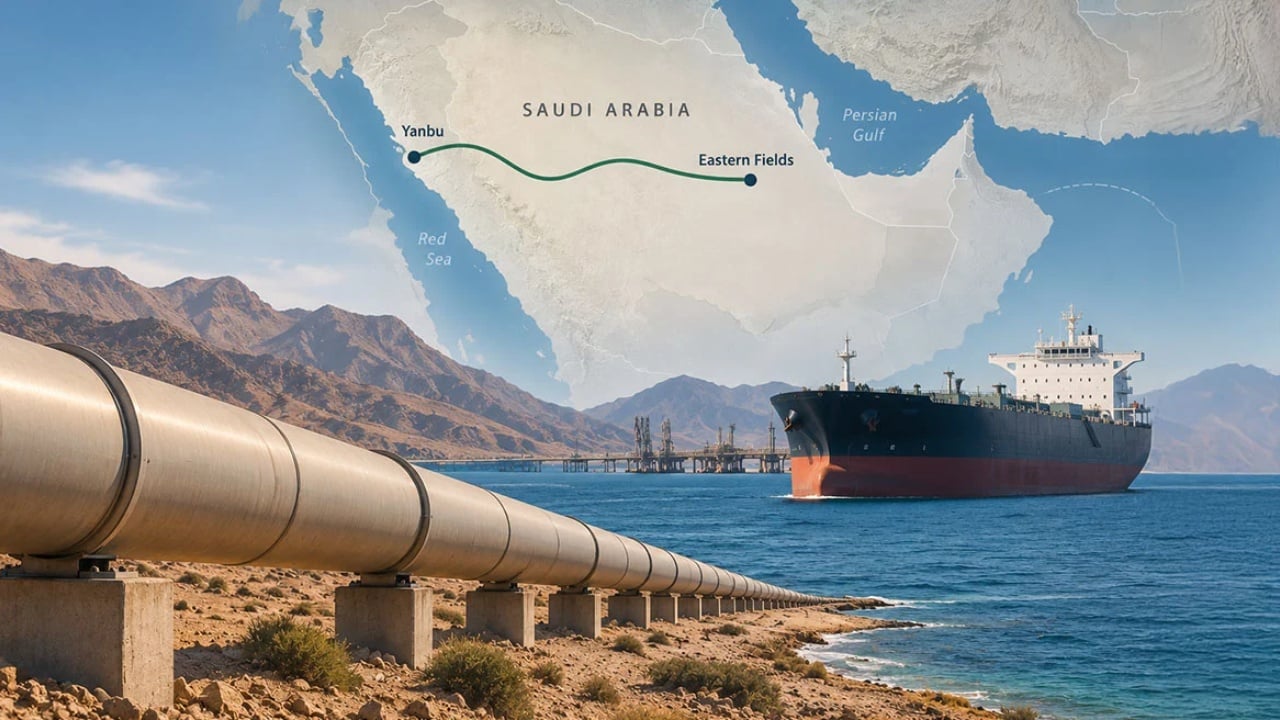
Saudi Arabia has brought the East–West Pipeline back into operation, reopening an overland route that bypasses the Strait of Hormuz. The move could ease some of the pressure on the supertanker market, but not immediately undo the freight-rate crisis fueled by a shortage of ships and tensions in the region.
The alternative route shifting the balance
According to Reuters sources familiar with the developments, Saudi Aramco’s pipeline was put back into service on September 22 after an interruption linked to drone attacks. The restart, however, is being carried out gradually and transported volumes remain limited for now.
The pipeline is considered Saudi Arabia’s main alternative to Hormuz, as it connects production areas in the east to Yanbu on the Red Sea. This gives Riyadh the ability to send significant volumes of crude to the western coast and then on to international markets, without necessarily passing through the Persian Gulf’s most exposed corridor.
How the supertanker market was pushed higher
The earlier pipeline disruption had an immediate effect on the maritime market. With the western route constrained, a larger share of Saudi exports shifted toward terminals in the Persian Gulf, increasing demand for tankers in an area where capacity was already under pressure.
According to the reported data, Aramco increased loadings from the country’s east and also used other alternative routes, including operations through Sohar in Oman. This added demand for shuttle tankers and VLCCs, at a time when every available supertanker carried greater weight in the market.
The pressure became particularly visible on September 20, when about 14 million barrels of Saudi crude were loaded onto seven VLCCs in a single day.
What could change now
The reopening of the East–West Pipeline could begin to partially soften this wave of demand. The more barrels are sent toward Yanbu, the less need there is, in theory, to channel additional cargoes through the Persian Gulf.
However, this is not an immediate return to normal. For the market, what matters is not only the fact that the pipeline has restarted, but above all the pace at which Saudi Arabia will be able to increase flows toward the Red Sea.
Why rates are not falling immediately
Even with the return of the overland corridor, VLCC rates are not expected to ease within a day. The market remains supported by extremely limited vessel availability, operational delays, heightened geopolitical risk and continuing uncertainty in the Strait of Hormuz.
In this picture, the pipeline’s return is seen more as a factor that could gradually cool the market rather than as an immediate solution to inflated seaborne transport rates.
If flows toward the Red Sea rise at a steady pace, pressure on the tanker market may partially fade. But as long as Hormuz remains unstable, the oil and shipping markets will continue to move under the shadow of risk.