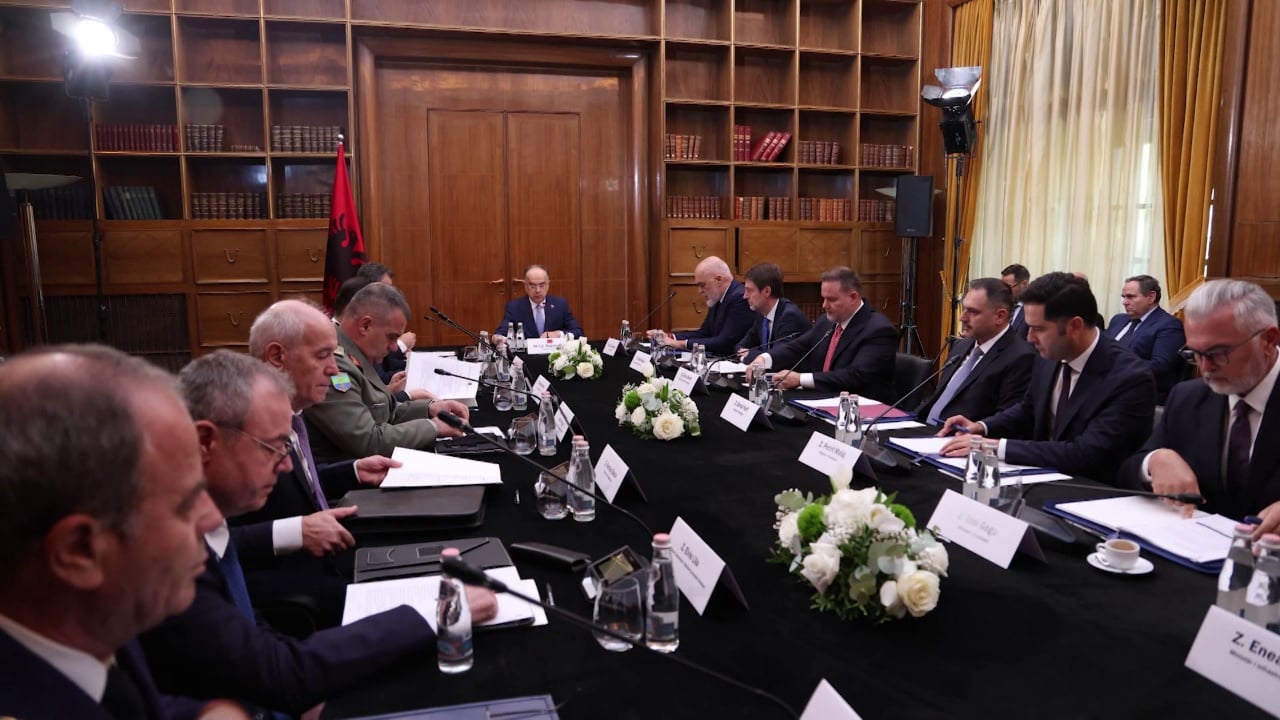
An urgent meeting of the National Security Council has put SHISH at the center of attention after the criminal measure against Vlora Hyseni. From the information made public about the discussions, what emerges is a familiar clash between institutional secrecy, criminal investigation and the need for accountability, while official versions remain limited.
SHISH: the audit found no document leaks affecting security
According to what has been reported by people present at the meeting, SHISH acting chief Elvis Lila insisted that a top-secret audit carried out after the measure against Vlora Hyseni did not produce any finding that documents affecting national security had left the institution.
At the same meeting, according to the same versions, emphasis was placed on the institution’s obligation to collect and safeguard security information, but also to cooperate with other institutions when required by law.
SPAK said the measure was based on evidence gathered in the investigation
The discussions at the meeting, which are not made public officially because of their nature, also included the position of the Special Prosecution. According to information reported by those present, chief prosecutor Klodian Braho told institutional leaders that SPAK concluded it had to request a security measure in court against the SHISH director after gathering several secret pieces of evidence.
In the same explanation, according to this version, several house searches were also mentioned as part of the investigative actions. The claim presented at the meeting was that the decision to seek the measure came after the investigative group secured the evidence it considered necessary.
Rama spoke of individual responsibility and mechanisms of interaction
According to sources cited by the media, Prime Minister Edi Rama stressed at the meeting that responsibility is individual. He is also said to have called for finding mechanisms of interaction between institutions, with the argument of safeguarding national security.
This position comes at a moment when the event touches one of the state’s most closed institutions and when any attempt to treat the issue only as a personal problem leaves out of the discussion the internal institutional filters that are supposed to prevent such crises.
The president called for no interference in SPAK’s work
For his part, the president, after assigning tasks to each institution, made clear that independence must be preserved and that there should be no interference in the work of the Special Prosecution.
Also according to reported sources, no debates were confirmed to have taken place at the meeting. The lack of transparency over such a sensitive issue nonetheless leaves room for legitimate questions about what was actually discussed and about how institutions are managing the crisis.
So far, the public has only partial versions from a closed meeting, while the essence of the issue remains tied to two axes: whether there was in fact a breach of national security and whether the institutional chain functioned properly.
Beyond the statements made behind closed doors, the weight of the evidence and the justice system’s official decisions will be the element that separates rhetoric from concrete responsibility.