
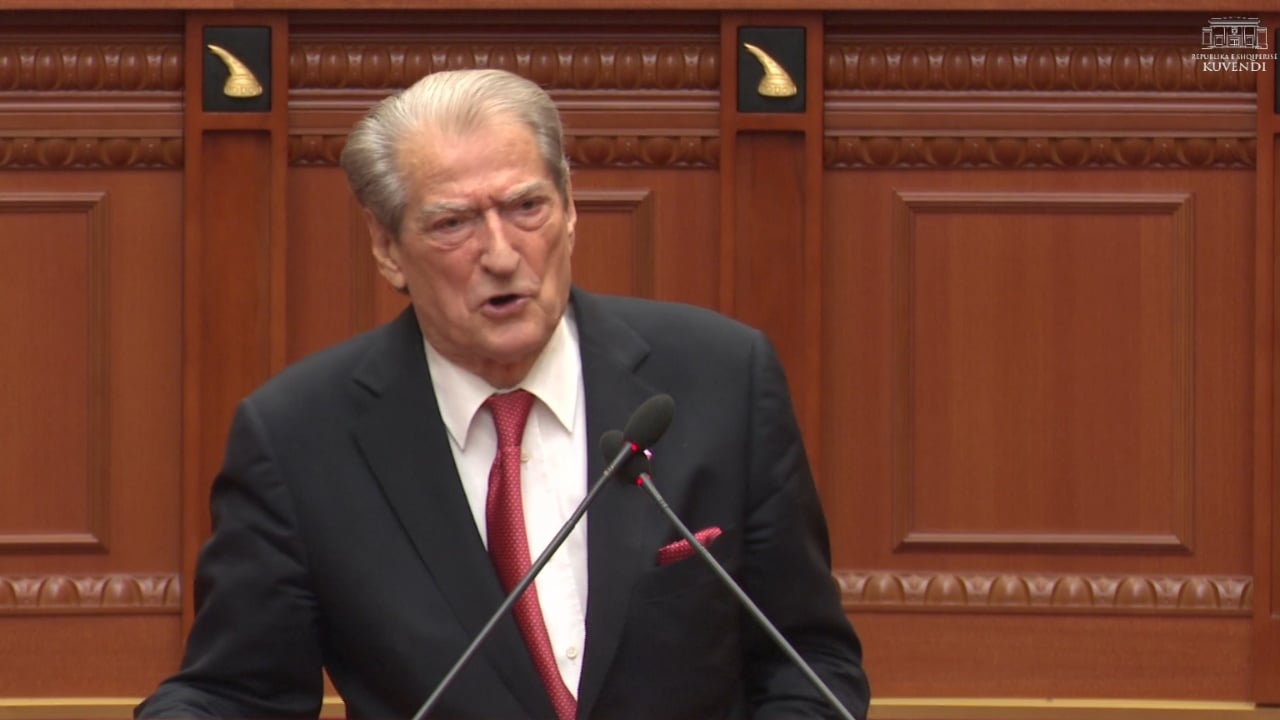
The parliamentary session was used by Democratic Party leader Sali Berisha for a direct attack on the administrative-territorial reform and the ruling majority, while in the same speech he also revived accusations against MP Olta Xhaçka. At the center of his statements were claims that the dissolution of 15 municipalities is being justified and that the reality is being hidden behind what he described as manipulative language.
Clash over the territorial reform
From the parliamentary rostrum, Berisha described the debate on the administrative-territorial reform as an attempt by the majority to mask concrete consequences for local government. According to him, the dissolution of 15 municipalities is being presented in terms aimed at softening the political cost of the decision.
He claimed that some of the municipalities affected by this intervention have performed well and had functional teams, and that the argument used by the majority, in his version, does not hold. Berisha’s criticism did not stop only at the substance of the reform, but also at the way it is being communicated publicly.
New accusations against Olta Xhaçka
In the same intervention, the opposition leader shifted the focus to MP Olta Xhaçka, against whom he made serious accusations of involvement in smuggling during the period when she held the post of defense minister.
He claimed that Xhaçka is voting in Parliament today to protect, according to him, interests linked to unlawful actions in the past. No evidence was presented during the session to support these accusations, which remain at the level of political statements.
Harsh rhetoric and political pressure in the chamber
Berisha used strong language against the majority, accusing it of debasing language to justify decisions with consequences and to cover up, according to him, corrupt affairs. His speech was constructed more as a political indictment than as a technical debate on the local map.
The statements in the parliamentary chamber come in a climate in which clashes between the opposition and the majority are often accompanied by serious public accusations, while institutions rarely provide immediate clarifications when specific names are included in such claims.
What remains after the statements
Beyond the political noise, two separate issues remain at the core: the debate over the administrative-territorial reform and the personal accusations against a lawmaker from the ruling majority. The first requires transparency on the reasons, costs and real effects for citizens; the second requires a standard of evidence, not only parliamentary rhetoric.
When such accusations are made from the floor of Parliament, the political weight is high, but that cannot replace institutional verification and public responsibility to clarify the facts.
Berisha used his return to the rostrum to combine criticism of the territorial reform with direct attacks on the majority and Olta Xhaçka.
At this stage, the claims raised during the session remain political statements made in Parliament, while the debate over the 15 municipalities is expected to remain another flashpoint in clashes between the opposition and the government.