
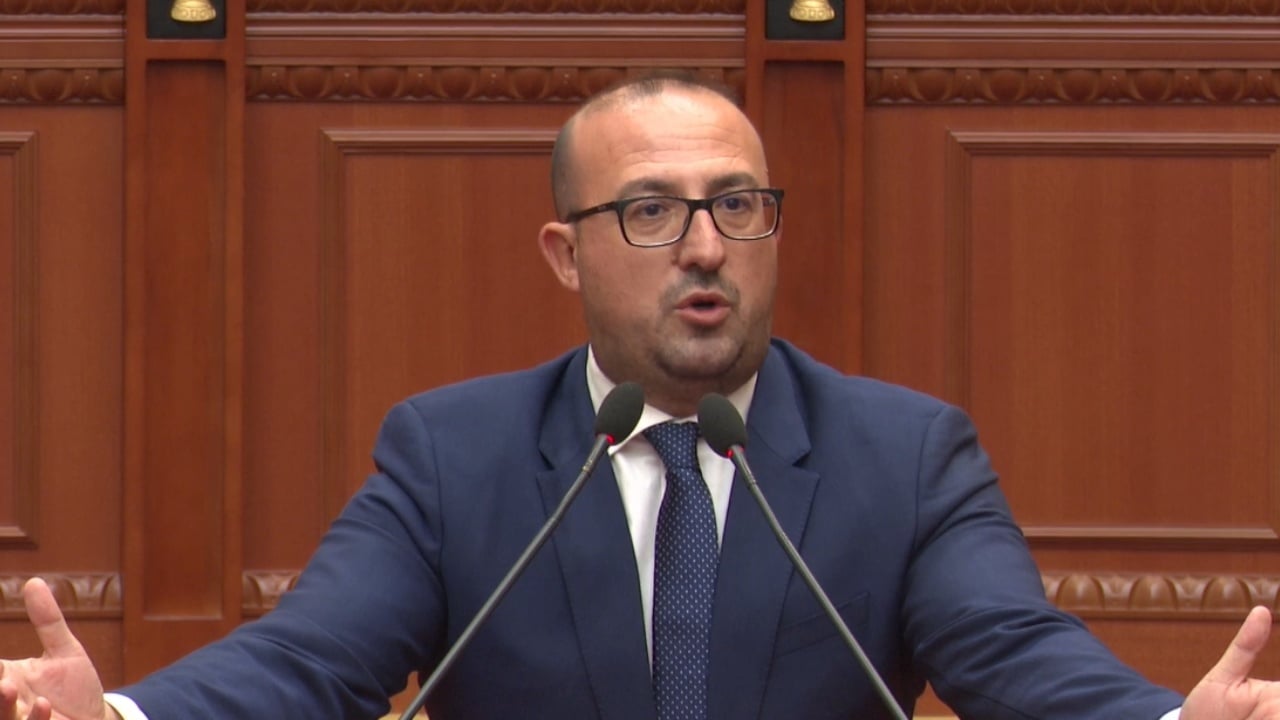
The debate over Territorial Reform flared up again in Parliament, where PD lawmaker Saimir Korreshi sharply attacked the new version of the map proposed by the majority. In a speech marked by ironic tones and strong political accusations, he questioned claims of improved services and opposed the administrative rapprochement between Divjaka and Lushnja.
Political clash over the territorial division
Korreshi spoke out against the new territorial map project, using direct language toward representatives of the majority in the chamber. He mocked the arguments presented for local reorganization and pointed out that, in his view, the promises of better services do not match the reality on the ground.
At the center of his criticism was the idea of merging areas that, according to the opposition, have neither public support nor guarantees of more efficient functioning of local administration.
Accusations of lack of services on the ground
During his speech, the PD lawmaker mentioned the state of local services in Lushnja and Divjaka, claiming that basic infrastructure and public services remain problematic. He cited urban transport, fire services, waste collection, and the condition of administrative units as examples of what he considers a failure of local management.
According to Korreshi, the majority is talking about a new administrative reform while many basic problems, from waste to maintenance and functional services for citizens, remain unresolved.
Criticism of the reform’s electoral logic
A strong part of his statement was tied to political doubts about the motive behind this intervention in the territorial map. Korreshi suggested that electoral interest, rather than the need for better local administration, lies behind the proposed changes.
He also mentioned the political result in Divjaka, suggesting that the way this reform is being pushed is linked to party calculations. This is a political accusation articulated by the opposition, while the majority has presented it as a reform aimed at increasing service efficiency.
“No one wants this merger,” says the PD lawmaker
In the most direct part of his speech, Korreshi claimed that residents do not want the rapprochement between Divjaka and Lushnja and that this move risks bringing more clashes than solutions. According to him, instead of a reform that makes life easier for citizens, confusion is being increased and distrust toward local government is being deepened.
The debate over the territorial map remains one of the points where the clash between the government and the opposition is not only technical, but deeply political: one side speaks of reorganization, the other sees control, patronage, and further centralization.
Beyond the jabs and harsh tones in Parliament, the controversy highlights a larger issue: how real are the promises of more services when many municipalities are accused of still failing to properly cover citizens’ most basic needs.
In this climate of distrust, every change to the territorial map is expected to be read not only as an administrative decision, but also as a political test of how local power is exercised in Albania.