
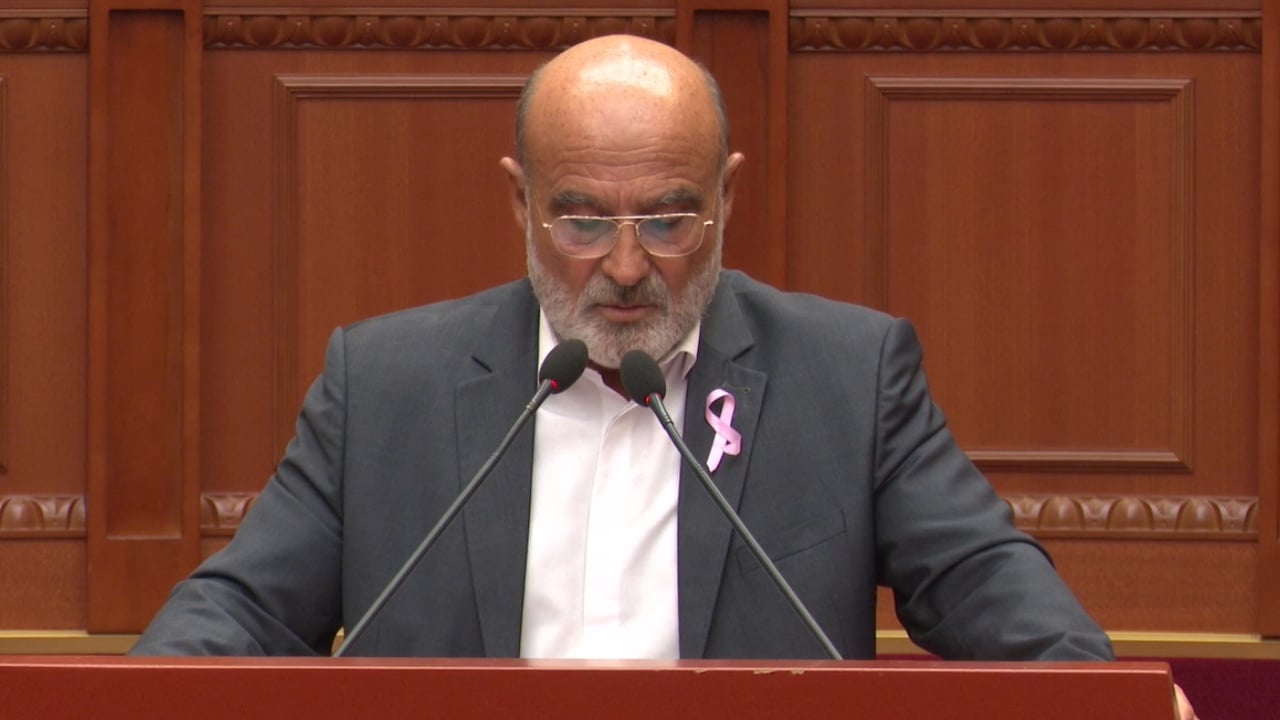
Socialist Party MP Vullnet Sinaj acknowledged in Parliament that he had opposed the way the new territorial map was pushed forward, especially the merger of Selenica with Vlora. In a debate that also highlighted cracks within the majority, he said some municipalities had been treated by different standards.
Objection over Selenica
Sinaj was among the Socialist voices who openly came out against this part of the reform. He rejected the merger of Selenica with Vlora and insisted that the municipality could not be presented as a failed unit.
In his speech in Parliament, the MP said Selenica had indicators of functionality and economic performance that, in his view, did not justify its elimination as a municipality in its own right. He argued that the area’s main problem is linked to its geographic spread and urban structure, not to any inability to exercise local functions.
Accusation of a double standard
The core of Sinaj’s objection was the claim that the reform had not used the same yardstick for all municipalities. According to him, it is not normal for units such as Selenica, Divjaka, Patos or Dimal, which in his version had carried out their functions well, to no longer exist.
He also used a politically strong phrase in the chamber, saying that this way of making decisions creates the impression that “some municipalities were like the mother’s children and some like the stepmother’s.” This is a direct criticism of the logic by which the reform was built, even though it comes from within the ranks of the majority itself.
The argument over services and their removal
Sinaj raised the concern that a geographically dispersed population runs a greater risk than others of losing public services or seeing them moved farther away. For this reason, in his view, such areas need stronger guarantees rather than standard solutions applied the same way on paper, but not on the ground.
This point touches one of the most sensitive debates of the territorial division: whether administrative reorganization truly brings efficiency, or simply moves decision-making centers and services farther from more peripheral communities.
In the end, alignment with the party line
Despite his strong criticism, Sinaj concluded his position with a clear political alignment. He declared that the debates had not been about personal interests or preserving local influence, but added that “my will gives way to the will of the Socialist Party.”
The statement suggests that even when publicly articulated reservations exist within the majority, the final decision-making remains conditioned by party discipline. This once again shifts the focus to the way decisions are made on reforms with a direct impact on local government and citizens.
Sinaj’s speech in Parliament brings back to the center the debate over the criteria of the territorial reform and the way different municipalities were treated in the same process.
When objections over double standards come from within the majority, the question remains as political as it is administrative: was the new division made using the same measure for everyone?
Read also:
- Territorial reform sparks clashes within the Socialist Party as well: Brae and Sinaj against the map with 46 municipalities
- More than 15 hours of session on the territorial issue, Rama seeks 84 votes while clashes erupt outside Parliament
- Protests at Parliament over the territorial reform: clashes with police, roads blocked