
The plenary session on territorial reform turned into a political and security marathon: inside parliament, a vote was expected on the Socialist Party draft, while outside the building the situation spiraled out of control between protesters and police. Prime Minister Edi Rama arrived at parliament at a moment when the majority was seeking to conclude a vote with high political stakes.
Rama in Parliament, majority seeks to pass the draft
Edi Rama arrived at the premises of the Parliament of Albania, where approval of the Socialist Party draft on territorial reform was expected.
According to the majority, the objective was to secure 84 votes to move the package forward, in a session that lasted more than 15 hours and also exposed tensions within the governing camp.
Outside the building, protest turns into physical clashes
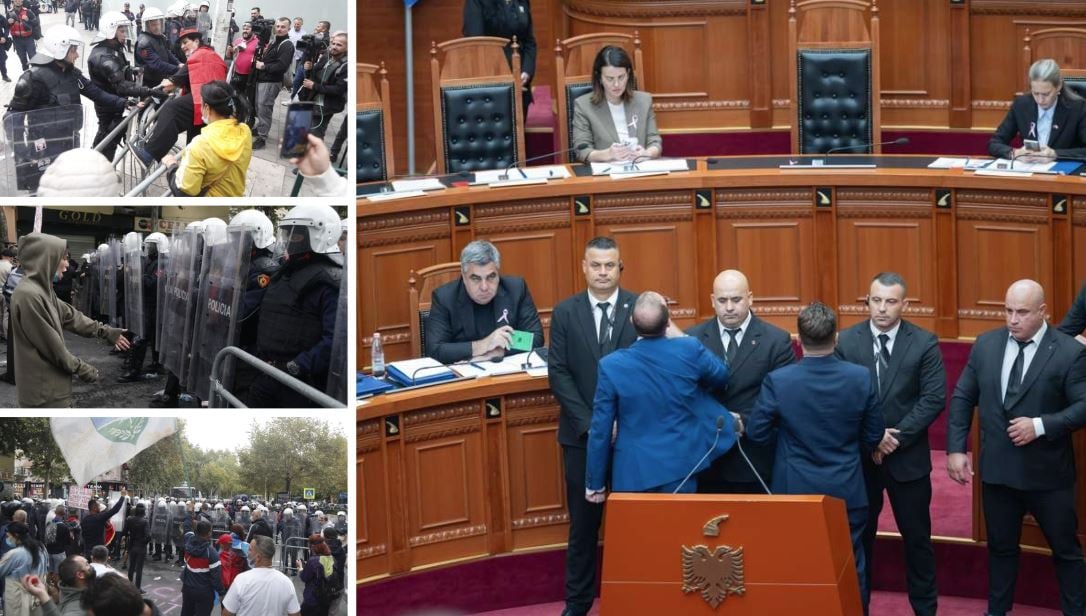
As the plenary session got underway, the situation outside parliament grew tense between protesters and police forces.
Protesters clashed physically with officers, pushing against the police cordon and attempting to bring down the barriers set up around parliament’s perimeter.
Police use tear gas to disperse the crowd
The escalation continued with police using tear gas to disperse protesters and regain control of the area in front of the parliament building.
The official version presents the intervention as a measure to restore order, while footage from the scene once again puts the spotlight on how protests are managed in public spaces facing state institutions.
Territorial reform heads to a vote amid political tension and pressure in the streets
The protest unfolded in parallel with discussions in the chamber on the issue of territorial reform, which was expected to be put to a vote during the session.
The combination of an overextended session, street clashes and pressure for the necessary numbers turned the parliamentary day into a political show of strength, not simply a procedural debate over the administrative map.
At the center remains the vote on territorial reform and the political cost of how it was pushed forward: with pressure for votes inside and open tension outside parliament.
Under these circumstances, what is presented as an institutional process is being accompanied by a climate of confrontation that raises significant questions about the political legitimacy of this moment.