
Prime Minister Edi Rama issued a public reaction from the damaged office of the College of Europe, using the scene as a political message after the previous day’s protest in Tirana. In his version, the attack on this institution is directly linked to the opposition and to an attempt to strike at the country’s European course.
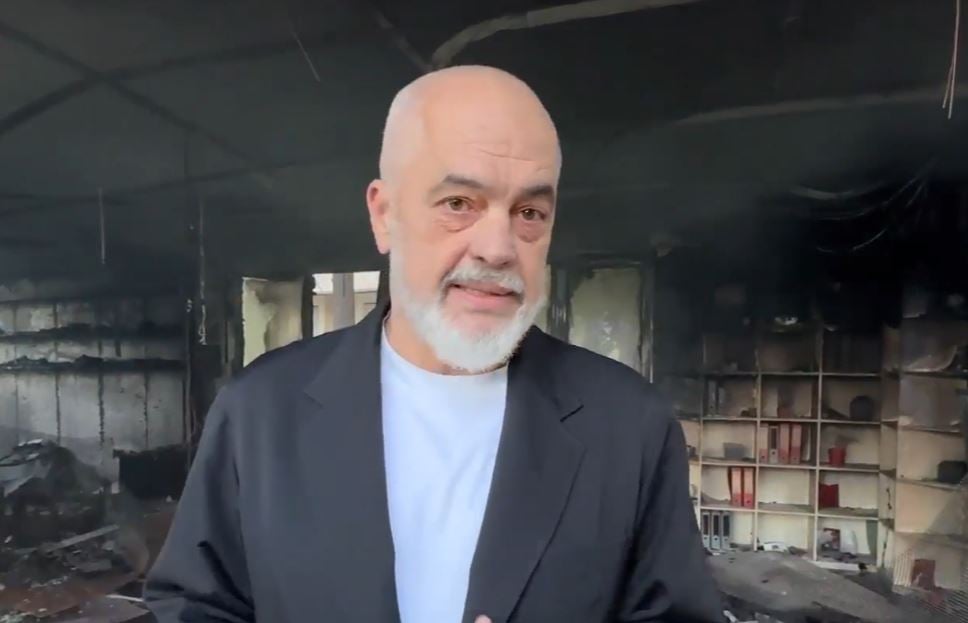
First reaction from the damaged premises
Rama appeared from the office premises of the College of Europe, which according to the public statement had been completely destroyed during yesterday’s gathering. He presented this space as a symbol of what happened at the protest and as evidence of a climate of violence that, according to him, aims to strike Albania at a sensitive moment.
The prime minister’s statement came in a strongly political form, in which the damage to the office was linked not only to the specific episode, but to a broader clash over the direction the country should take.
Political accusation against the opposition
In his remarks, Rama accused the opposition of trying to block Albania’s path toward Europe. According to him, behind what happened are “hands” seeking to drag the country down every time it tries to move forward.
This is a direct political accusation, articulated by the head of government himself, but without being accompanied by other concrete public elements beyond the political position expressed at the scene.
Warning: ‘Whoever had a hand in it will pay’
The strongest part of the reaction was the warning that “whoever had a hand in this chaos will pay.” With this wording, Rama signaled that identification and punishment of those responsible is expected, although the public statement did not provide details on which structures are investigating or on what facts this conclusion is based.
His message was also accompanied by the rhetoric that Albania will not turn back and that the future, according to him, belongs to the students and to Albanians.
From damage to an office to the narrative about Europe
The prime minister elevated the event from the level of an act of damage to a broader political narrative, calling the office of the College of Europe a symbol of what Tirana saw. This interpretation remains part of the government’s official version of the episode and of the political meaning being assigned to the protest.
At its core, Rama’s reaction seeks to read the damage as a blow against a project linked to the younger generation and the country’s European orientation, not simply as an isolated incident during the gathering.
It remains to be seen whether the warning of accountability will be followed by concrete institutional action and transparency regarding those responsible for the damage, or whether it will remain only at the level of the political clash that usually follows tense protests in Tirana.