
Prime Minister Edi Rama commented on the protests held in Tirana with a message that allows for two parallel readings: on the one hand, according to his version, the government respects the right to protest; on the other, he chose to target critics with insulting labels and harsh comparisons. Between the claim of institutional reflection and the aggressive tone toward dissent, Rama’s reaction appears more like an attempt to control the narrative than to provide accountability.
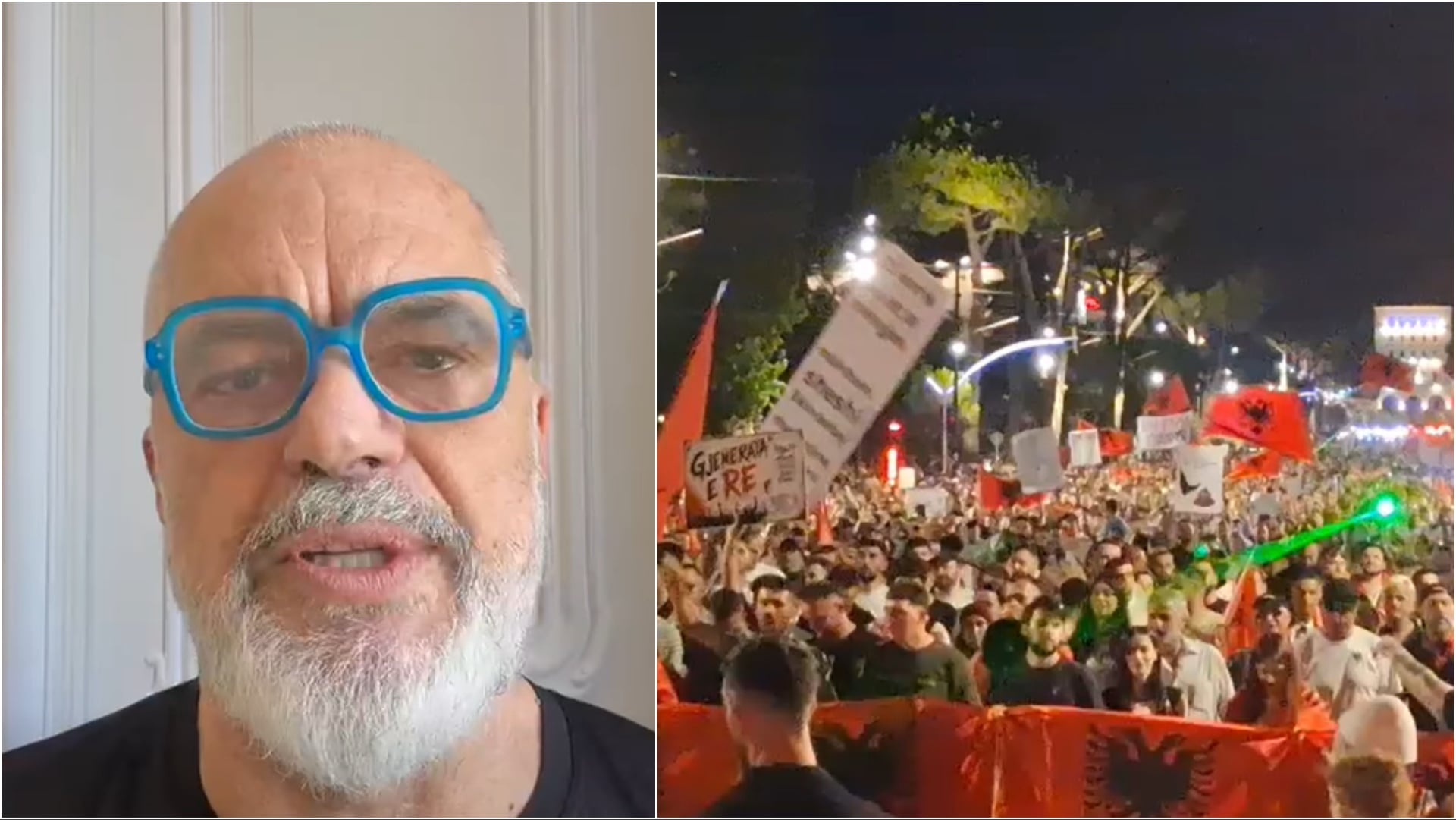
Officially he speaks of respect for the protest, but sets the limit at “pressure”
During the video message, Rama said that peaceful demonstrations are an essential part of democracy and that the government respects citizens’ right to protest. According to him, those who peacefully take to the square with legitimate demands are not prejudged by the government.
In the same appearance, he condemned every form of violence, threat or blackmail, accusing part of the protesters and social media activism of trying to impose their will through pressure. This once again places the debate on terrain where the authorities accept protest in principle, but problematize the way public discontent is articulated.
Harsh vocabulary toward critics and denigrating comparisons
The strongest part of the reaction was the language used toward opponents and critics. Rama spoke of “lynching choirs” and an “online mob of abusers,” while at the end he used the expression “a flock of crows and magpies” for those who, according to him, are accusing him of attacking the citizens who protested.
He also said that he does not accept the idea that in Albania in 2026 citizens should remain silent, artists should withdraw, or businesses should pay “tribute” to an online mob of abusers. In the same line of argument, he compared fake profiles on social networks to the “Red Guards” of China’s Cultural Revolution.
Rama: I do not prejudge peaceful protesters
According to his statement, Rama drew a distinction between citizens who protest peacefully and those who, in his view, use violence or blackmail. He said he has not prejudged young people seeking a more protected environment, family members demanding better-quality healthcare, parents asking for better education, or citizens who want a more humane administration.
In this part of the message, the prime minister tried to present the protest as a signal of rising expectations toward the state. However, beyond this verbal acknowledgment, no concrete deadlines, clear measures, or identified responsibilities were given for the concerns raised by citizens.
The government says it is collecting concerns and will reflect
Rama claimed that the government is listening carefully to every demand and that a specially established group is gathering the concerns voiced since the first days. According to him, work is under way on a reflection regarding the government’s mistakes, shortcomings and gaps.
He added that these will be communicated to citizens “step by step.” So far, however, these remain promises at the declarative level and not a concrete package of public responses to the protest.
The prime minister’s message keeps open a familiar contradiction in official communication: the formal acceptance of protest as a democratic right and, at the same time, the delegitimization of part of the criticism through denigrating language.
Beyond the formulas of “reflection” and “listening,” it remains to be seen whether the government will produce concrete responses to the grievances raised in the square, or whether the reaction will remain only at the rhetorical level.