
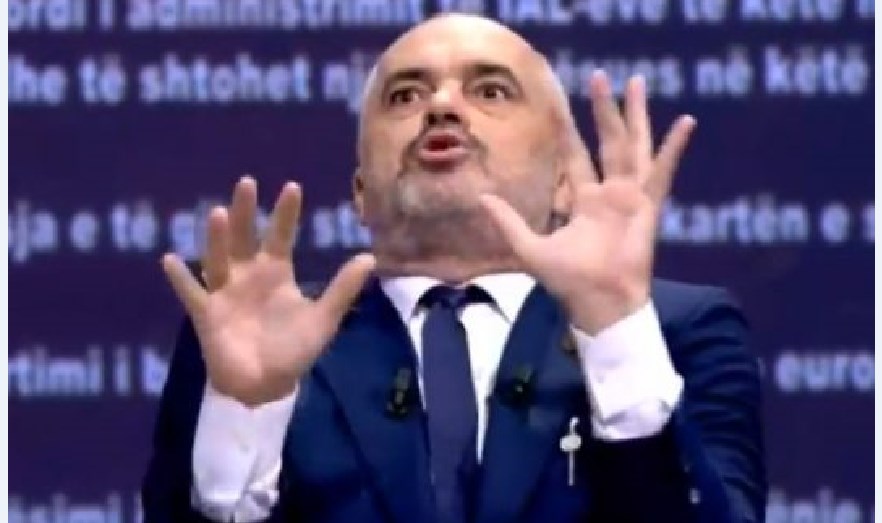
After five days of protests that have shaken Tirana, Edi Rama appeared before Albanians today not to take responsibility, but to declare once again that everyone else is Albania’s problem. The students are manipulated, the citizens are uninformed, the opposition is incompetent, the media incite violence, and behind the popular revolt stand Russia, Iran, and invisible hands. The only person who, according to his rhetoric, has the ability, wisdom, and right to lead this country toward Europe is Edi Rama himself.
In what can be considered one of the most politically desperate communications of recent years, Prime Minister Edi Rama today displayed all the political symptoms of a government that has begun to lose touch with reality.
It was not a speech of reflection. It was not a serious attempt to understand the revolt of the young. Nor was it a response to the grievances that have brought citizens into the streets.
It was a long monologue filled with self-praise, contempt for opponents, imaginary enemies, and claims of international conspiracies.
A torrent of political paranoia, in which everyone is found guilty for the country’s crisis except the man who has governed Albania for more than thirteen years.
An Entire People Incompetent, Only Rama Competent!
At the core of today’s speech was a troubling message: Albania cannot move forward without Edi Rama.
According to the prime minister, opposition supporters are a bunch of incompetents and mediocrities. The students do not understand what they are doing. Young people are being manipulated. The media lie. The protesters do not know how to distinguish their own interests from the interests of those supposedly directing them.
And above all, European integration is supposedly possible only if he remains in power.
This is no longer simply political arrogance. It is a deeply problematic conception of the relationship between power and the citizen.
In a democracy, the prime minister is a temporary administrator of the popular will, not the owner of a nation’s future.
No one has a monopoly on competence. No one has a monopoly on patriotism. And no one, least of all a politician who has governed for more than a decade, can present himself as a necessary condition for Albania’s European existence.
A country that supposedly cannot politically survive without one man is not the success story of that man. It is the gravest proof of his institutional failure.
From the Students to Putin and Iran: When Every Protest Becomes a Conspiracy
The most absurd part of today’s communication was the attempt to give the protest a geopolitical dimension.
Suddenly, the revolt of Albanian youth is no longer supposedly the result of economic grievances, lack of prospects, injustices, or fatigue with those in power.
Behind it, according to Rama, stand foreign hands, Russian influence, Iranian propaganda, and organized structures aiming to obstruct European integration.
The prime minister went so far as to declare that a drone carrying explosives aimed at the Prime Minister’s Office had been neutralized. An extraordinarily serious claim that requires evidence, institutional transparency, and a publicly verifiable investigation.
But in Rama’s rhetoric, claims of security threats are intertwined with political accusations, creating the impression that anyone who opposes the government can be placed under the shadow of a conspiracy against the state.
This is a dangerous way to treat democratic dissent.
If evidence of foreign interference exists, it should be investigated and presented by the competent institutions. If there are perpetrators of criminal acts, they should answer individually before the law.
But neither Russia, nor Iran, nor any other external enemy can be used as an argument to automatically devalue the discontent of Albanian citizens.
It is not Vladimir Putin who should answer Albanian students for the problems in education. It is not Iran that has governed Albania for thirteen years.
It is Edi Rama.
The Prime Minister Who Wants to Be Convinced Why He Should Leave
“Come and convince me why I should leave,” the prime minister declared today, in a challenge that reveals much about the way he perceives power.
But citizens have no obligation to personally convince Edi Rama why he should resign.
They have the right to protest, to demand accountability, to oppose the government, and to seek political change.
Of course, protest does not replace the constitutional and electoral process. But neither does an electoral mandate give a prime minister immunity from political responsibility or from calls to resign.
Instead of asking for arguments for his departure, Rama could begin by answering several much simpler questions.
Why do a considerable number of young people not see their future in Albania? Why do citizens complain about the cost of living, corruption, and lack of opportunities? Why does trust in institutions remain such a major concern?
And above all, what responsibility does the prime minister himself bear for these problems?
Because you cannot govern a country for more than thirteen years and, every time discontent erupts, look for those responsible everywhere else.
The European Union Is Not Edi Rama’s Private Property
One of the speech’s most politically manipulative messages was the attempt to place public opinion before a false choice: either Edi Rama, or there is no integration into the European Union.
The prime minister presented the continuation of his rule as a necessity for negotiations with Brussels.
But the European Union is not a prime minister’s personal project. It is a national aspiration that belongs to Albanians regardless of their political beliefs.
European integration rests on the rule of law, functioning institutions, media freedom, accountability in power, and respect for fundamental rights.
If the negotiation process is truly so dependent on a single person, that does not prove that person’s necessity. On the contrary, it raises serious questions about the sustainability of the institutions he has built.
Europe does not require irreplaceable leaders. Europe requires institutions that function even when leaders change.
He Speaks About the Police, but Is Silent About Abused Citizens
In his remarks, Rama dwelt at length on the sacrifice of State Police employees.
And no one should deny that officers have the right to be protected from attacks, stones, or dangerous objects. No protest justifies the burning of private businesses, the injuring of police officers, or endangering the lives of citizens.
But that is only one side of state responsibility.
What about the citizens who claim they were unlawfully struck by police? What about the students who denounce disproportionate use of force? What about the documented cases captured on video that require an independent investigation?
Who apologizes to them if it is proven that their rights were violated?
The police are an institution of the Republic, not the prime minister’s personal instrument. Their duty is to protect order and security, while at the same time guaranteeing the rights of every citizen, including those protesting against the government.
A prime minister who takes the rule of law seriously should demand an investigation into every act of violence, regardless of which side it comes from.
Otherwise, the law risks turning into a double standard: merciless toward the opponent and indulgent toward those in power.
The Political Agony of a Government That Does Not Accept Dissent
Edi Rama’s biggest problem today is not only the protest.
It is the way he interprets its existence.
Instead of seeing discontent as a signal that must be analyzed, he describes it as the product of manipulation, ignorance, extremism, or foreign interference.
Instead of explaining the failures of governance, he lists the supposed failures of his opponents.
Instead of accepting that Albania can have a future even without him at the helm, he tries to identify the country’s fate with his political fate.
This is what makes today’s communication so significant.
Not because it proves that the end of the government is near. That will be determined by political and institutional developments, not rhetoric.
But because it reveals the mentality of a government that seems increasingly unable to distinguish criticism of the prime minister from an attack on the state.
And when a leader reaches the point where every critic is incompetent, every protester is manipulated, and every act of dissent is part of a conspiracy, the problem is no longer only in the communication.
The problem lies in the way he understands democracy.
Albania is not Edi Rama. The state is not the Socialist Party. The European Union is not a personal reward for the prime minister. And Albanians are not an incompetent people in need of an irreplaceable leader.
If there is something Edi Rama should understand from these days of protest, it is precisely this: power is not property, a mandate is not eternity, and citizens do not need the prime minister’s permission to demand change.
Because in a democracy, the question is not who dares to challenge the leader.
The question is whether the leader has yet understood that his power flows from the citizens and not the other way around.
And if, after thirteen years in government, Edi Rama still believes that the only Albanian capable of leading the country is himself, then perhaps he has just made the strongest argument against his own philosophy of power with his own words.