
After five days of protests and clashes in Tirana, Prime Minister Edi Rama delivered a lengthy message in which he refused to step down, defended the actions of the Police, and framed the crisis as a confrontation that, according to him, does not simply challenge the government, but Albania’s goal of joining the European Union. In the same appearance, he made serious allegations about “foreign hands,” including Russia and Iran, and also spoke about a drone carrying explosives that, according to his version, was intended to strike the Prime Minister’s Office.
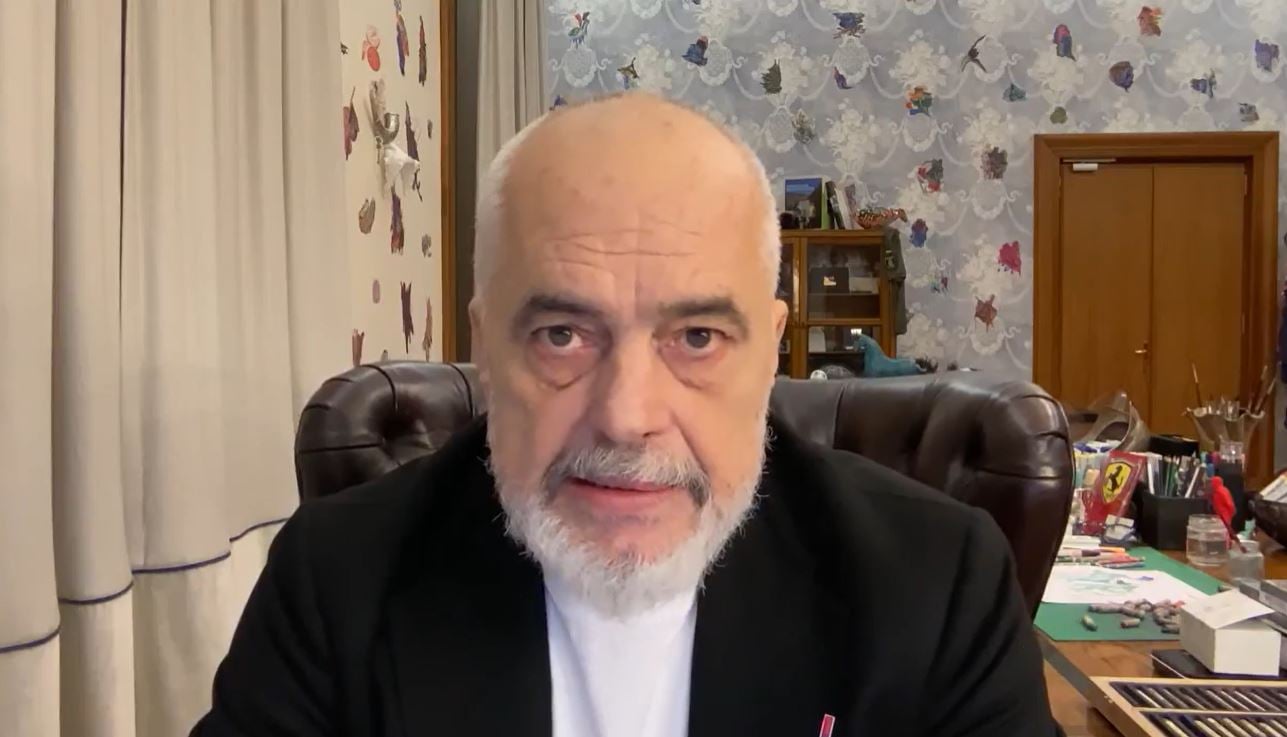
Resignation, according to Rama, is not an option
The head of government said that the demand for him to leave is legitimate in a democracy, but objected to the way it is being expressed in the streets. He responded to calls for his departure with the challenge, “convince me why I should go,” presenting himself not as a politician under normal protest pressure, but as part of a state mission.
Rama directly linked his staying in office to the European integration process. According to him, negotiations with the EU have a tight schedule through the end of 2027 and any political interruption would damage the continuity of the work with the European Commission.
He went further, turning the debate over political responsibility into a stark alternative: either this path, or risking the objective of membership. It is a thesis that clearly serves the government’s survival, but so far it remains the prime minister’s own political claim, not an institutionally proven fact.
Protests, violence and defense of the Police
Rama acknowledged that the damage from the protests “is not small,” but insisted it can be repaired quickly. According to him, the bigger problem is not the physical damage, but the climate of violence and pressure on the state.
He said the protests are not represented by students, but by a core of 200-300 masked people, whom he called the “fire group.” According to the prime minister’s official version, these individuals used stones, birdshot, Molotov cocktails and other means against the Police.
In a considerable part of the statement, Rama openly lined up in defense of the blue uniforms, saying officers are being publicly demonized while facing continuous attacks. He also justified the use of rubber bullets and the presence of RENEA, saying these structures intervene when there is a real threat.
On the other hand, he warned of a tougher response toward masked individuals, stressing that hiding one’s identity is not permitted by law. For students and young people who want dialogue, he offered a meeting at the Prime Minister’s Office or at faculties, with or without cameras.
Accusations of “foreign hands” and an explosive drone
The politically heaviest part of the statement was related to the claim of foreign interference. Rama said that crime is also operating within the protests and stated that two days earlier a drone carrying explosives had been neutralized, allegedly intended to strike the Prime Minister’s Office.
For this episode and the other accusations, the prime minister did not publicly present evidence in his appearance, but used the event as an argument to say that the unrest is not driven only by domestic grievances. He directly mentioned Russia, Vladimir Putin and Iran, speaking of interference on social networks and disinformation.
According to Rama, there is “a lot of data” on this interference, but without making its contents public. In the absence of transparency on these elements, the statements remain at the level of political accusations made by the prime minister at the peak of the crisis.
He also dismissed claims circulating online about Israelis in Albania or Serbian soldiers hidden behind Police uniforms, calling them part of a wave of absurdities and disinformation.
The EU as the government’s political shield
At the core of his message, Rama sought to shift the crisis from accountability for governance to fear of blocking integration. He said that what is being challenged is not simply a majority, but “European Albania” and the goal of joining the EU in 2030.
This is a formulation that gives the conflict historic weight and places the government’s critics in a defensive position. However, the fact that the protest is demanding resignation does not automatically make it anti-EU, as presented by the prime minister.
At the end of the statement, Rama also addressed businesses that were damaged. According to him, by midday on Saturday there were around 50 affected entities, mostly counters, banks, phone shops and a few small businesses, for which he promised support.
Rama’s appearance marked a clear refusal to open any discussion about his departure and a strong effort to turn the political crisis into an issue of security, order and European integration.
What is still missing so far is public verification of the most serious claims: from the explosive drone to foreign interference on networks. Without this transparency, the government is seeking to win trust through statements, while the situation remains charged with tension and suspicion.