
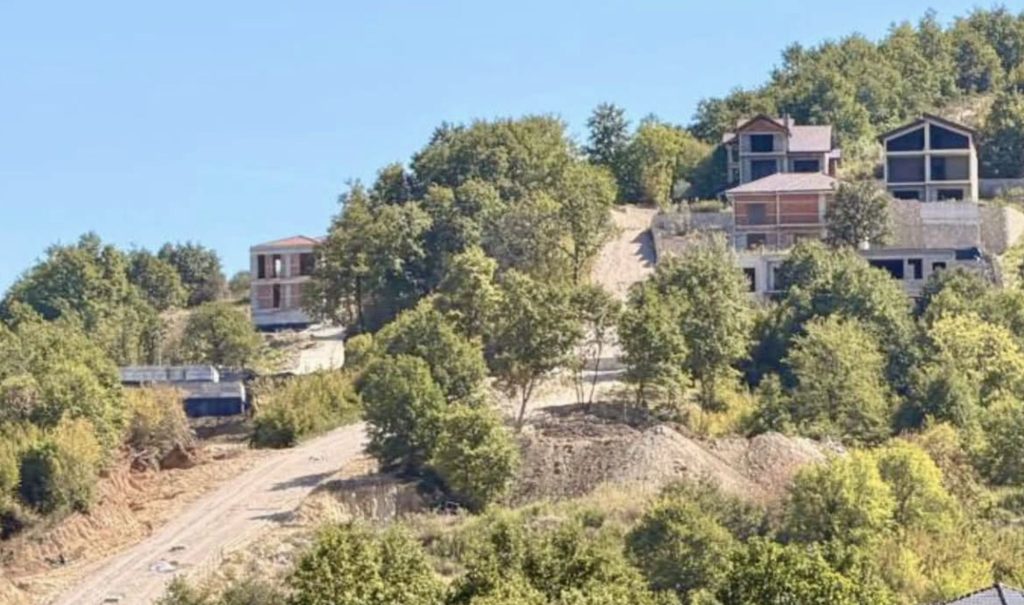
At the height of the student protests and accusations of police violence against young people, Democratic Party MP Belind Këlliçi has published images of several villas under construction, which he claims belong to State Police Director General Skënder Hita. The denunciation raises an issue of major public interest: are these properties linked to the police chief, how were they financed, and do they match his declared lawful income?
As Tirana continues to experience tense days of protests, with students in the streets, injured citizens and serious allegations of excessive use of force by police, another issue has erupted in the political debate.
This time, the focus is on State Police Director General Skënder Hita himself.
Democratic Party MP Belind Këlliçi has published photographs on social media of several villas under construction, claiming that they are the property of the police chief.
The allegations are serious, but so far the published material has not been accompanied by cadastral documents, asset declarations or financial data proving ownership and the origin of the funds.
Nevertheless, Hita’s senior public position makes a full and documented clarification essential.
The message from Këlliçi to police officers: Think about what you are protecting
In his reaction, the Democratic MP addressed not only Skënder Hita, but also State Police officers engaged during the protests.
Këlliçi drew a contrast between the working conditions of ordinary police officers and the wealth he claims their superior possesses.
He mentioned salaries, overtime, allowances and the economic difficulties officers face, accusing the police leadership of using them to protect the interests of those in power.
According to him, officers should reflect on the orders they receive, especially when police operations are accompanied by claims of violence against students and minors.
Këlliçi went further, predicting that a future asset verification could bring criminal consequences for the police chief.
These remain allegations and political statements by the MP. Criminal responsibility, if it exists, can be determined only through a lawful investigation and a court ruling.
From rubber bullets to villas: Two issues that require answers
The allegations about Skënder Hita’s wealth come at a particularly delicate moment.
During the protests, clashes, injuries and the use of force by police have been reported, including rubber bullets.
In his October 17 statement, Hita defended the use of police equipment, saying the tools were permitted and certified, while stating that cases of overstepping authority would be verified.
This is a separate issue that requires a full investigation.
If police officers used disproportionate force against citizens, responsibility must be determined individually, but the verification must also include orders, operational leadership and oversight mechanisms.
The police have an obligation to protect order, security and institutions. But that obligation does not give anyone the right to use violence outside the limits of the law.
On the other hand, attacks on police officers and destruction of property cannot be justified by the right to protest.
The standard of the law must be the same for everyone.
Do the villas really belong to Skënder Hita?
That is the first question that needs to be answered.
Photographs of buildings under construction, published by an MP, are not enough to prove ownership.
To determine Skënder Hita’s possible connection to these properties, cadastral records, construction permits, beneficial owners and asset declarations need to be verified.
If the buildings turn out to be owned by him, his family members or entities with which he has economic ties, it must be examined whether there was a legal obligation to declare them and how the investment funds were secured.
If no such connection exists, the allegations should be publicly corrected on the basis of documents.
That is precisely why the most important answer is not political rhetoric, but documentation.
A senior public official cannot be condemned on the basis of photographs. But neither should a documentable denunciation regarding his wealth remain without institutional verification.
SPAK facing a denunciation that demands transparency
In his reaction, Këlliçi directly mentions SPAK, essentially demanding accountability for the actions of the police and raising suspicions about the wealth of its chief.
But the task of justice institutions is not to fulfill the demands of a political party.
It is to assess concrete information, determine jurisdiction and, when the legal conditions exist, carry out the relevant verifications.
Such a review could clarify several essential questions: who owns the published buildings, when ownership was acquired, what the real value of the investment is, and what the sources of financing are.
It is just as important to determine whether there are links to individuals or companies that have benefited from public contracts or decisions.
None of these circumstances can be assumed without evidence.
But all of them are legitimate matters for verification when they concern one of the highest-ranking officials in the State Police.
The ordinary police officer should not bear the burden of leaders’ decisions
Beyond the allegations about villas, Këlliçi’s reaction touches on another problem: the relationship between institutional leaders and the employees who carry out orders in the field.
A police officer is not a representative of a political party.
He is a state employee charged with the duty to enforce the law and respect citizens’ rights.
This means he must carry out lawful orders, but cannot justify an unlawful act merely by saying he received an order from a superior.
Likewise, leaders cannot automatically transfer all responsibility to officers on the ground.
If a police operation was organized or led unlawfully, the investigation must also examine responsibility along the chain of command.
And if officers acted within the law, the institution must protect them from unfounded accusations.
The police are an institution of the Republic, not the property of their director nor of the parliamentary majority.
Officials’ wealth is a public issue, not merely a private one
Skënder Hita was appointed Director General of the State Police on March 30, 2026, by decision of the Council of Ministers.
Because of the office he holds, he carries high institutional and public responsibility.
That responsibility is not limited to directing police operations.
It also includes the obligation to preserve the integrity and credibility of the institution.
The wealth of a senior state official cannot be treated as an untouchable subject when concrete accusations are raised about a possible mismatch with lawful sources.
A documented response may also be in the interest of the accused official himself, because it separates facts from speculation and prevents suspicions from turning into premature conclusions.
Who gives the citizen an answer?
At a moment when protests have placed the relationship between citizens and power at the center, the demand for transparency is more important than ever.
Belind Këlliçi has made a serious accusation public.
Now the responsibility for clarifying it cannot remain only at the level of political confrontation.
If documents confirm that the villas are linked to Skënder Hita, the next question must be about the source of the funds and compliance with legal obligations.
If the claim proves untrue, the public should learn that with the same clarity.
Meanwhile, the allegations of violence during the protests must be investigated separately, on the basis of evidence and specific responsibilities.
Because the question is not only who owns the photographed villas. The question is whether Albanian institutions are capable of impartially verifying a denunciation against one of the country’s highest-ranking security officials.
The State Police must serve citizens and the law.
Justice must investigate without regard to office or political affiliation.
And public officials must be accountable for their wealth and the exercise of their duties.
In a state that aspires to membership in the European Union, these are not extraordinary demands.
They are the minimum standard of public accountability.