
The government has immediately put into effect the new package on public assemblies and protests, an intervention that gives the police greater authority for fines, on-the-ground restrictions and data collection on people referred to prosecutors or under investigation. According to the official version, the measures are aimed at violence during protests, but the changes also directly affect the exercise of the right to assemble.
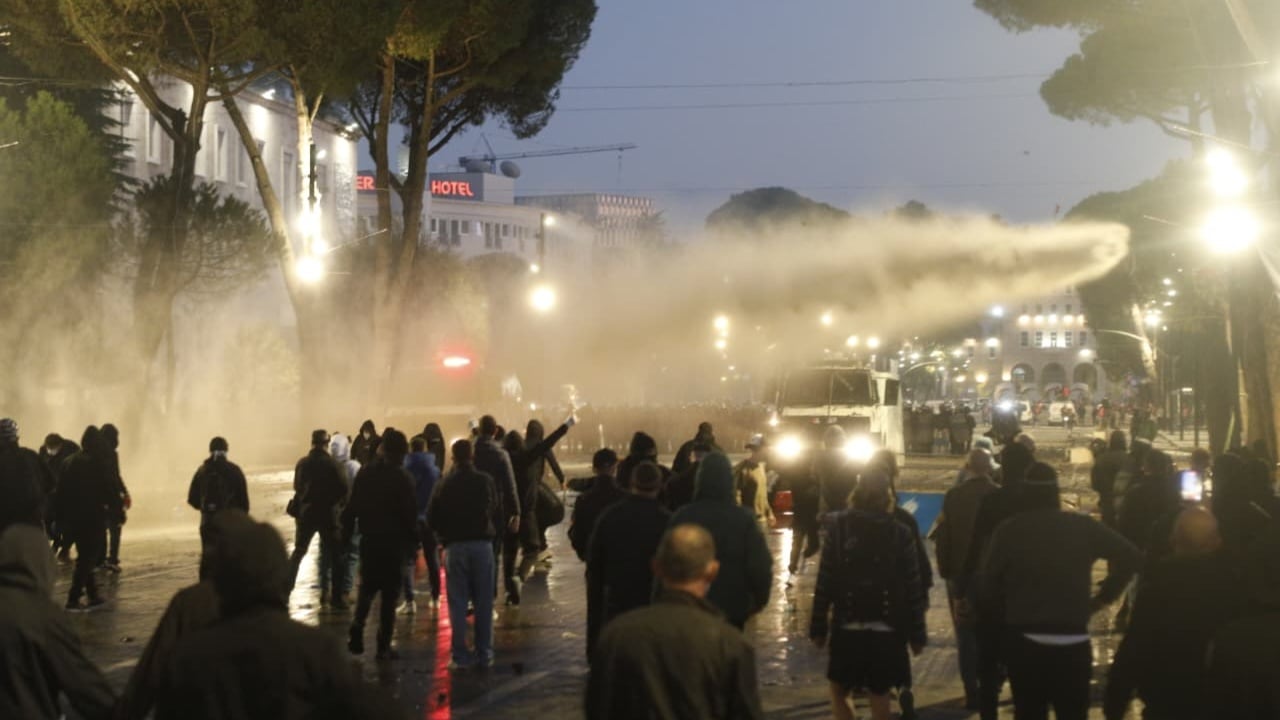
Fines increase, masks and disobedience penalized more harshly
The changes to the law on assemblies provide for fines from 10,000 to 100,000 lek for participation in a banned assembly and for unlawful concealment of identity. For disobeying a police order to disperse an assembly, the fine goes up to 200,000 lek.
In cases where a person is masked, the financial penalty becomes even harsher, from 50,000 to 500,000 lek. Road blockages during assemblies will also be punished with 5,000 lek for each day of blockage for each individual, while the fines will be imposed by the State Police as administrative misdemeanors.
Police gain the right to restrict protests near institutions
The package gives the head of the local police, with the approval of the prefect, the right to ban or restrict assemblies within a specified perimeter around educational, health or state institutions. According to the act, this can be done when a real, serious and imminent risk of violence or serious property damage is found.
The restriction may last up to 72 hours and may be renewed only once with a new reasoned decision. The law provides for an appeal to the administrative court within 48 hours, but the appeal does not automatically suspend enforcement of the decision.
Protected zones have also been defined, such as public transport stations and terminals, ports, airports, the perimeters of schools, health institutions and cultural heritage sites. In these cases, the police may order a person removed from the area for up to 48 hours.
Social networks are also included in the package
Under the changes, when messages calling for violence are distributed on social networks, by email or by telephone communications during the organization or conduct of an assembly, the police may request that the identified person delete the content and not repeat it.
If the content is not removed or the behavior is repeated, other legal measures are provided for. The police will also record with audiovisual means warnings for the dispersal of assemblies and acts of violence or property damage, with the formal obligation to comply with personal data protection rules.
Electronic registry for referred persons and border checks
Alongside the changes to the law on assemblies, the government has also approved the creation of a special electronic registry for people referred to the prosecution or under investigation for criminal offenses linked to violent acts during public gatherings and protests.
The registry will be administered by the General Directorate of the State Police and will contain data on persons identified in materials referred to the prosecution, for whom specific violent acts against persons or public and private property are documented.
According to the decision, the Border Police will have limited access to this registry for checks at the border. If, during verification, concrete data emerge about participation in violent acts, border authorities may administratively refuse departure from the country, under the conditions provided for in the legislation on state border control.
In cases where departure is not refused, border authorities may notify the authorities of the country to which the person is traveling that he or she has been referred for these offenses. The decision also provides that the police notify private accommodation structures about persons for whom they have concrete data and materials referred to the prosecution.
The decisions entered into force with publication in the Official Gazette and constitute a clear expansion of police powers in the management of protests.
On paper, the act speaks of proportionality and the protection of personal data. In practice, the burden of enforcement will fall on the police and the administration, raising real questions about the boundary between public order and limiting freedom of assembly.