
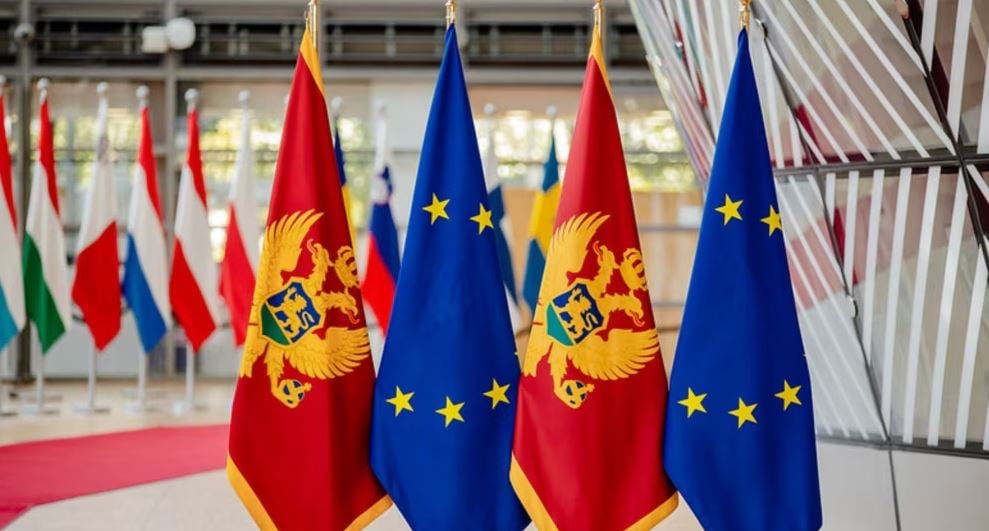
Montenegro could be the next country from the region to move closest to joining the European Union, but the timelines circulating from Brussels are still far from a done deal. According to a preliminary plan by the European Commission, Podgorica could close negotiations by the end of December 2026 and sign the accession treaty in June 2027, if it passes the EU’s political and technical filters without obstacles.
An optimistic timetable from Brussels
The roadmap that the European Commission is expected to publish on November 4 for the four countries that have advanced the furthest toward membership — Montenegro, Albania, Ukraine and Moldova — sets an ambitious deadline for Podgorica.
According to the document obtained by Radio Free Europe, Montenegro is expected to close the remaining negotiation chapters during two intergovernmental conferences, in November and December of this year. After that, the drafting of the accession treaty would be completed in the spring of 2027, while the signing could take place by summer, with June the most frequently mentioned deadline.
So far, Montenegro has provisionally closed 21 of the 33 negotiation chapters, and at least one more is expected to be closed within this week.
The Commission itself steps back: the deadlines are not final
The European Commission itself makes clear that these dates should not be read as a settled decision. According to the official version, progress will depend on the pace at which Montenegro meets the conditions for membership.
Brussels also clarifies that the plan guarantees neither the completion of negotiations nor the signing of the treaty within these deadlines. Decision-making does not rest only with the Commission, but also with the EU Council and the European Parliament, making the process politically more complicated than the initial timetable suggests.
Which chapters are expected to close by the end of the year
According to the roadmap, five chapters are expected to be provisionally closed at the November conference: energy, transport policy, food safety with veterinary and phytosanitary policy, taxation, and the free movement of goods.
December is expected to bring the most sensitive phase, with the closure of the remaining chapters, including financial services, regional policy and coordination of structural funds, environment and climate change, foreign policy, security and defense, as well as financial and budgetary provisions.
Equally decisive remain Chapters 23 and 24, which are linked to the rule of law, justice and fundamental rights. These are among the key chapters of the process, opened first and closed last, precisely because they weigh on the pace of the entire negotiation process. According to the enlargement package that the Commission is expected to publish on Wednesday, Montenegro has made progress in reforms on fundamental rights and has met the closing benchmarks for these two chapters.
Signing in 2027 would not mean automatic entry
Even if the treaty is signed in June 2027, the road does not end there. The text must be aligned and approved by all EU member states and by Montenegro, and also translated into all of the union’s official languages and into Montenegrin.
Before the signing and after it, several other steps are also required: translation and review of core EU legislation, a positive opinion from the European Commission, the consent of the European Parliament, and the decision of the EU Council on Montenegro’s admission.
The treaty is expected to be part of a new generation of documents with stricter safeguard mechanisms. This means the EU aims to monitor Montenegro until the day of membership, with reports twice a year. If backsliding is identified and corrective measures do not work, membership could be postponed as a last resort.
Podgorica’s political objective
Montenegro’s government has declared it a goal for the country to become the 28th member of the European Union by 2028.
However, as the experience of other countries has shown, including Croatia, signing the treaty and actual entry into the EU are two different stages, separated by ratifications and political scrutiny in every capital of the union.
For now, the signal from Brussels is positive for Montenegro, but not final. Behind the optimistic deadlines lies a process in which every chapter, every institutional approval and every ratification can turn into a real obstacle.
For the countries of the region, including Albania, the message remains the same: the enlargement calendar is moving, but final decisions continue to depend as much on the EU’s political will as on reforms on the ground.