
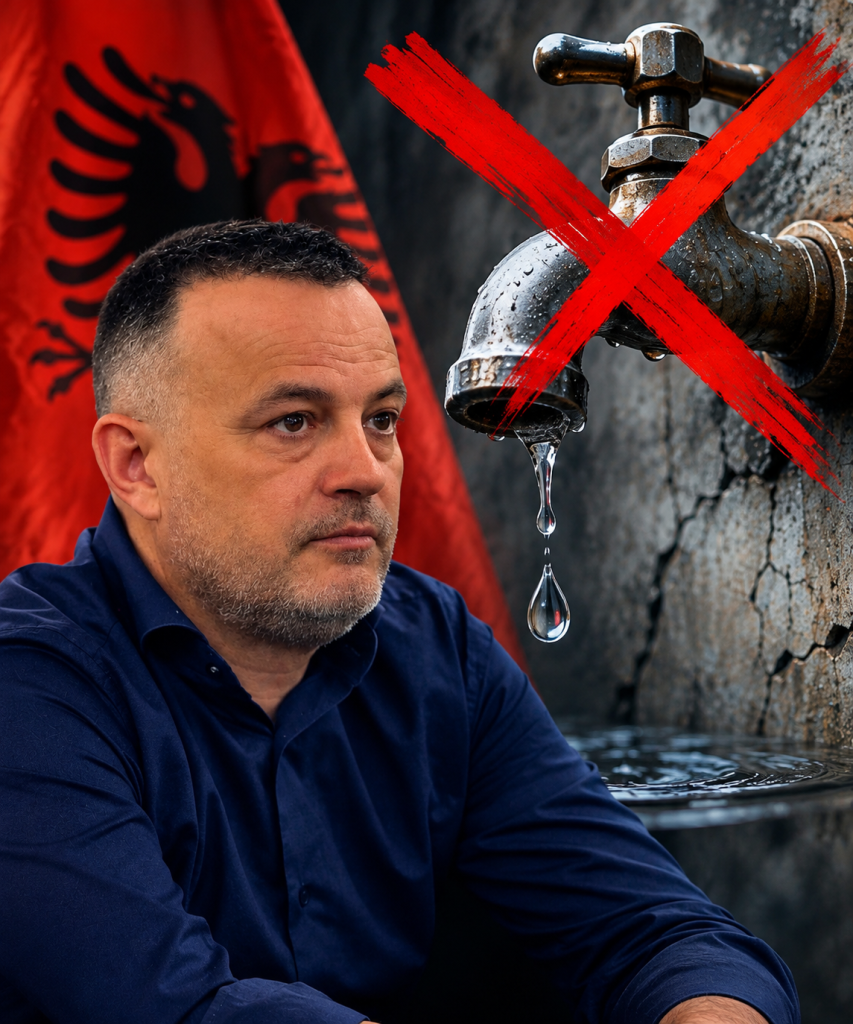
Three months of prolonged drinking water cuts, more than 1,000 residents affected, and businesses facing every day the consequences of a public service that is not functioning properly. This is the troubling picture on Elbasani Road and “Pjetër Budi” Street, just minutes from the center of Tirana. Meanwhile, the director of Tirana Water Supply and Sewerage, Flauers Shoshi, is facing accusations of failing to respond and of institutional indifference.
In the capital, where multimillion-euro investments in water infrastructure have been promoted for years, one of citizens’ most basic needs remains a problem: drinking water from the tap.
More than 1,000 residents of Elbasani Road and “Pjetër Budi” Street, in Administrative Unit No. 2, report that for more than three months they have faced long and repeated interruptions in water supply.
The situation affects not only families, but also dozens of commercial businesses operating in this densely populated area of the capital.
For residents, the issue has long gone beyond the limits of an ordinary technical fault. It has become a daily problem that affects hygiene, normal living conditions, and the functioning of businesses.
Flauers Shoshi, where is Tirana’s water utility?
At the head of UKT since January 2026 is Flauers Shoshi, former head of the National Water Supply and Sewerage Agency.
A manager with experience in the water sector, who should be among the first to understand that the supply of drinking water is not a luxury, but a fundamental obligation of a public enterprise.
However, according to residents’ complaints, despite the continued interruptions and the worsening of the situation, no work team has been seen in the area taking concrete action to solve the problem.
If these claims are confirmed, then an unavoidable question arises: What are the leaders of Tirana’s water utility being paid for, if they cannot guarantee even normal water supply in the center of the capital?
What has to happen for the director of UKT to react? How many days, weeks or months must pass before such a problem is treated seriously?
And above all, is Flauers Shoshi aware of the situation these citizens are experiencing? If so, what measures has he taken?
Millions of euros for the water system, but citizens still fill up containers
For years, investments in Tirana’s water supply network have been presented as one of the priorities of local and central government.
Millions of euros have been committed to infrastructure projects, network rehabilitation and interventions that were supposed to improve water supply.
But on Elbasani Road and “Pjetër Budi” Street, residents continue to face the same problem.
Millions of euros in investments on paper, but taps without water in reality.
This contradiction requires explanation and transparency.
Where have the investments gone? What concrete improvements have they brought for citizens? Why does an area so close to the center of Tirana continue to face prolonged interruptions?
It is not enough for institutions to publish investment figures and inauguration photos. The result of investments is measured in the service citizens receive, not in the millions announced at press conferences.
Residents feel abandoned by the government and institutions
What makes the situation even worse is the sense of abandonment expressed by residents.
According to them, in the face of a problem that has lasted for months, the responsible institutions have provided neither a convincing response nor a concrete deadline for the normalization of supply.
Families are forced to organize their daily lives according to unpredictable supply schedules. Businesses face additional costs and operational difficulties, while tax obligations and bills continue.
The irony is bitter: citizens are asked to pay regularly for public services, while the institutions that are supposed to guarantee them do not offer the same regularity in meeting their own obligations.
In a European capital in 2026, residents should not have to face every day the uncertainty of whether they will have water to wash, cook or keep their homes clean.
This is not a matter of convenience. It is a matter of human dignity and state responsibility.
Director Shoshi must be held accountable, not remain silent
Flauers Shoshi is not a newcomer to the water sector. Before his appointment at UKT, he led the national institution responsible for this sector.
That very experience makes public explanations all the more necessary.
Water interruptions cannot be justified indefinitely by technical problems, network deterioration or infrastructure difficulties, without showing what exactly has been done to solve them.
A director is judged not by the post he holds, but by his ability to manage the institution and respond to citizens.
And when more than 1,000 residents report serious water supply problems for more than three months, institutional responsibility cannot disappear behind administrative silence.
UKT should make public the interventions carried out in this area, the causes of the interruptions, the related investments, and the deadline for normalizing supply.
If the company has sent work teams, it should say when they intervened and what they found. If it has not intervened, it should explain why.
A question for the government: Is this the Tirana of multimillion-euro investments?
Beyond Flauers Shoshi, political responsibility for the quality of public services cannot be ignored.
The government and local authorities have an obligation to demand accountability for the way public funds are managed and for the results citizens receive.
There can be no constant talk of modernization, urban transformation and European standards while residents in the heart of the capital face elementary water supply problems.
A city does not become European because of towers, facades and luxury projects. It becomes European when the citizen turns on the tap and water comes out.
The case of Elbasani Road and “Pjetër Budi” Street is a concrete test of the accountability of UKT’s leadership.
Flauers Shoshi must respond publicly to residents and explain why the problems continue.
Because citizens do not need another promise, another statement or another investment figure.
They need water. Today. Not after another three months.
And if the institution is unable to provide even this basic service, then the question that arises is very simple:
Why should Flauers Shoshi continue to lead Tirana’s water utility if, under his leadership, residents in the center of the capital continue to be left without water?