
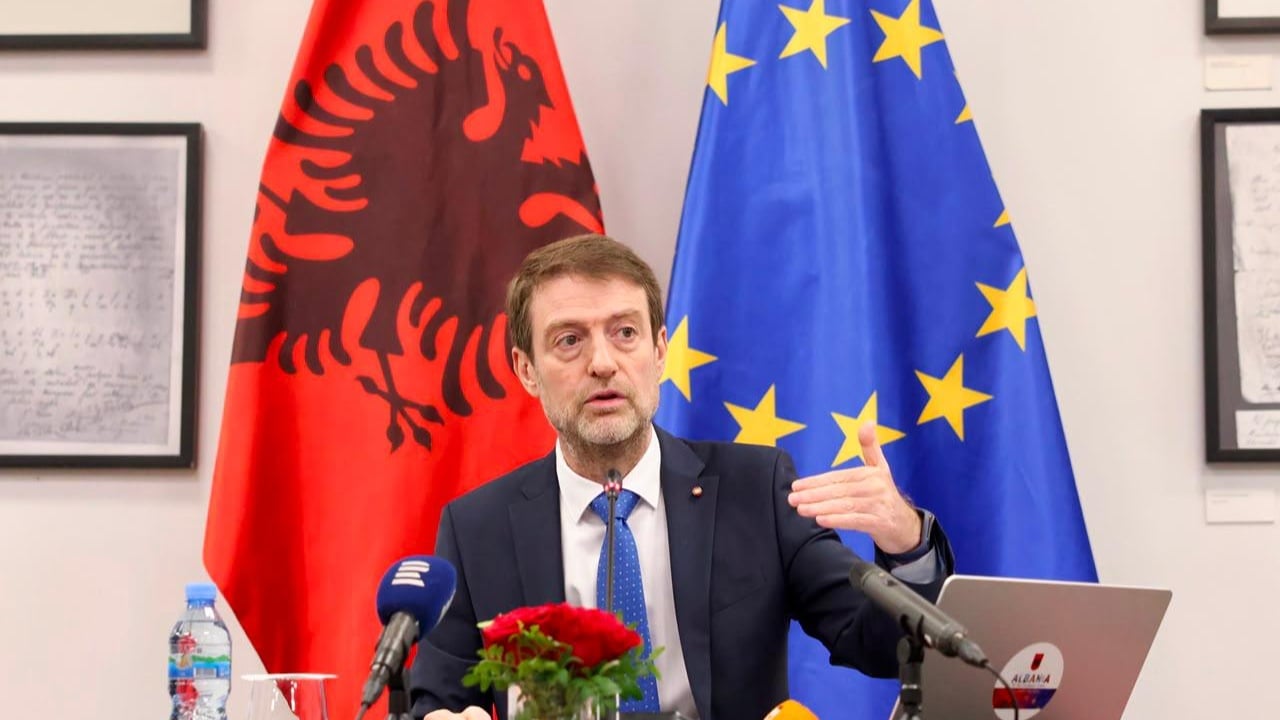
After the Serbian foreign minister’s statement about an agreement in principle on opening consular offices in Shkodra and Bujanoc, official Tirana has chosen to step back from any definitive reading of the issue. Ferit Hoxha said there is still no full agreement and that decision-making remains conditional on an agreement on all details between the two countries.
Official Tirana adjusts expectations
The reaction from the minister for Europe and Foreign Affairs came after his Serbian counterpart, Marko Djuric, spoke of an agreement in principle between Albania and Serbia. Tirana’s version is more reserved: according to Hoxha, concrete steps will be taken only if the parties agree on every aspect of the process.
This means that, unlike the enthusiasm created by Belgrade’s statement, the Albanian government is not presenting the matter as settled. For now, there is a declared political aim, but no final agreement.
What Albania wants and what Serbia wants
According to Hoxha’s public position, Albania is seeking the opening of a Consulate General in the Presheva Valley. On the other hand, Serbia has requested the opening of a Consulate General in Shkodra.
This formula is being presented by Albanian diplomacy under the logic of reciprocity. However, the minister himself underlines that reciprocity does not necessarily mean equality in content, objectives, or interests, but rather a framework of understanding between states.
Presheva at the center of the declared interest
The Albanian government insists that its main interest is the creation of a permanent consular presence in the Presheva Valley. According to Hoxha, this is seen as an overdue step in an area where a significant Albanian community lives.
In the official argument, such a mission would bring greater closeness to Albanian citizens there, more direct support, and a stronger mechanism for protecting their legitimate interests.
Public debate and the minister’s political message
The Serbian minister’s statement has sparked debate, especially because the opening of a Serbian consulate in Shkodra has been viewed with suspicion in public opinion. In his response, Hoxha said it was incomprehensible that part of the discussion was focusing on the other side’s interests rather than on the benefit that, according to the government, an Albanian consulate in the Presheva Valley would bring.
The minister presented this line as part of a foreign policy based on national interest, international norms, and European orientation. But beyond the diplomatic wording, the issue remains open: there is still no full agreement, and everything depends on the negotiation of details between Tirana and Belgrade.
For now, the clearest element in this story is not the opening of any consulate, but the difference between what was said by the Serbian side and what the Albanian government is publicly acknowledging.
If there is to be a real agreement, it will have to pass through full political and diplomatic consensus, not simply through statements that generate debate before any decision has been made.