
A lengthy profile published by the Spanish daily El País once again places Edi Rama at the center of international attention, this time not for his governance, but for his exhibition in Berlin. In the interview, the head of government speaks about art as a personal refuge in the face of politics, while the article constructs his figure between the two roles that he himself keeps connected: artist and prime minister.
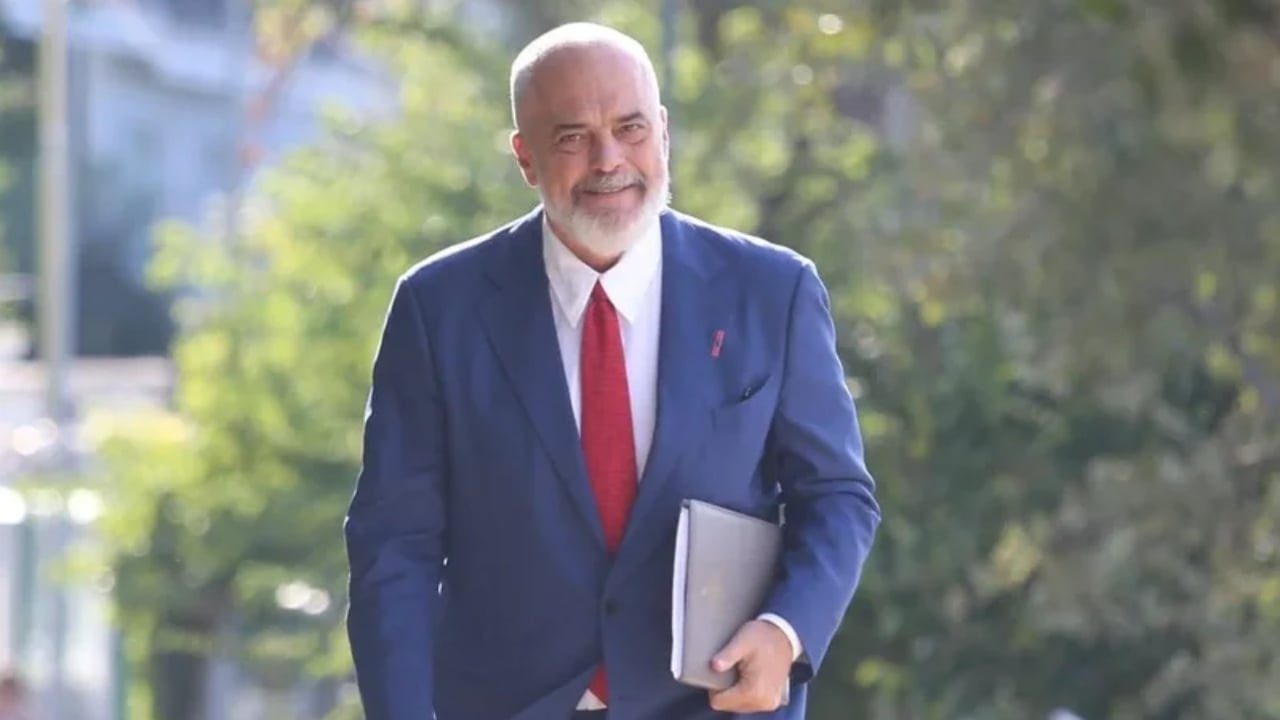
Focus on the “Chrysalizing” exhibition in Berlin
The article focuses on Rama’s latest exhibition in Berlin, “Chrysalizing,” where he presented bronze sculptures created from 3D prints. According to the interview, these works emerge as a development of his earlier painting practice and move toward a new sculptural form.
Rama describes this process as a path that arose naturally, saying that he uses artificial intelligence to create a digital model, from which the 3D print is made, and then intervenes by hand on the work. The article presents this exhibition as a new moment in his artistic practice.
From the Academy of Arts to politics
The profile also revisits Rama’s journey from his studies at the Academy of Arts in Tirana during communism, where he recalls a system that was technically strong but lacked artistic freedom. In the interview, he speaks about the restrictions of the time and the lack of contact with modern art in Albania during that period.
The article then moves to his relocation to Paris in the 1990s and his entry into politics at the end of the decade. El País links that transition to his later role as minister, mayor of Tirana, and then prime minister, treating the entire itinerary as part of the same public profile.
How Rama presents the relationship between art and politics
In the interview, Rama says that art for him is “an effort not to go mad,” while he describes politics as a field where the risk of becoming deformed is immediate. This is one of the article’s main axes, as it builds its narrative around the idea that art serves as a counterweight to political life.
He also defends the separation between art and politics, opposing their conflation in judging international artistic events. According to his version, art does not have the mission of changing the world or providing political solutions, but of changing people’s point of view.
Art inside the government office
Part of the interview also focuses on the way Rama says he creates drawings during meetings and official engagements. He presents this as a form of “detoxification” from the burden of politics, while the article sees this practice as an inseparable part of his public image.
Rama also says that he does not sell his works to Albanians or to people with businesses in Albania, claiming that checks are carried out on every buyer to avoid conflict with his government role. This remains an important element of the interview, as it touches precisely on the sensitive boundary between political power and private interest.
The El País profile does not bring any new political developments, but carefully reproduces the figure that Rama seeks to project abroad: a leader who speaks about power through art and about art from the heart of power.
That is precisely where the main tension of this public narrative lies: not in the exhibition itself, but in the way a prime minister uses an artistic identity to shape his international image.