The political earthquake in Hungary following the defeat of Viktor Orbán is no longer just a domestic event. Its ripple effects are spreading across Central and Eastern Europe, reaching even into Albania’s financial system.
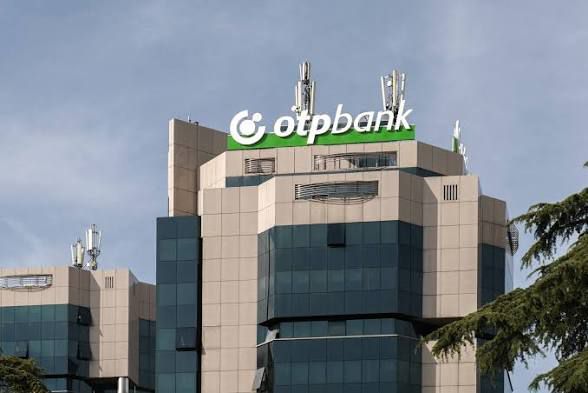
At the center of this uncertainty stands OTP Bank, one of the most aggressive regional banking groups of the past two decades. Its expansion into Albania, particularly through the acquisition of Société Générale Albania in 2019, was not seen purely as a commercial move. It was widely interpreted as part of a broader geopolitical strategy, closely aligned with Hungary’s political influence in the Western Balkans.
Now, that foundation has been shaken.
From Political Shield To Market Vulnerability
For years, OTP Bank’s regional growth coincided with the consolidation of power in Budapest. In multiple countries, including Albania, the bank operated in a context where political relationships provided an additional layer of stability and confidence.
In Albania, this translated into a visible role in financing large projects, strategic investments, and sectors tied closely to public policy. The perception was clear: OTP was not just another commercial bank—it was part of a wider network of influence.
With Orbán out of power, that perception becomes a liability.
The new political leadership in Hungary, under Péter Magyar, has already signaled a shift toward transparency and institutional restructuring. If this translates into concrete investigations or financial audits, OTP Bank could face scrutiny not only at home, but across all markets where it expanded under the previous political umbrella.
A New Era Of Financial Transparency
The potential “de-Orbanization” of Hungary’s institutions introduces a fundamental risk for OTP Bank. Financial flows, political affiliations, and past investment decisions may come under closer examination.
This is particularly sensitive in regions like the Balkans, where the line between political influence and business expansion has often been blurred.
In Albania, the implications could be significant. If international pressure—especially from European institutions—pushes for deeper transparency, OTP may be required to disclose details about financing structures, partnerships, and exposure to politically linked projects.
Such a process would not necessarily imply wrongdoing. However, even the perception of risk can affect market confidence.
Leadership Under Pressure
Sándor Csányi, the long-time leader of OTP Bank, has built a reputation as a resilient and pragmatic strategist. But the current challenge is different in nature.
Without the political backing that supported the bank’s expansion for over a decade, OTP now faces a more conventional, but also more demanding environment: one defined by regulatory scrutiny, competitive pressure, and the need for institutional credibility.
The question is no longer how fast the bank can expand, but how well it can adapt.
Implications For Albania
For the Albanian market, the situation creates a dual-layer risk.
On one hand, OTP remains a major financial institution with strong operational capacity. Its presence contributes to competition, liquidity, and access to financing.
On the other hand, any instability at the group level—whether reputational, regulatory, or strategic—could have downstream effects. These may include tighter lending conditions, delayed investments, or a more cautious approach to large-scale financing.
In a financial system that is still developing and highly sensitive to external shocks, such changes cannot be ignored.
From Expansion To Survival Mode
The fall of a political ally does not automatically translate into the fall of a financial institution. However, it changes the rules of the game.
OTP Bank is entering a phase where its strength will no longer be measured by expansion speed or political alignment, but by transparency, resilience, and independence from past power structures.
In Albania, as in the rest of the region, the coming months will be critical.
Because for the first time in years, OTP is not expanding under protection.
It is operating under scrutiny.