
The debate over the new territorial reform is entering a more sensitive phase, as a draft report by the Council of Europe signals the risk that the process could be carried out in haste and with consultations only for form’s sake. The document calls for the changes not to be imposed from above, but to be based on serious analysis and genuine listening to the affected communities.
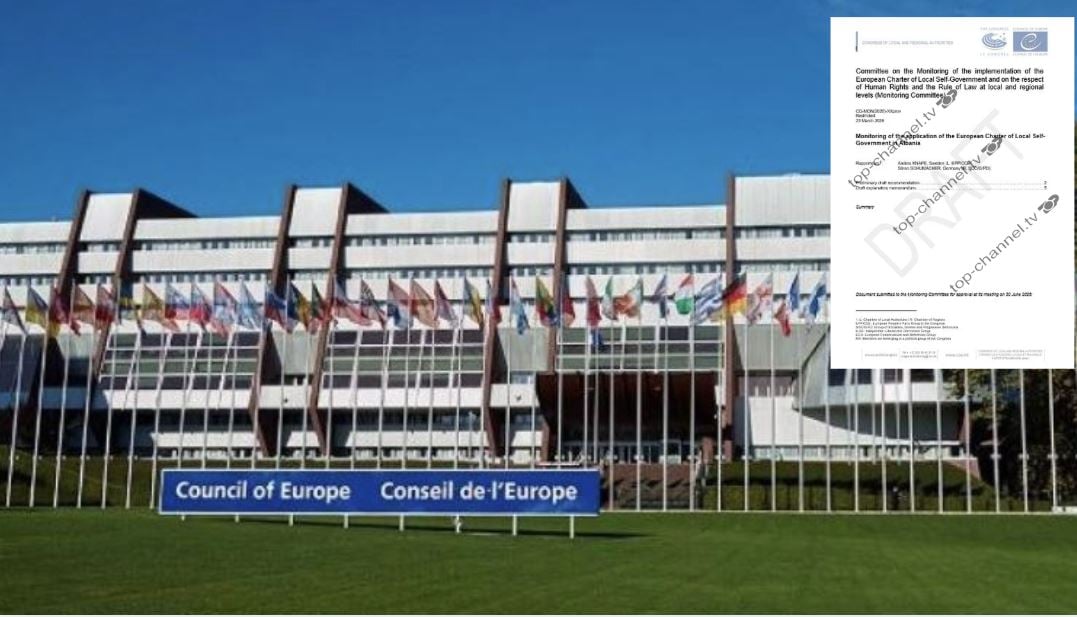
The report questions the declared pace of the reform
In its nine-page draft report on Albania, the Council of Europe says that no decision on the administrative map should be taken without a full assessment of the 2015 reform.
According to the report, there is a risk that the territorial reform planned for 2026 could be pushed forward through formal consultations if the government insists on meeting the deadlines it has publicly announced. This warning puts at the center of the debate not only the substance of the reform, but also the way the process is being built.
Consultations with local government seen as limited
The document underlines that local government, up to this stage, has had a limited role in the process. This means that municipalities, which are directly affected by any territorial redesign, may be genuinely involved only at the end, when the main decisions have already been taken.
According to this assessment, late involvement would leave local units with little time to prepare and even less room to influence the process with their proposals. For a reform that affects the organization of local governance, this is a strong signal that the process cannot be reduced to formal hearings.
Key services remain under central control
The report also raises a deeper problem than simply boundaries on a map: many public services continue to be controlled by the central government, even when the strengthening of municipalities is discussed on paper.
Waste management, water supply and education are mentioned as areas where municipalities do not exercise full powers. According to the report, this limits their role and often leaves them in the position of implementing decisions taken at the center, rather than functioning as real units of self-government.
Warning against any further removal of powers
One of the document’s most critical points is that the weaknesses of some municipalities should not be used as a justification to strip them of even more powers.
The Council of Europe rapporteurs say the reform should not be reduced to the question of how many municipalities the country should have. In their view, the role of the counties should also be reviewed, as in their current form they do not meet the criteria to be considered full-fledged units of local self-government.
Amid the political clash between the majority and the opposition, this position by the Council of Europe adds pressure for the territorial reform not to be treated as a technical exercise with predetermined deadlines.
If the warnings are ignored, the problem will not be only the changing of administrative boundaries, but the deepening of a model in which decision-making remains at the center while municipalities are left with responsibilities but no real power.