
A political analysis in sharply critical tones places Edi Rama at the center of a problem that, according to the author, cannot be solved simply through cabinet reshuffles or a formal return to the party base. The core of the criticism is deeper: the question of legitimacy, the relationship with citizens, and the tendency to seek approval from external actors when trust on the ground begins to waver.
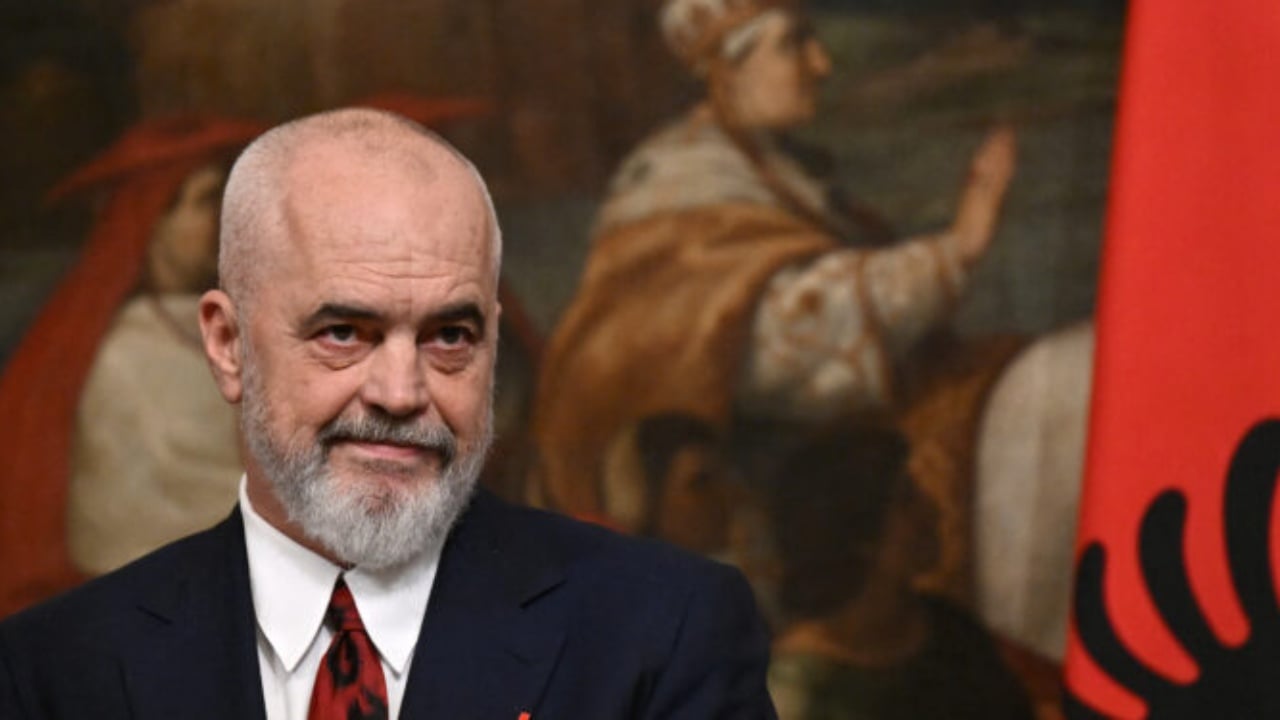
The crisis cannot be closed with a change of ministers
The analysis argues that the removal of some worn-out or unsuccessful ministers may be necessary, but it is not enough to stop the decline in public trust. From this point of view, the problem lies not only with the prime minister’s subordinates, but also with the perception that has been created around the very way he governs.
The author sees as insufficient any reflection that presents public dissatisfaction simply as a lack of presence on the ground or as the effect of algorithms. In this reading, political responsibility cannot be shifted only onto the party, ministers, or mayors, while leaving out the central figure of governance.
Confronting legitimacy and the relationship with foreigners
One of the main questions raised is where a prime minister finds the real source of legitimacy: in the votes of citizens or in the approval of foreign bureaucrats and allies. The analysis takes a critical view of part of Albanian politics, which according to the author often overvalues how it is seen abroad and undervalues its relationship with the public in Albania.
This criticism is also directly linked to Rama’s reaction to Ukrainian President Volodymyr Zelensky, following the latter’s statements on Ukraine’s position toward Kosovo. According to the analysis, the prime minister’s post in English and the language used toward Albanian critics have fueled the perception that he is speaking more to foreign chancelleries than to the citizens he claims to represent.
SPAK, pretrial detention and suspicions of power without checks
A large part of the article focuses on the justice system and especially on SPAK, with strong political accusations against a structure that, according to the author, is expanding beyond normal institutional control. The analysis mentions concerns about the balance between the prosecution and the court, the use of surveillance, and the power given to the special body in the name of justice reform.
Along the same lines, the case of Erion Veliaj is also mentioned, not to prejudge his guilt or innocence, but to point out the way pretrial detention, according to this interpretation, risks turning into prior punishment. This is presented as a symptom of a system in which the weight of accusation is seen by the author as greater than the fundamental guarantees of due process.
The patriotism of the younger generation and the political cost for Rama
The analysis also dwells on generational change, arguing that young Albanians are less inclined toward inferiority complexes and more sensitive to issues of national dignity. According to the author, this spirit has also been shaped by moments when Rama himself took stronger positions in foreign policy, making the contradiction with his recent conduct even more visible.
From this perspective, the current gap is not seen as an accidental product, but as the consequence of a political and communications shift that irritates part of the base that once supported him. For the author, the question is not only whether Rama will keep power, but how he will be remembered: as a reformer who changed the country, or as a leader who lost contact with his own society.
The final call: reflection must begin with oneself
The concluding message of the analysis is direct: if the prime minister seeks to recover trust, a cabinet reorganization is not enough, nor is a routine political communications operation. According to the author, reflection must begin with personal responsibility, with the way he addresses the public, and with the relationship he chooses to have with international actors.
The article also calls for greater attention to the everyday corruption citizens encounter in the administration, services, permits, hospitals, and local tenders, not only to high-profile battles. At this point, the criticism goes beyond the figure of Rama and touches on the way the state functions, where the propaganda of reform is often seen as greater than the result felt in everyday life.
At its core, the analysis brings the debate back to the strongest political question: to whom does power really answer, the citizens or approval from abroad.
And that is precisely where the test for Rama is set: not in rhetoric, but in the ability to convince the public that he still governs with a mandate from below, not with a blessing from above.