
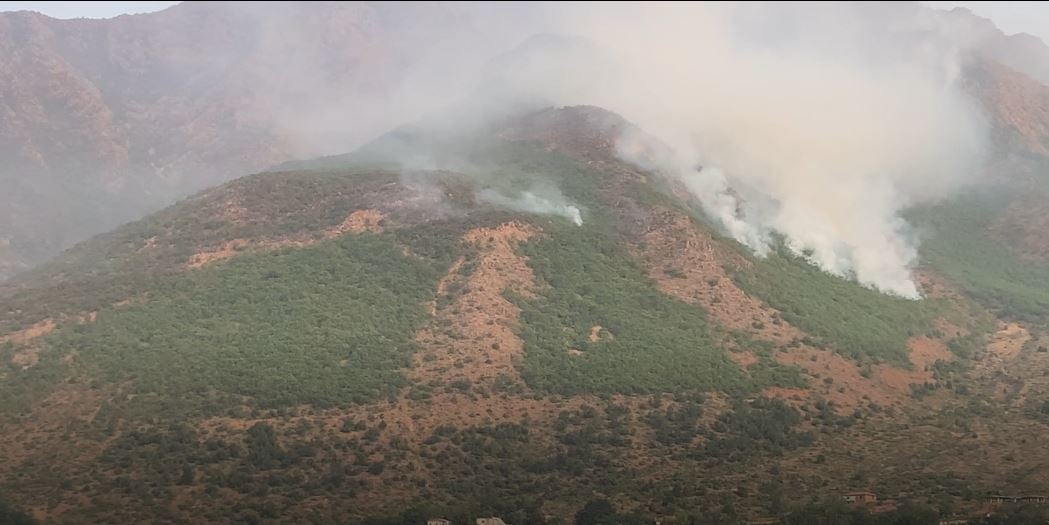
The wildfire toll across the country remains concerning. According to the official version from the Ministry of Defense, 27 fire hotspots were reported over the past 24 hours, while some of the hardest-hit areas remain under pressure, especially in Dibër and along the Dajt–Qafë Priska axis.
What institutions are reporting about the situation
The Ministry of Defense says that of the 27 hotspots reported nationwide, 3 remain active, 4 are under monitoring and 3 have been completely extinguished. The official data point to a broad engagement on the ground, while it remains to be seen how effective the intervention is proving in the most problematic areas.
In the extinguishing operations, according to the institutions, 292 operational forces and 26 firefighting vehicles have been involved. The Armed Forces supported the intervention with 80 personnel and 3 helicopters.
Dibër remains the epicenter of the active hotspots
The main active hotspots are concentrated in Dibër County. In Vajkal, Bulqizë, the fire has spread across more than 18 hectares, and intervention is continuing with firefighting services, municipal forces and 30 members of the Armed Forces.
Another active hotspot continues in Lundre, Mat, where the fire has affected a considerable forest area. There too, the operation is being supported by 30 Armed Forces personnel.
In Mallunxë, Mat, the situation has become further complicated after the fire was reactivated by strong winds. According to the authorities, the flames have moved toward the villages of Mallunxë and Lis.
Dajt–Qafë Priska also remains a risk area
The situation in Dajt–Qafë Priska also remains problematic. According to the official report, there is no risk to inhabited areas, but the operation is continuing today as well with the support of 30 Armed Forces personnel.
The fact that this area continues to be considered problematic, despite the increased engagement on the ground, raises questions about the real control of the hotspot and the capacity to quickly neutralize its spread.
Hotspots under monitoring and difficult terrain
Hotspots in Qafa e Lugut–Vithkuq, Mount Qukës in Prrenjas, and Iballë–Fushë-Arrëz are also under monitoring. For the latter, the authorities acknowledge that the terrain is very difficult, which also required intervention by an Armed Forces helicopter during the day yesterday.
The National Civil Protection Agency says it is monitoring the situation across the entire territory, in coordination with prefectures and municipalities. Likewise, according to the institutions, the priority remains the protection of life, homes and the environment.
At this stage, the picture emerging from the official reporting is that of a still unstable situation in several key areas, with particular focus on Dibër and Dajt–Qafë Priska.
Despite the figures provided by the institutions, the real test remains stopping the spread of the flames on the ground, especially where wind and difficult terrain are complicating the intervention.