
The government is presenting Price Watch as a tool for transparency in the prices of basic products and detergents, but expectations for an actual reduction in prices remain unclear. So far, the official message is that the platform requires time, institutional coordination, and cooperation, while families are facing costs that cannot wait.
Transparency on screen, but not necessarily on the receipt
According to the government, the launch of the Price Watch Albania platform is expected to guarantee greater transparency and curb unjustified price increases for some basket goods and detergents.
But the move from monitoring to a concrete reduction in prices is not presented as a quick process. Economist Igli Tola says that seeing results in price reductions will require a long period of implementation, as well as coordination with institutions such as the Tax Administration, the Competition Authority, inspectorates, and the National Food Authority.
One year for transparency, while the market calls for more tangible intervention
According to the official version, about one year is needed to guarantee transparency for consumers. That means the effect on citizens’ wallets remains pending, even though pressure from prices is current and daily.
Against this backdrop, the dilemma remains whether the government is limiting itself to publishing data without addressing, through stronger measures, the mechanisms that actually affect the final price on the shelf.
The comparison with Greece highlights the slow pace
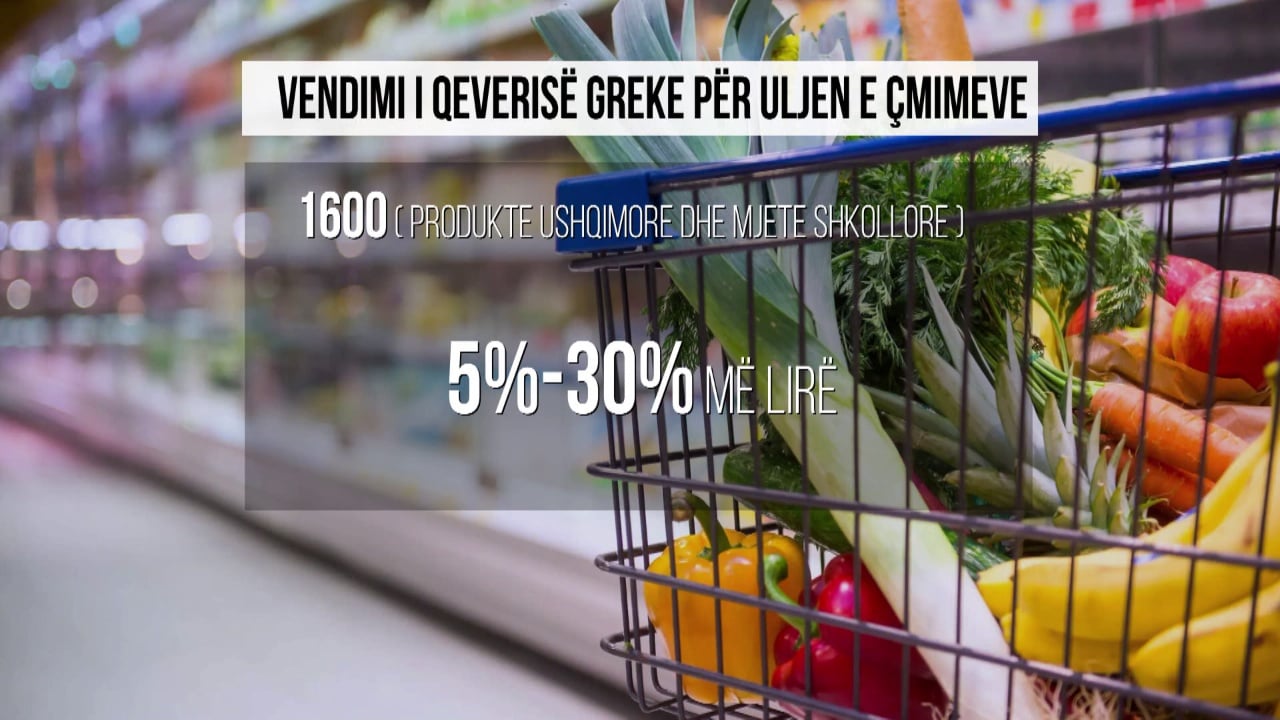
While Albania needs time to see effects, citizens in Greece are facing a different reality in supermarkets. For days now, according to reports from the ground, 1,600 food products and school supplies have been sold at prices 5% to 30% lower.
In accounts given by Albanian emigrants in Greece, several concrete examples are reported: oil from €6.10 to €5.54, tomato sauce from €1.43 to €0.84, pasta from €1.46 to €0.99, tuna from €8 to €5.50, and butter from €2.92 to €2.18. According to them, the reductions have also brought a heavy influx of shoppers to supermarkets.
Criticism: delayed response in the face of price crises
For economist Igli Tola, decision-making by the Albanian government in times of crisis has come late and with limited effect. He recalls that even during the inflationary wave after the Russia-Ukraine war, the government focused on fuel and staple food boards without intervening to subsidize consumption or reduce certain taxes on essential goods.
Pressure on prices, meanwhile, has also been driven by international developments. Conflicts in the Middle East and movements in fuel prices have subsequently also affected the rise in the cost of basket goods.
It is precisely here that the difference is measured between promoting a platform and having a real impact on the market: consumers do not buy transparency, but lower prices. For now, in Albania, that remains more of an expectation than a verified result.