
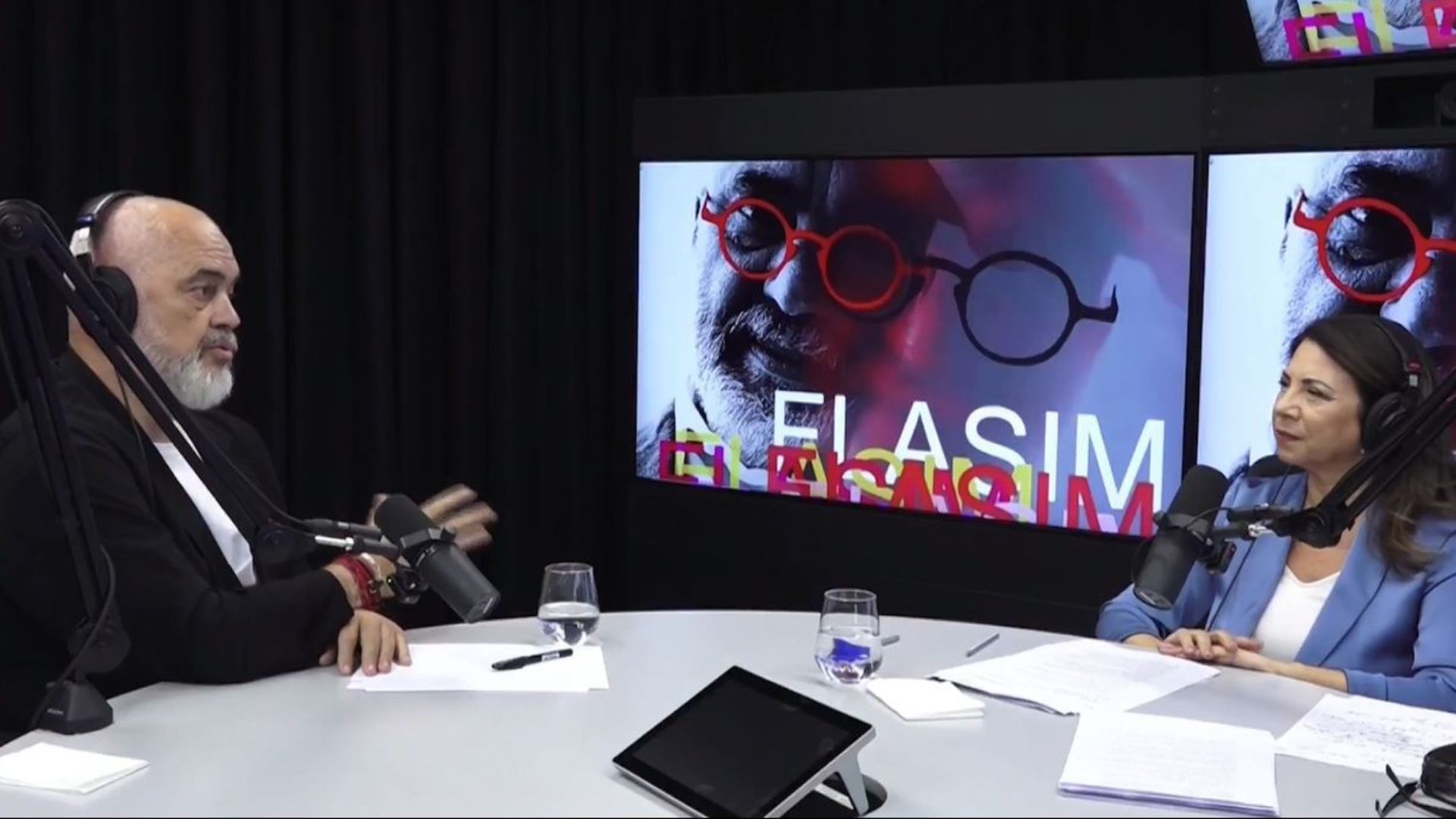
Prime Minister Edi Rama has brought two politically sensitive issues back into focus: the protests that, according to him, pushed him to consider resigning, and the debate over the project on Sazan, which he linked to a campaign fueled by non-authentic accounts on social media. The statements were made in an interview on his podcast, where the head of government sought to offer his own reading of public discontent and the online noise surrounding the investment.
Resignation as political reflection, not as a decision
Rama said that at one point during the protests he had also considered resigning, presenting this as part of a reflection on the relationship between governing and public dissatisfaction.
He spoke about the need, in his version, for a leader to have not only conviction in what he is doing, but also the courage to accept that a challenge from the public may have a basis. Along these lines, he said citizens’ reactions pushed him to analyze more deeply the changes in Albanian society.
From “gravel” to higher expectations
In the interview, the prime minister argued that Albania has entered a phase he described as the “revolution of high expectations.” According to him, investments or improvements in services no longer automatically produce political gratitude, but instead generate new demands.
Rama gave examples from the past, when a road, a school or lighting in a neighborhood was accompanied by immediate support, while today citizens demand more. He acknowledged that he did not immediately understand this change.
Sazan and the claim of fabricated profiles
A significant part of Rama’s remarks focused on the debate over the investment in Sazan and the link that has been made between it and Israel. The prime minister claimed that part of this narrative has been fueled by non-authentic accounts, artificially created to amplify certain messages.
According to him, these profiles take on the appearance of ordinary users and are difficult to distinguish even by the major social platforms themselves. Rama described them as an “army” of accounts created in technological laboratories that intervene in public debate by giving weight to different narratives.
Claims of interference and references to cybersecurity
Along the same lines, Rama linked this reality to the need to strengthen cyber defense. He recalled the cyberattack that Albania attributed to Iran and said that, after that event, the state has built more advanced capacities to identify foreign interference.
However, beyond the prime minister’s claims about artificial profiles and fueled narratives, no concrete evidence was presented in this interview for the specific case of the debate over Sazan. This leaves the matter at the level of a political accusation, while public debate over the investment remains open.
Rama’s statements come at a time when the government is facing not only political opposition, but also growing distrust over the way major projects are managed and how public communication around them is handled.
For precisely this reason, any claim about an “army” of false profiles or manipulation of narratives requires transparency and evidence, especially when it is used to explain real public reactions to government decision-making.