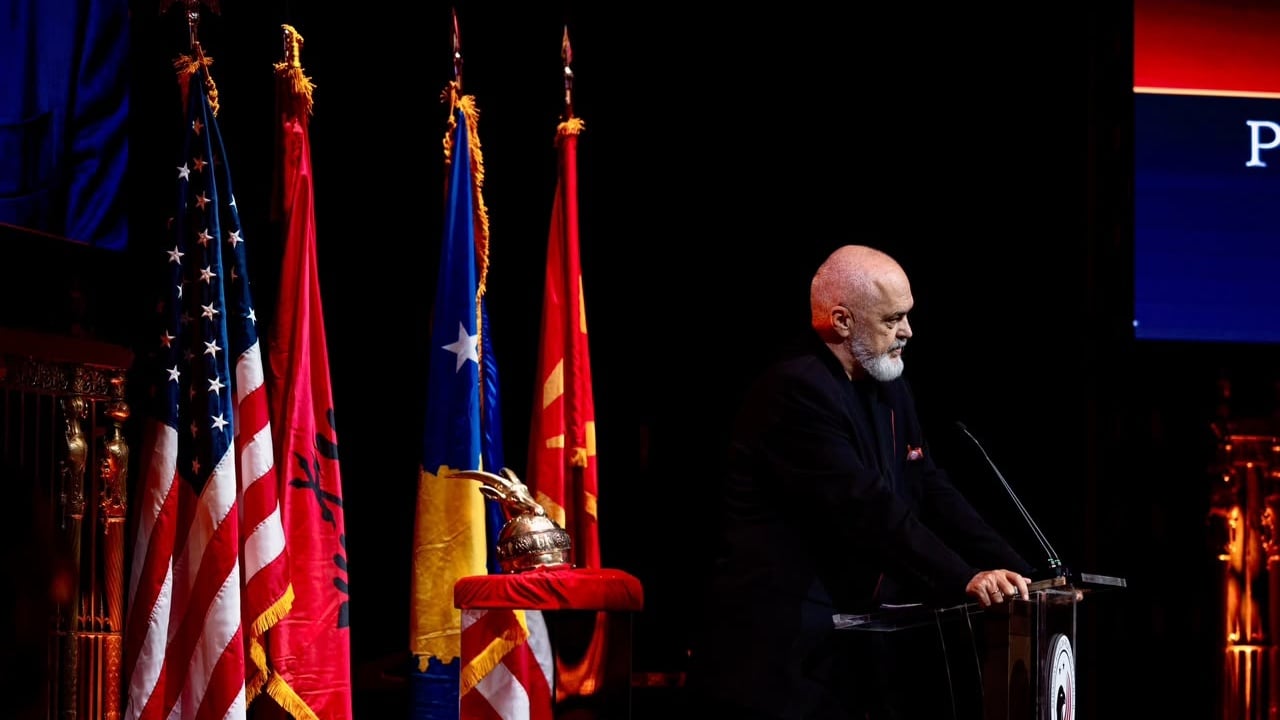
Prime Minister Edi Rama used harsh language toward social media, portraying it as a space where, according to him, a direct intervention in the minds of young people is taking place. At the same time, he kept his distance from any open call to shut down or ban the platforms, placing the emphasis on what he described as disregard for the truth.
Alarm over the impact on young people
In his statement, Rama compared the lack of protection for children and young people in the digital space to being left unprotected in the face of an invisible threat. According to him, while states think about military shields and war scenarios, what he described as the brain of the younger generation is being left without protection.
This is a strong political formulation that shifts the debate from the ordinary use of social media to their impact on shaping the opinions and behavior of young people. However, Rama did not present concrete measures or a detailed institutional approach to address this concern.
Social media as a field of manipulation
According to the version presented by the prime minister, the attack does not come through classic means, but through interference with the minds of young people via social media. He linked this to the spread of content he described as trash, suggesting that freedom of expression is being used as a shelter for manipulation and the distortion of public debate as well.
In essence, Rama raised a familiar accusation against digital platforms: that they not only transmit information, but also create a space for interference, the poisoning of public discussion, and the relativization of truth. But the statement remained at a political and rhetorical level, without addressing the concrete responsibilities of the state, the platforms, or regulatory mechanisms.
“I am not for shutting them down”
Despite the harsh tone, Rama said he is not an advocate of shutting down social media, persecution, or obstructing freedom of expression. This places his statement between two positions: on the one hand, alarm over the influence that, according to him, is being exerted on society; on the other hand, the absence of a direct call for restrictions.
He insisted that the main problem is the devaluation of truth, which according to him is being consumed and suppressed by lies, manipulation, and evil. Here too, the prime minister articulated a broad concern about the public climate, but without clarifying where criticism of online chaos ends and where the idea of control over it begins.
Political message on divisions among Albanians
At the end of the statement, Rama broadened the message beyond social media and focused on divisions among Albanians. He said these divisions damage Albanian society itself and that Albanians, according to him, have grown by harming themselves.
The message is meant to be read as a call for public reflection, but it comes at a time when both political and online debate are deeply polarized. Against this backdrop, the rhetoric about truth, manipulation, and divisions remains strong in words, while it remains to be seen whether it will be accompanied by concrete and measurable approaches.
Rama’s statement once again places at the center the relationship between freedom of expression, the influence of platforms, and public responsibility in the digital age.
But beyond the verbal alarm, the question remains open: what solution is the government actually proposing for a problem it describes in such severe terms?