
Prime Minister Edi Rama, speaking from the United States, made a strong political statement about Hashim Thaçi, saying the former president of Kosovo “was betrayed” and elevating his stature in an unusual comparison to George Washington. The statement came in a politically charged tone and directly touched on one of the most sensitive issues in the Albanian-speaking sphere.
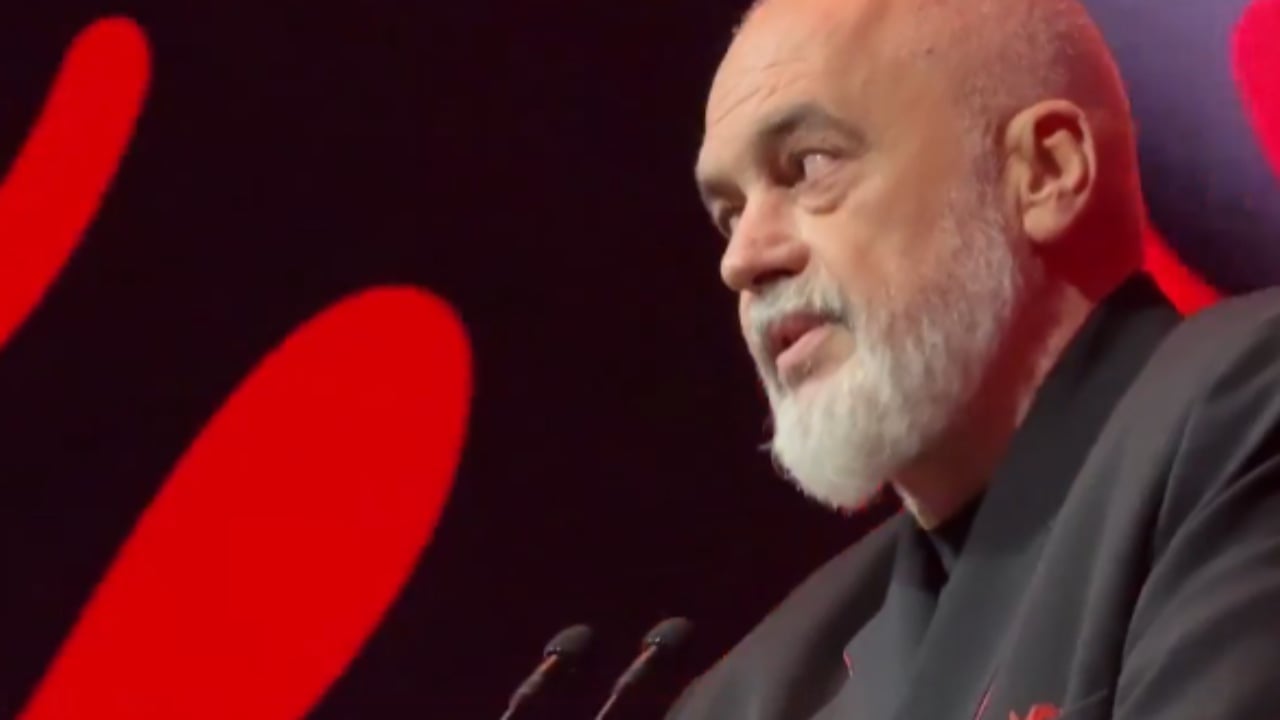
Rama’s statement on Thaçi
During his remarks, Rama said he felt Hashim Thaçi’s absence from the event, stressing that he had always been invited “under his roof.” He then went further, voicing a direct political accusation.
“He is not here today because this country betrayed him, not Biden betrayed him, because General Clark also did his best. This country did not do its best for Thaçi, for Kosovo’s George Washington,” Rama said.
A comparison with heavy political weight
The strongest part of the statement was the comparison of Hashim Thaçi to “Kosovo’s George Washington,” a formulation that places the former president’s figure on a very high historical and political pedestal.
This kind of positioning does not pass as a mere emotional comment. It carries clear political weight, especially when it comes from the head of the Albanian government and is used to suggest that responsibility for Thaçi’s fate should not be sought abroad, but within “this country” itself, as Rama put it.
Who the accusation is aimed at
Rama did not publicly clarify in this statement which institution, state or decision-making body he specifically had in mind when he said that “this country betrayed him.” That is precisely what leaves the statement open to political and public interpretation.
What remains clear is that the prime minister chose to draw a sharp distinction between the American figures he mentioned, such as Joe Biden and General Wesley Clark, and the responsibility that, according to his version, belongs to another party.
A message resonating beyond the ceremony
Rama’s speech did not stop at the ceremonial dimension of the event he attended. It turned into a message carrying a strong charge about how Thaçi’s figure is treated in Albanian and Kosovar political discourse.
At its core, the prime minister used a public stage in the United States to articulate an open political defense of Thaçi, choosing maximal terms and language that is expected to generate new debate in public opinion.
Rama’s statement adds tension to the debate over how the figure of Hashim Thaçi is treated and the role politics chooses to assign to this issue in public.
Beyond the strong wording, the fact remains that the prime minister chose to deliver a direct political message from the United States, with an accusation that carries weight and a comparison that is unlikely to pass without consequences in the debate.