
European Commission President Ursula von der Leyen appeared in Tirana with a clear political message for the Albanian government: reforms must continue and, above all, be fully implemented. At the joint conference with Prime Minister Edi Rama, the focus of the public statements was on justice, the environment and the European Union’s support package through the Growth Plan.
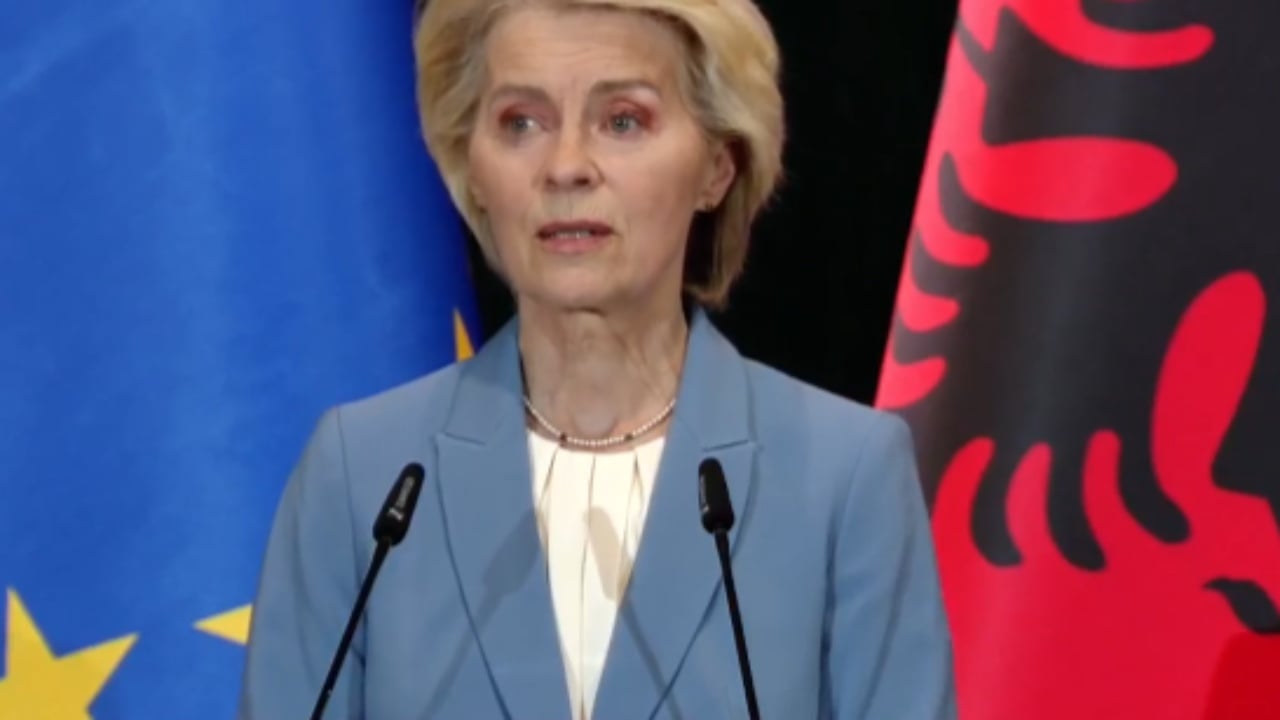
Brussels demands not only reforms, but full implementation
Von der Leyen said Albania still needs further reforms in the open chapters of the integration process, highlighting the judicial framework and environmental protection.
She stressed that the changes should not remain at a declarative or formal level, but should produce a real effect for citizens. This is a familiar signal from Brussels: progress is measured not simply by laws adopted, but by their implementation in practice.
EU claim: more than 80% of the steps have been completed
According to the president of the European Commission, Albania has completed more than 80% of the steps foreseen in the EU Growth Plan.
In the same public appearance, she said the country has benefited from 213 million euros from the European Union. The statement presents the progress as positive, although no further public details were given at the conference on how these steps were concretely measured or on the direct impact of the funds on citizens.
What the European Commission’s economic message includes
Von der Leyen linked the Growth Plan to preparing Albania’s economy for the European market, arguing that EU investments and reforms go hand in hand with increasing the competitiveness of companies.
She also mentioned Albania’s accession to SEPA as a concrete result in this process, while also speaking about efforts to reduce roaming charges between the countries of the region and the European Union.
Political message on integration: preparation on both sides
At the end of her statement, the president of the European Commission said that Albania is preparing for membership, but that the European Union itself is also preparing on its side.
This wording suggests that the process remains two-sided and conditional, despite the encouraging tone used at the conference. For official Tirana, Brussels’ emphasis on the implementation of reforms remains the main proof that the road to the EU does not pass only through political rhetoric, but through verifiable results.
The statements in Tirana reinforced the EU’s political support for Albania, but at the same time brought back to the center Brussels’ longstanding demand: measurable reforms, real implementation and tangible benefits for the public.
That is precisely where the real weight of the figures and promises presented at the conference will also be judged.