
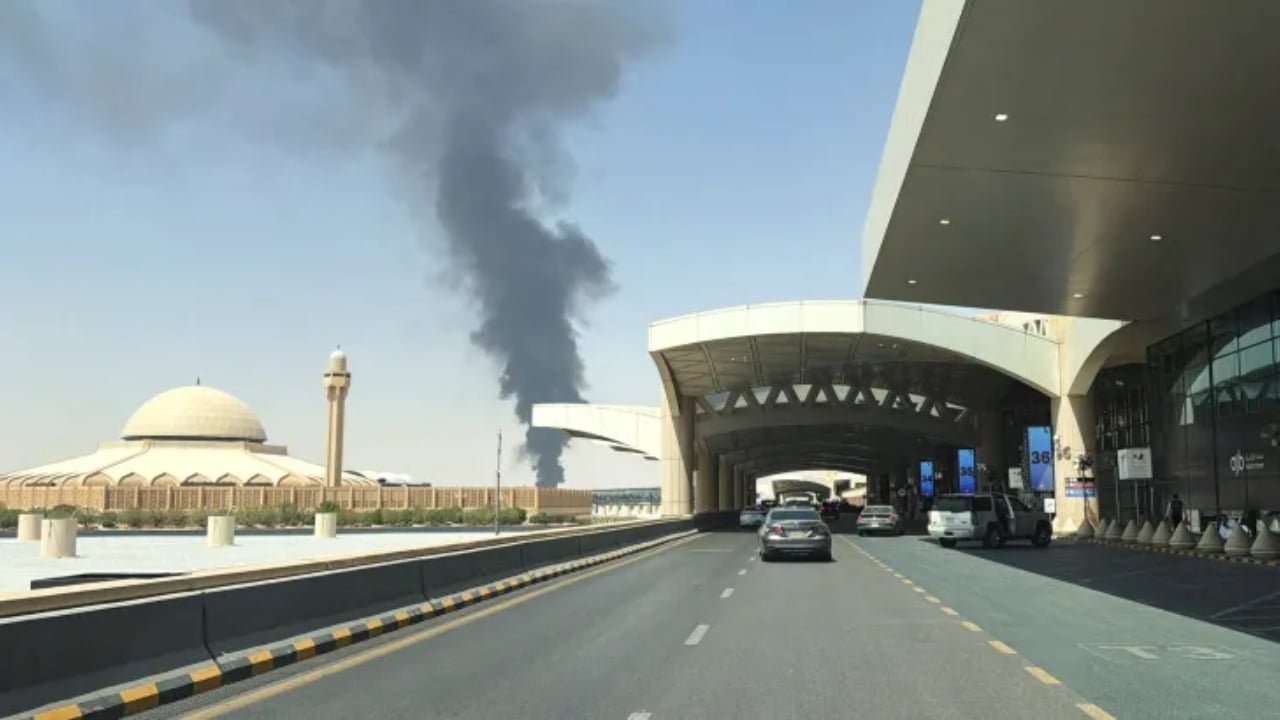
At least 12 people have been killed and 309 others injured after an attack on Riyadh’s international airport, in an incident that once again exposes the vulnerability of Saudi civilian infrastructure amid regional escalation. Operations at King Khalid Airport have been suspended, while the official Saudi account immediately linked the attack to Yemen’s Houthi rebels.
Heavy toll and airport shutdown
Local authorities in Saudi Arabia confirmed the preliminary toll of dead and injured, while some of the wounded are reported to be in critical condition. Among the victims, according to Saudi civil aviation authorities, are Saudi nationals and foreigners, including an American citizen.
After the attack, activity at King Khalid International Airport was halted, while damage to infrastructure continues to be assessed. The strike on a major air transport hub has led to flight cancellations and diversions, increasing uncertainty at a sensitive point for the region.
Witness accounts from the terminal and scenes of panic
Scenes of panic were reported on the ground, with witnesses describing a mass rush of travelers immediately after the attack erupted. One person present at the domestic flights terminal said he saw Gate 401 being hit and injured people in front of him.
Reuters reported that more than a dozen ambulances arrived quickly at the airport, an indication of the scale of the incident and the pressure on emergency services.
Accusations against the Houthis and coalition rhetoric
The Saudi Arabia-led military coalition attributed the attack to the Iran-backed Houthi rebels. Coalition spokesman Major General Turki al-Maliki said the strike on the passenger terminal caused casualties among travelers and airport staff, calling the incident an “outright war crime.”
So far, the Houthis have not commented directly on the latest attack, although they have previously claimed responsibility for other attacks on the same airport. In recent days alone, separate attacks on Saudi airports have caused additional casualties and material damage.
International reactions and the shadow of escalation
US Secretary of State Marco Rubio condemned the attack and confirmed that an American citizen was among the victims. President Donald Trump said Washington is considering the possibility of a military response alongside Saudi Arabia, without yet giving a final decision.
UN Secretary-General António Guterres also said he was shocked and described the attacks as violations of international law. The incident was also condemned by several countries in the region, while Western embassies in Saudi Arabia urged their citizens to avoid the airport area.
Conflict in the background and consequences for regional security
The attack comes at a new moment of tension between Yemen’s government forces, backed by Saudi Arabia, and the Houthi rebels, who control large parts of the country. The Houthis claim that strikes on Saudi territory are retaliation for Riyadh’s role in the war and the years-long blockade.
The escalation in recent months has included missile and drone attacks on airports, oil facilities and ships in the Red Sea. This turns every such strike not only into a human tragedy, but also into evidence of the failure of the informal ceasefire that had been fading since July.
So far, there has been no independent clarification of responsibility for the attack, beyond claims by the Saudi side and the previous record of attacks claimed by the Houthis.
What remains clear is that the strike on Riyadh airport pushes the region even further toward a more dangerous phase, with civilians once again on the front line of the war’s cost.