
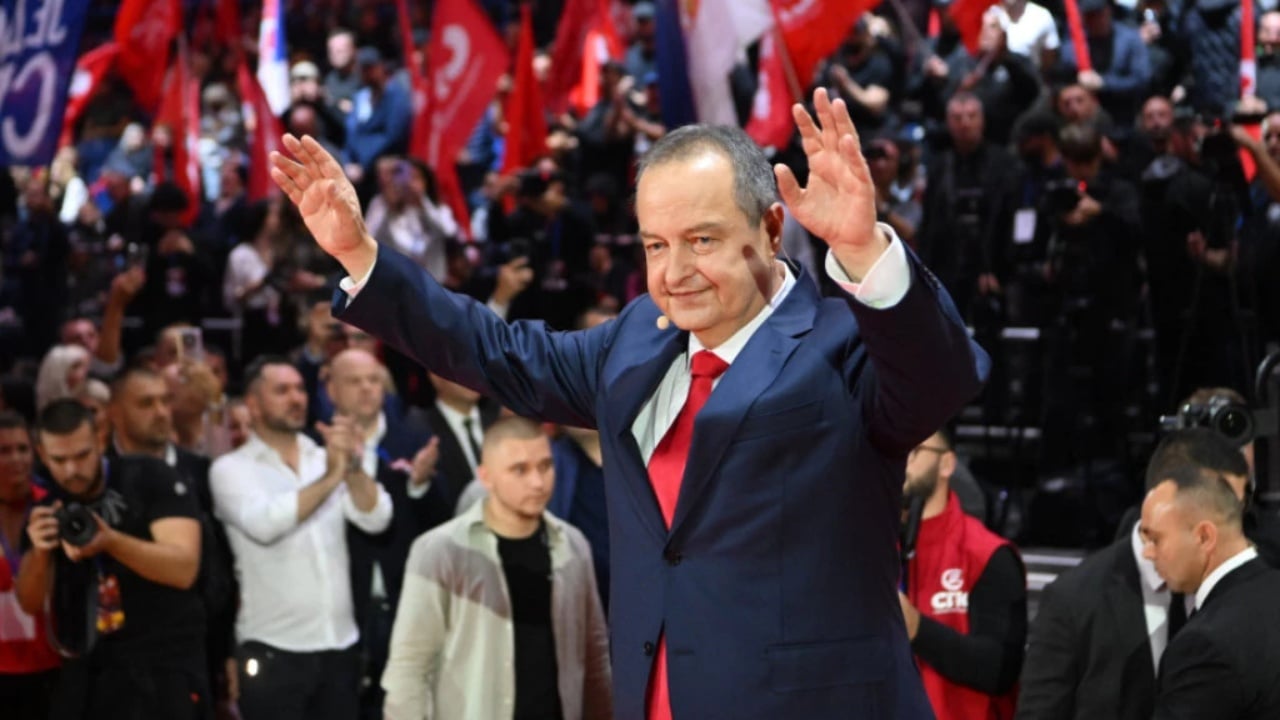
Ivica Dacic has brought back to the campaign trail one of the region’s most sensitive issues, with statements that openly challenge Kosovo’s political reality and fuel nationalist rhetoric in Serbia. At an election rally in Belgrade, the Serbian interior minister and deputy prime minister again claimed that the “Serbian flag” would fly in Prizren, accompanying the remark with historical references and confrontational language.
Prizren at the center of election rhetoric
During his speech, Dacic claimed that Prizren was the first Serbian capital and insisted that Serbia would not retreat from its political positions on Kosovo. The statements came at an election event, making clear the use of the Kosovo issue for domestic political consumption.
He also responded to criticism that, according to him, had been made by former German minister Michael Roth after his earlier statement that the Serbian flag would fly again in Prizren. In essence, Dacic chose to present the provocation as a show of strength and a sign of political “courage.”
Claims about war and nationalist messages
In his remarks, Dacic said he “dares” to speak this way because, according to him, Serbia “defended” Kosovo through war. This language, delivered at an election rally, comes as part of an old nationalist narrative that returns whenever Serbian politics seeks to mobilize the electorate.
He also said he was born in Prizren and linked this to a personal right to make such statements. He further claimed that few Serbs live in the city today, comparing the situation with decades ago and using this as an argument for the continuation of Belgrade’s political claims toward Kosovo.
Kosovo, Russia, China and political ambition
Dacic devoted a significant part of his speech to opposing Kosovo’s independence. According to his statements, he has helped more than 20 countries withdraw recognition of Kosovo and suggested that this line would continue if his political force remains a factor.
Along the same lines, he mentioned Russia and China as Serbia’s allies on the Kosovo issue. The rhetoric went beyond that topic as well, as Dacic spoke about his ambition to run for president, using the Kosovo issue as the central axis of his political profile.
Praise for Milosevic and the signals sent by Belgrade
The speech also included positive references to former Serbian president Slobodan Milosevic, to whom Dacic attributed, according to his version, the restoration of Serbian national pride. This deliberate choice of figures and symbols shows that the rhetoric is not softening, but being kept alive for political purposes.
Such statements are not merely election folklore. They send a clear signal of the continuation of confrontational language from senior officials in Serbia, especially when it comes to Kosovo and its historical and state symbols.
Dacic again presented Kosovo as an inseparable part of Serbia, while his speech turned Prizren into a symbol of Belgrade’s old rhetoric.
Instead of language that lowers tensions, the message delivered was the opposite: a repetition of political claims, the use of history for electoral mobilization, and reliance on allies such as Russia and China to keep the diplomatic confrontation over Kosovo alive.