
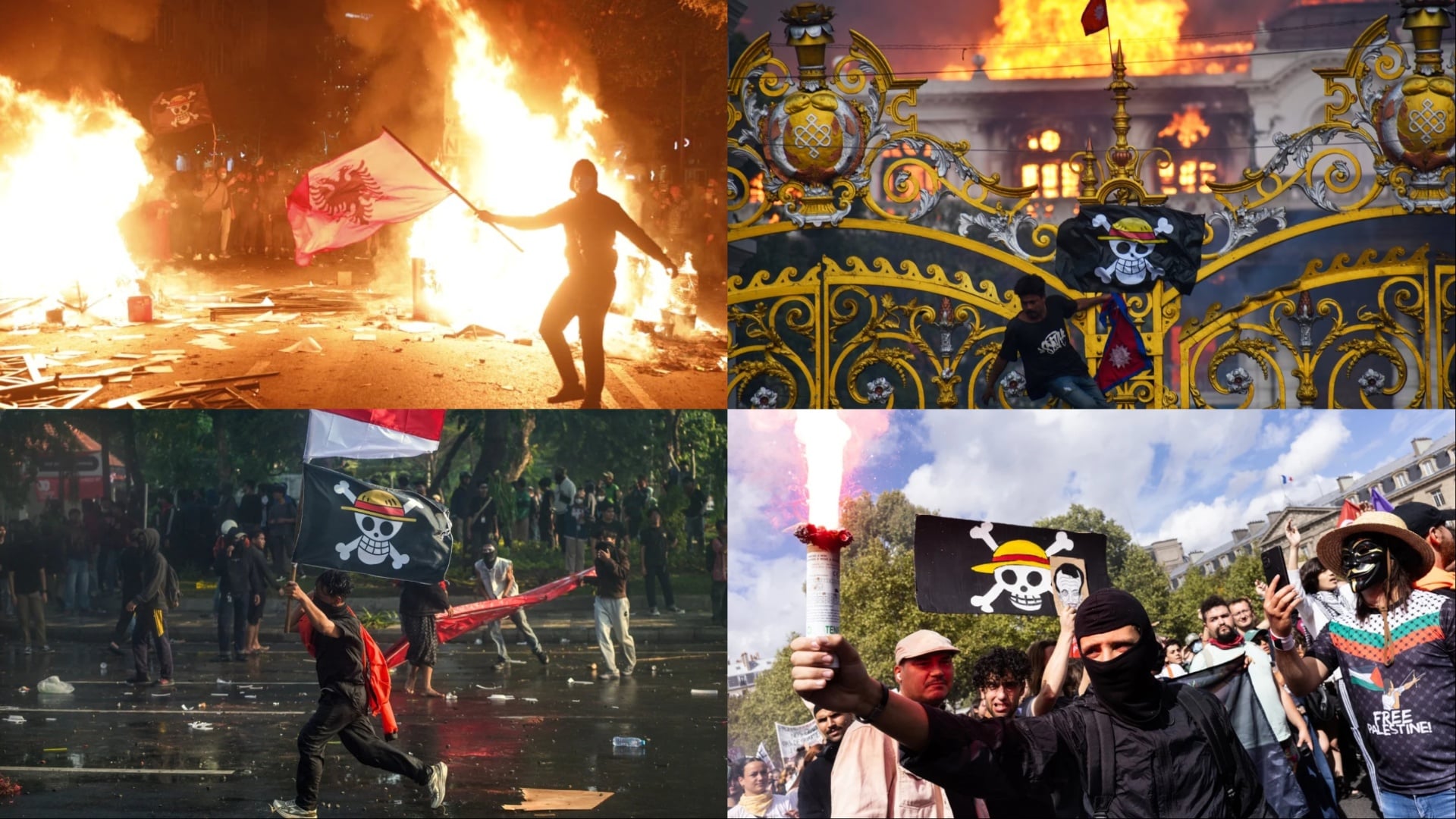
An unusual element stood out during the youth protest in Tirana: the “One Piece” flag, waved next to the national flag at a gathering that deteriorated into strong tensions with police. Footage published from the scene places this symbol at the center of attention in a protest that saw fires in the street, vandalism and forceful intervention by the blue uniforms.
The protest began at the Ministry of Education and escalated
The gathering began with students positioned in front of the Ministry of Education, but the situation later turned into clashes. According to the version reported by media close to coverage of the event, the protest lasted for more than five hours and was accompanied by numerous tensions.
On the ground, broken windows, the removal of railings and the throwing of bricks toward the state institution were reported. The protesters then moved toward Rruga e Durrësit, where clashes with police continued at different intervals.
Police intervention and fires in the street
According to reports from the protest, police responded with batons, detentions and water cannon trucks. The presence of law enforcement did not immediately calm tensions on the ground.
On several road axes, fires could be seen burning in the middle of the street, while some of them remained active during later developments. This turned the area into an open flashpoint for clashes, with an increased risk of escalation.
What the “One Piece” flag represents
Amid these scenes, the “One Piece” flag was also noticed, known from the 1997 Japanese manga created by Eiichiro Oda. In its universe, it is linked to the character Monkey D. Luffy and his crew, built around the idea of freedom, defiance of power and the liberation of the oppressed.
In public use outside pop culture, this flag has been seen as a protest symbol in youth-led movements. This is why its appearance in Tirana was read not simply as an aesthetic detail, but as a political and cultural message from part of the protesters.
From Asia to Tirana, a symbol that crosses borders
The flag has also been used in protests in countries such as Indonesia, the Philippines and Nepal, and it has also appeared on the streets of Paris. In these cases, it has been linked to the defiant spirit of the younger generation and the rejection of authority perceived as oppressive.
At the protest in Tirana, it was seen next to the red-and-black flag, waving at the center of the gathering. Its presence at a demonstration marked by clashes makes the symbol part of the day’s narrative, beyond cultural interpretation or anime fandom.
Beyond the debate over the flag’s symbolism, the main development remains the fact that the protest in the capital turned into a direct confrontation between young people and the police.
Against this backdrop, the use of a global protest symbol appears to be a sign of a new visual language on the streets of Tirana, in a climate where political communication through pop culture codes is gradually gaining ground.