
Prime Minister Edi Rama commented from Paris on the protests in Albania, offering a political reading of them and attributing the escalation of violence to a small group of protesters. In the same appearance, he accused the opposition of, according to his version, hiding behind radicalized young people, while also placing the debate against the backdrop of social media and youth emigration.
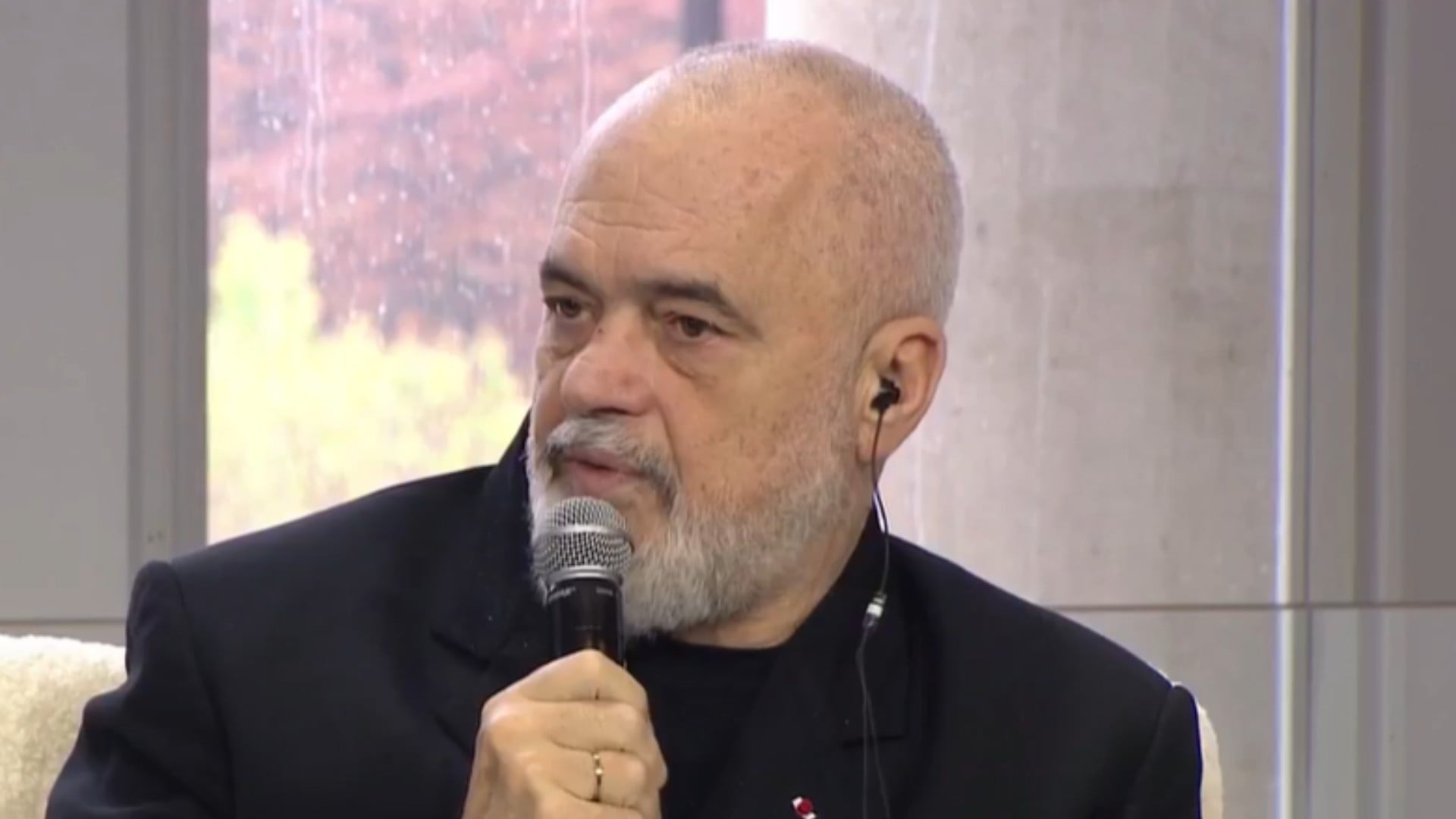
The statement was made at the Paris Peace Forum
Rama took part in a discussion at the Musée de l’Homme in Paris, where the Peace Forum is being held. The conversation focused on the enlargement of the European Union and the future of the younger generation.
The question put to him concerned youth demonstrations in Albania, concerns about migration, especially labor migration, and similarities or differences with protests in countries such as France and Italy.
How Rama divided the protest into two phases
In his response, the prime minister drew a distinction between the June protest and later developments. According to him, there was initially broader civic participation, with concerns linked to the project that he associated with Jared Kushner.
Later, according to Rama, the protest remained in the hands of a small number of people who escalated it into violence. He insisted that this part no longer represented the initial nature of the public reaction.
Political accusations against the opposition and social media
Rama also linked the situation to the influence of social media, claiming that this is where young people are informed, but also misinformed. Along these lines, he presented the protest as a mixture of different motives and grievances.
He then attacked the opposition, saying that small and large parties have hidden behind radicalized young people. It is a strong political accusation, articulated without providing concrete details of direct responsibility or public evidence at that forum.
Message to the EU and Albania’s European identity
In the second part of his response, Rama shifted the focus to Albanians’ relationship with the European Union. He said that, despite internal political clashes and protests, the European orientation remains the point on which, according to him, there is broad agreement.
The prime minister argued that Albania has a particular history in relation to East and West and that, for this reason, the European project remains the country’s shared destination. According to him, Albanians are not influenced by other actors, but by the prospect of integration into the EU.
The appearance from Paris came as an attempt to interpret the protest crisis before an international audience, giving it a framework in which real discontent, violence, social media and internal political conflict are mixed together.
But beyond the prime minister’s official version, it remains essential that claims of political manipulation, radicalization and responsibility for the violence be measured against verifiable facts, not only against a political narrative exported from international stages.