
Spain has signaled a softer tone toward Kosovo in relation to the European Union, at least at the declarative level. In Brussels, Foreign Minister José Manuel Albares said Madrid would not become an obstacle to Kosovo’s closer ties with the EU, although Spain’s fundamental position remains unchanged: recognition of independence is still absent.
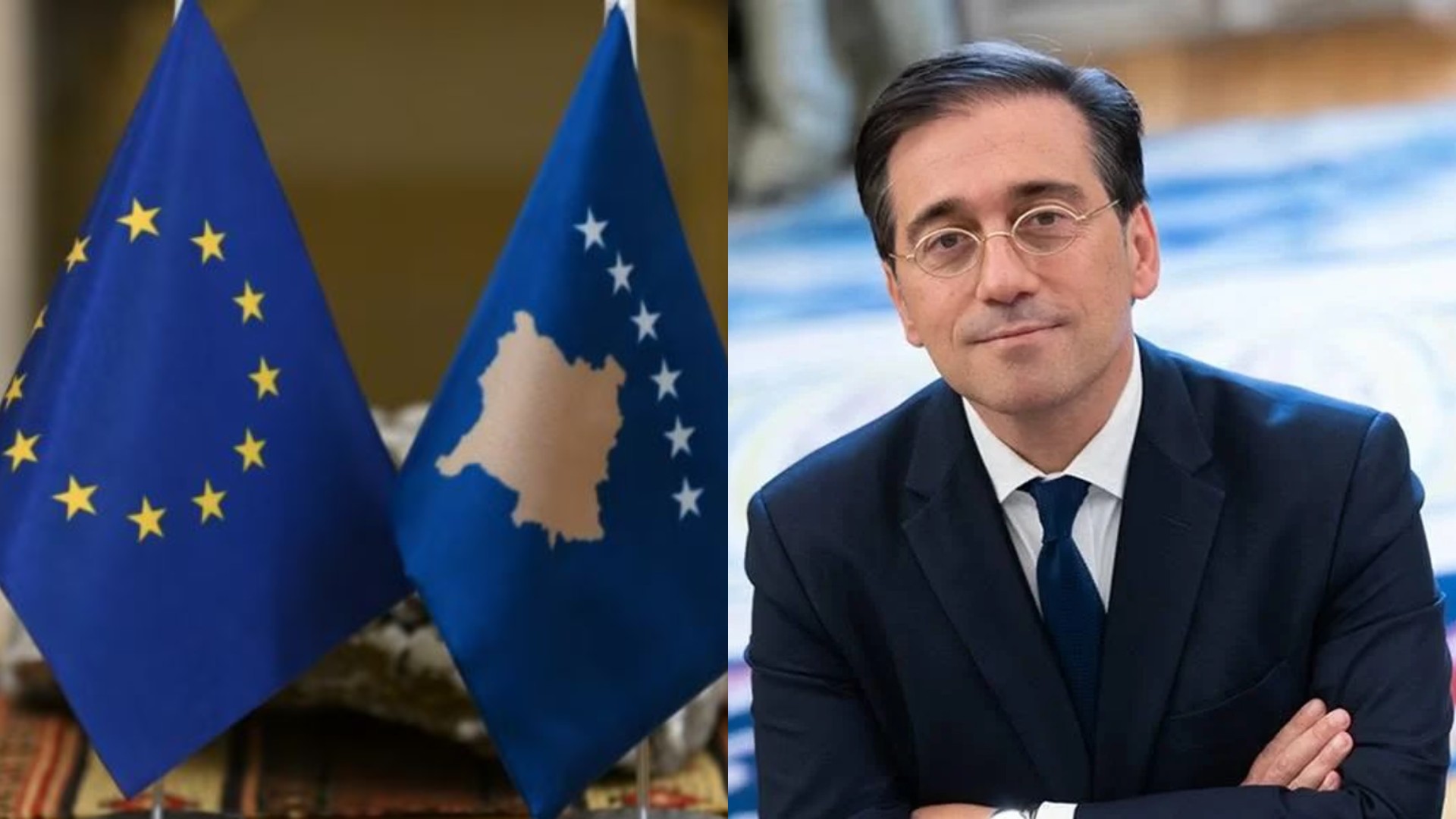
Albares’ statement in Brussels
During the 2026 Enlargement Forum, Albares said that Spain would not obstruct either the dialogue between Pristina and Belgrade or Kosovo’s closer ties with the European Union.
The message comes as a cautious diplomatic move from one of the five EU countries that still do not recognize Kosovo. In essence, Madrid is speaking about not blocking the process, but not about changing its position on Kosovo’s statehood.
What Spain presents as proof
To support this position, the Spanish minister mentioned visa liberalization for Kosovo’s citizens and the recognition of Kosovar passports by the Spanish authorities.
These are practical signals of a softer approach, but they do not change the main political fact: Spain remains among the group of EU countries that do not recognize Kosovo’s independence. Alongside it in this position are Cyprus, Slovakia, Greece and Romania.
The real obstacle remains unanimous decision-making
Despite the more conciliatory tone from Madrid, the institutional obstacle for Kosovo remains serious. Irish Minister of State for European Affairs Thomas Byrne made it clear that the position of the five non-recognizing states continues to be a challenge for Kosovo’s integration into European structures.
Kosovo remains the only country in the Western Balkans without candidate country status. Pristina applied for EU membership in December 2022, but the request has still not been taken under consideration. To begin the assessment process, the European Commission must receive a mandate from the member states, which must agree unanimously.
Kosovo left out of the forum, for the second year
On the political level, the contrast remains clear: while there is talk of Kosovo’s closer ties with the EU, Kosovo itself was not invited to the Enlargement Forum held on November 15 and 16 in Brussels. It was the second year in a row that Pristina was left out of the event.
Prime Minister Albin Kurti has repeatedly called for Kosovo to be granted candidate status and for the path toward negotiations to be opened. However, between political statements and concrete EU decisions, the gap remains evident.
Albares’ statement can be read as a less obstructive signal from Madrid, but not as a full shift in relation to Kosovo.
As long as recognition is absent and EU decision-making requires unanimity, Kosovo’s path toward the union remains dependent not only on diplomatic rhetoric, but on the real will of the member states.