
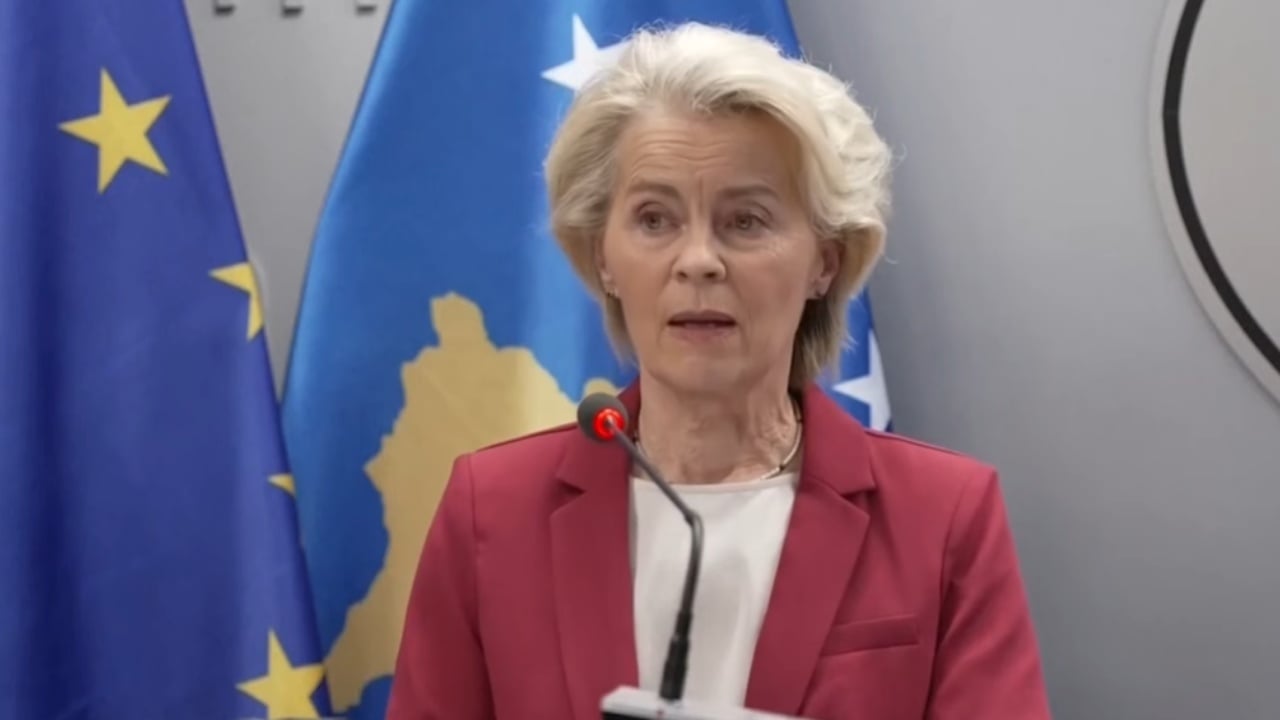
European Commission President Ursula von der Leyen delivered a message from Kosovo built on two pillars: on the one hand, support for the historical memory of the 1999 war, and on the other, insistence that the ruling of the Specialist Chambers be treated within the framework of justice and appeal. Her remarks come at a politically and emotionally sensitive moment for Kosovo.
The message on 1999 and collective memory
Von der Leyen said that 1999 remains etched in the memory of Kosovo’s citizens, recalling the repression, humanitarian crisis and suffering of the population.
She said that Kosovo’s history cannot be rewritten, presenting this as a clear political and moral line in debates that have reopened after the latest judicial developments.
The EU reaffirms support for Kosovo
In her remarks, the president of the European Commission described Kosovo as an important partner for the European Union and repeated that its future lies in the EU.
According to her statements, European support has included reconstruction, economic development, reforms and the strengthening of democratic institutions. This is a familiar message from Brussels, repeated whenever the issue of Kosovo’s European perspective is placed at the center of high-level visits.
Reaction to the Specialist Chambers ruling
Von der Leyen also addressed the judgment against former KLA leaders, which she said has caused strong emotions in Kosovo.
She praised calls for calm from citizens and political leaders, while underlining the EU’s official position that the ruling was delivered by an independent judicial institution and that its mandate must be respected.
Individual responsibility, not a judgment on the war
In one of the most sensitive parts of her statement, Von der Leyen drew a distinction between the individual responsibility of the defendants and the history of Kosovo’s resistance.
According to her, the judgment concerns specific individuals and not Kosovo’s war as a whole. She also added that the defense has the right to pursue all legal procedures, including an appeal, while calling for respect as well for the memory of victims from all communities in Kosovo.
Von der Leyen’s statement seeks to maintain a difficult balance: not to leave room for the relativization of 1999, while at the same time defending the legitimacy of the judicial process in the Specialist Chambers.
It is precisely this political and legal duality that is expected to remain at the center of public debate in Kosovo, where the memory of the war and the relationship with international justice continue to clash sharply.