
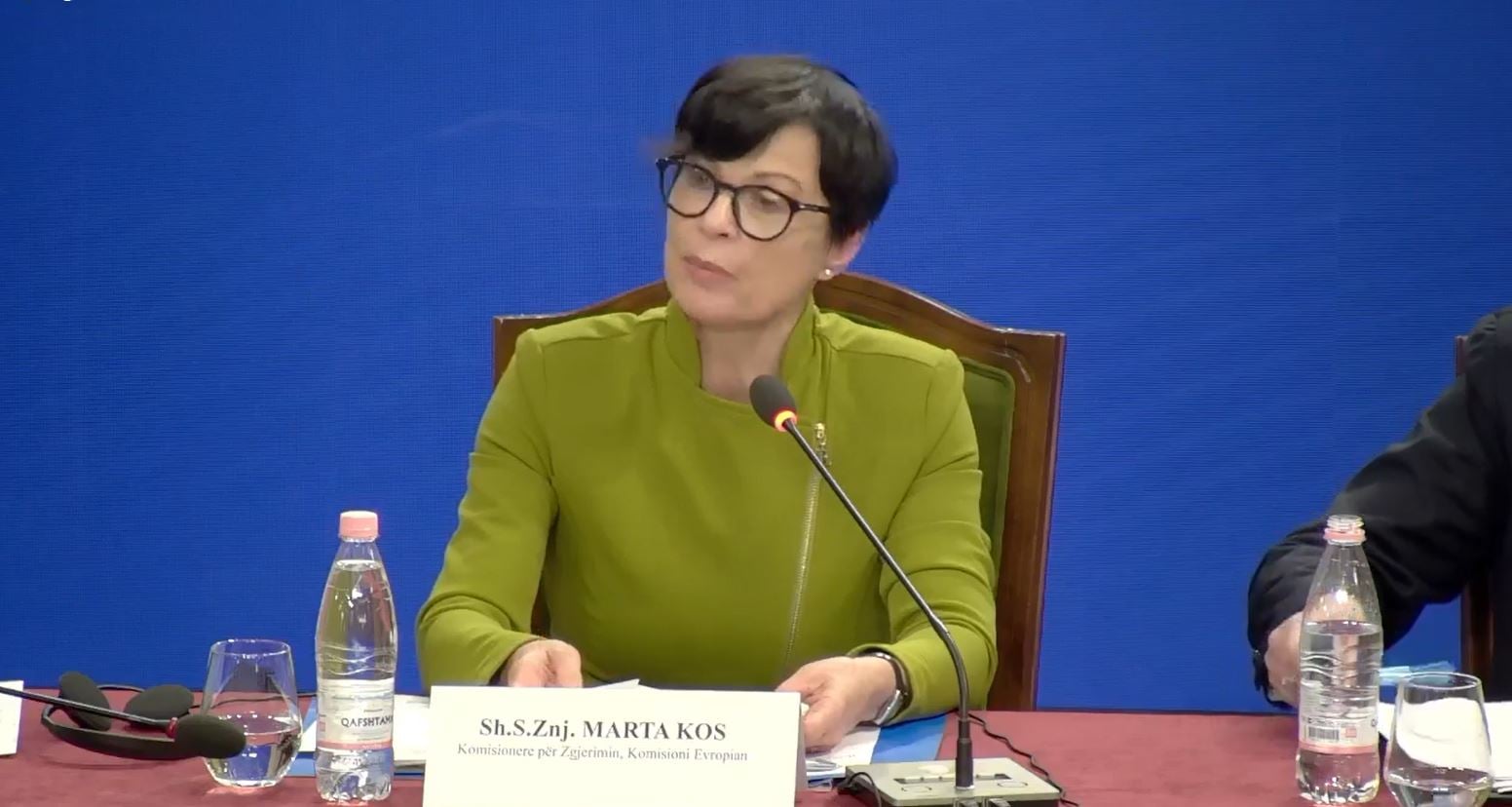
Albania may set 2027 as a political target for membership in the European Union, but the message that came from Tirana was less ceremonial than optimistic. European Commissioner for Enlargement Marta Kos praised the pace of negotiations so far, while making it clear that the real test lies not in roadmaps or declarations, but in the implementation of the law and in the ability of institutions to reach even those in power.
Positive signal from Brussels, with clear conditions
Speaking at the National Council for European Integration in Tirana, Kos said Albania has made visible progress on its path toward the EU. According to her, the country has opened all negotiation clusters in just 13 months, and four chapters have already been closed.
She said that by the end of the year, nearly a quarter of all negotiation chapters are expected to be closed, presenting this as a fast pace in the accession process.
2027 as a possibility, not a guarantee
According to the Commissioner for Enlargement, 2027 could be Albania’s year. But she warned that a roadmap on paper is not enough and does not constitute a guarantee of membership.
Her message was direct: the closer the country gets to the EU, the more important it becomes to prove that institutions work and that laws do not remain only on paper.
Fight against corruption and the accountability of people in power
Kos placed the emphasis on the results that, in Brussels’ view, will weigh most heavily for member states: the fight against corruption, tackling organized crime, and alignment with EU environmental legislation.
She said the decisive test in the rule of law will be how authorities respond to investigations, including cases where even people in power must be held accountable. It is precisely there, she said, that it becomes clear whether institutions are truly independent.
Call to politics: less confrontation, more responsibility
The commissioner called on political parties and society to unite around the goal of integration rather than remain focused only on political debate. She argued that Albania has a strong advantage: high public support for EU membership.
According to her, that support gives politics a mandate to push difficult reforms forward, but also the obligation to genuinely involve citizens in the process, not merely as a pro-integration statistic.
Partners’ trust depends on accountable institutions
Kos said one of the clearest signs of trust from member states was the approval in May of the assessment report on the interim benchmarks for the rule of law.
However, she acknowledged that building accountable institutions remains among the most difficult challenges for candidate countries. According to her, these changes always meet resistance and require strong political will.
The statements from Tirana once again place the emphasis on a contradiction that has accompanied the integration process for years: progress on paper and pace in negotiations, but a much tougher test on the ground.
Beyond the 2027 target, the main message remains this: the road to the EU is measured not only by chapters opened and closed, but by whether the law is enforced even when it touches the interests of those in power.