
Edi Rama’s two-day meeting with ministers, commission heads and the Socialist Party’s political leaders in Pogradec was presented by the prime minister himself as a moment of reflection on governance and the new political season. But beyond the language of self-correction, the main message was clear: more presence on the ground, more control over the administration, and a new scheme to collect and manage citizens’ dissatisfaction.
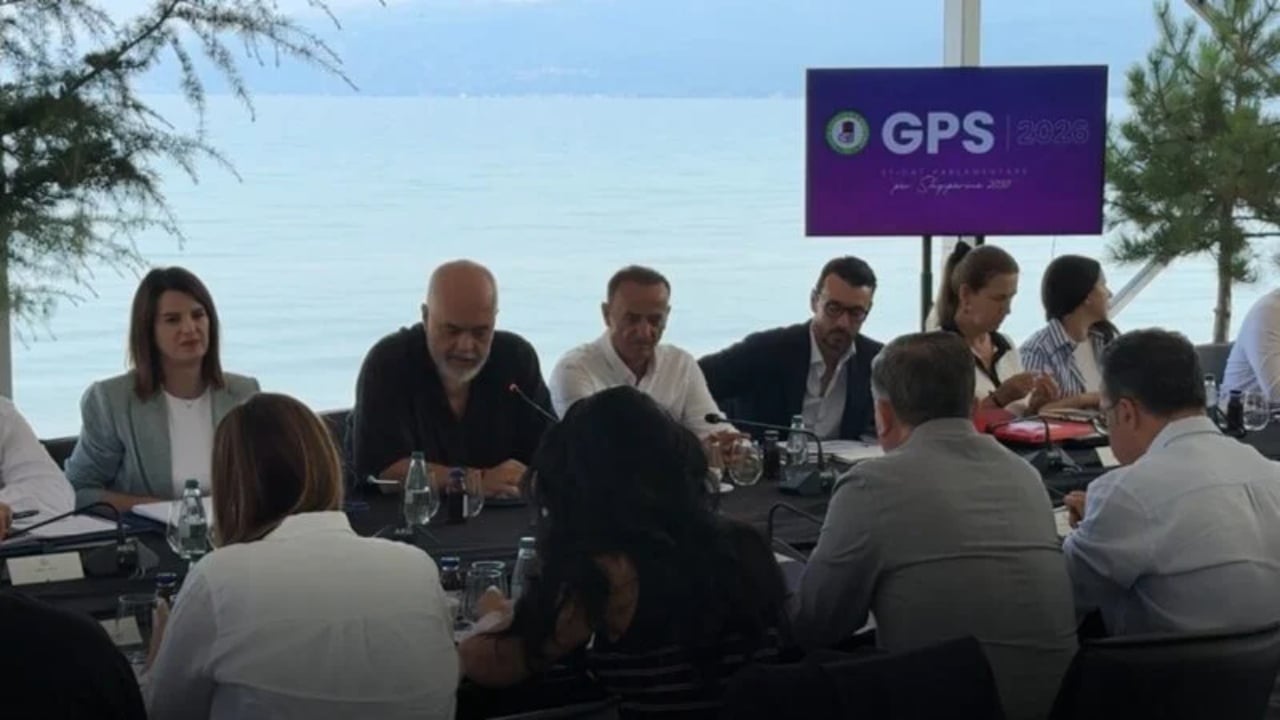
Rama’s instruction: ministers should personally monitor the directorates
According to the official version made public through a video shared by Rama, at the center of the discussions was the need for the government and the PS political structure to move closer to citizens’ concerns and turn them into concrete decision-making.
The prime minister asked political leaders to be more engaged in the territory, while ministers should exercise more direct control over the institutions under their authority. He said the government’s “fixation” should be every citizen’s concern and that ministers should personally follow the respective directorates every month.
“Besa,” the document through which the PS says it will read public dissatisfaction
One of the main points of the meeting was the “Besa” document, which socialist leaders say is intended to identify more accurately the problems raised in public and give them a concrete name.
Mirela Kumbaro presented “Besa” as an instrument to identify the concerns voiced by citizens, while Ogerta Manastirliu spoke about the need to understand the problems of families, businesses, professionals and pensioners.
Along the same lines, Arbian Mazniku acknowledged that after a long period in government there is a risk of erosion of trust, wording that suggests the majority is trying to address political wear through a reorganization of its relationship with the public.
Internal debate: listening is not enough without consequences for underperformance
In the published discussions, the idea was repeated that listening to citizens must be turned into results, not simply a political slogan. Erion Malaj called this the main challenge, while Evis Kushi spoke about the need for reflection.
On the other hand, the issue of responsibility for performance was also raised at the meeting. Adea Pirdenji pointed to the lack of punishment for failure to carry out duties as a problem, touching on a sensitive point in public administration, where promises of accountability often remain confined to political meetings.
Fatmir Xhafaj called for strengthening the government-citizen relationship, while Niko Peleshi linked trust to results and facts. Iris Luarasi drew a distinction between the role of the government and the party, describing the government as the producer of policies and the party as the structure that listens to citizens.
From “Prania Besnike” to “Pasqyrë Albania,” the new monitoring scheme
According to the presentation made at the meeting, the new model is expected to be extended to all 12 counties through the “Prania Besnike” mechanism. Ervin Demo described it as a national system for understanding what is happening on the ground, while Ermal Nufi said the burden of implementation would fall to the PS’s political leaders, MPs and local leaders.
At the same time, the government is also linking this approach to the “Pasqyrë Albania” platform, which it claims will respond to citizens’ complaints within two weeks. The structure will rely on two other mechanisms, “Flamingo Albania” for collecting concerns and “Radar” for real-time tracking of how they are handled by ministries, municipalities and other institutions.
At the center of this approach, according to the published statements, are sectors such as healthcare, education, housing, social policies and the prices of basic foodstuffs — areas where public dissatisfaction has been continuous and where promises of faster institutional response are truly tested.
The Pogradec meeting was used by the majority as a signal of political and administrative reorganization ahead of the new political year.
However, beyond new documents, platforms and new names, the test remains the same: whether citizens’ complaints will actually produce decision-making, better services and accountability for those who fail to deliver results.