
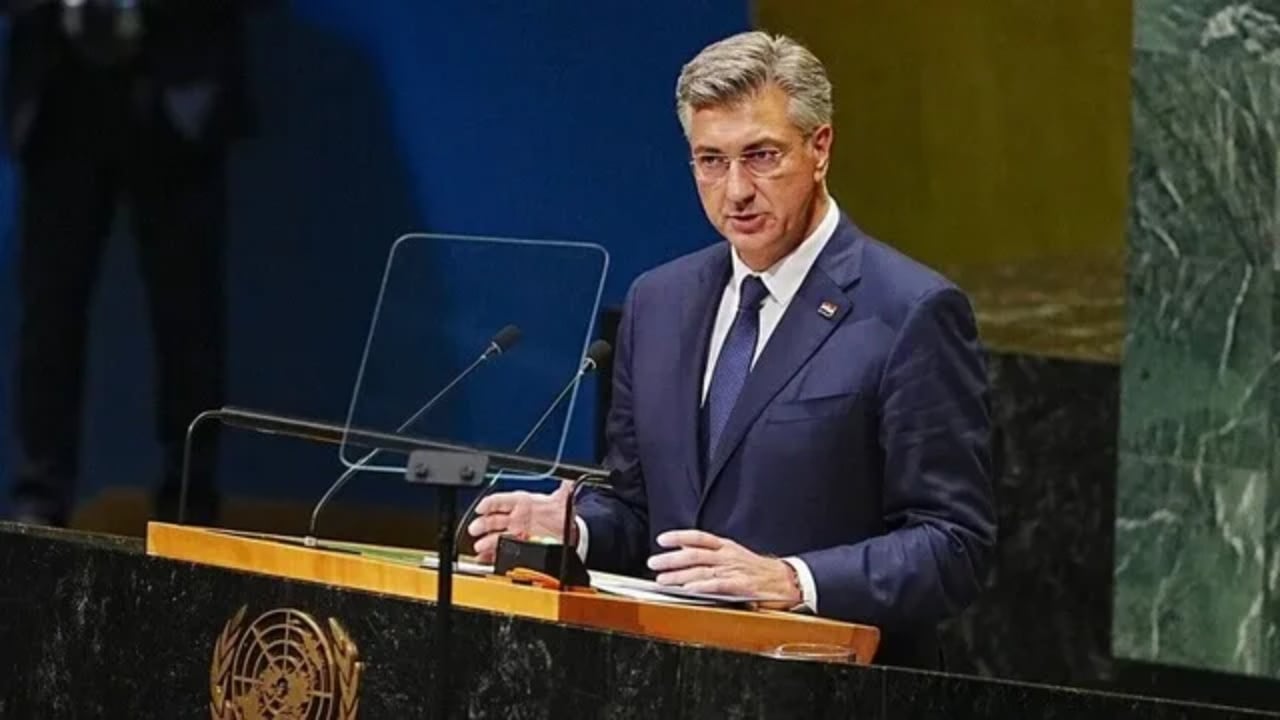
The clash between Zagreb and Belgrade has reopened at a point that is as symbolic as it is political: the way figures convicted of war crimes are treated. At the UN, Croatian Prime Minister Andrej Plenković sharply criticized the ceremony held in Serbia for Ratko Mladić, presenting it as a message that offends victims and calls into question the seriousness of appeals for reconciliation in the region.
Direct criticism from the UN podium
Plenković called the ceremony held in Belgrade for Ratko Mladić an insult to the victims and to the judgments of international courts. His position once again puts at the center the issue of Serbia’s relationship with the legacy of the wars of the 1990s.
According to his statement, the military and official honors given to Mladić cannot be separated from the weight of the crimes for which he was convicted. The political message, in this reading, goes beyond a ceremony and touches on the very standard by which the states of the region speak about justice and historical memory.
Mladić and the weight of the international conviction
The Croatian prime minister described Mladić as a war criminal convicted of genocide in Srebrenica. He added that his criminal activity had also extended into Croatia, thus linking the reaction not only to Bosnia, but also to Croatia’s wartime experience.
This makes Zagreb’s reaction more than a routine diplomatic comment. It touches a red line for states seeking full recognition of crimes and the rejection of any form of political or ceremonial rehabilitation of their perpetrators.
Reconciliation, but with clear conditions
Plenković said reconciliation in the region cannot be built on avoiding responsibility for the crimes of the past. According to him, such a process requires acknowledgment of guilt and the rejection of its glorification.
In essence, the Croatian position challenges political narratives that speak of regional stability but avoid confronting the darkest figures and episodes of the war. This remains one of the most sensitive knots in relations among the Balkan countries.
Message for EU integration
Plenković also stressed that Croatia supports the enlargement of the European Union in the Western Balkans. However, he underlined that European integration cannot be treated separately from the way the countries of the region confront the past.
This is a clear political signal: support for enlargement, according to Zagreb’s line, does not exclude moral and institutional conditionality on issues related to war crimes, public memory and respect for the decisions of international justice.
The Croatian prime minister’s reaction returns the debate to a question the Balkans have still not closed: can there be real integration and reconciliation when figures convicted of war crimes continue to receive official honors?
It is precisely in this gap between rhetoric about the European future and the way the past is treated that the political signals emerging from the region are being measured today.