
Prime Minister Edi Rama appeared at the United Nations with a clear position on artificial intelligence: in his view, its development should not be stopped. In a global debate where states are moving between fear of abuse and the race for technological advantage, Rama openly sided against the idea of slowing it down and said the answer is not surrender, but building democratic and sovereign capacities.
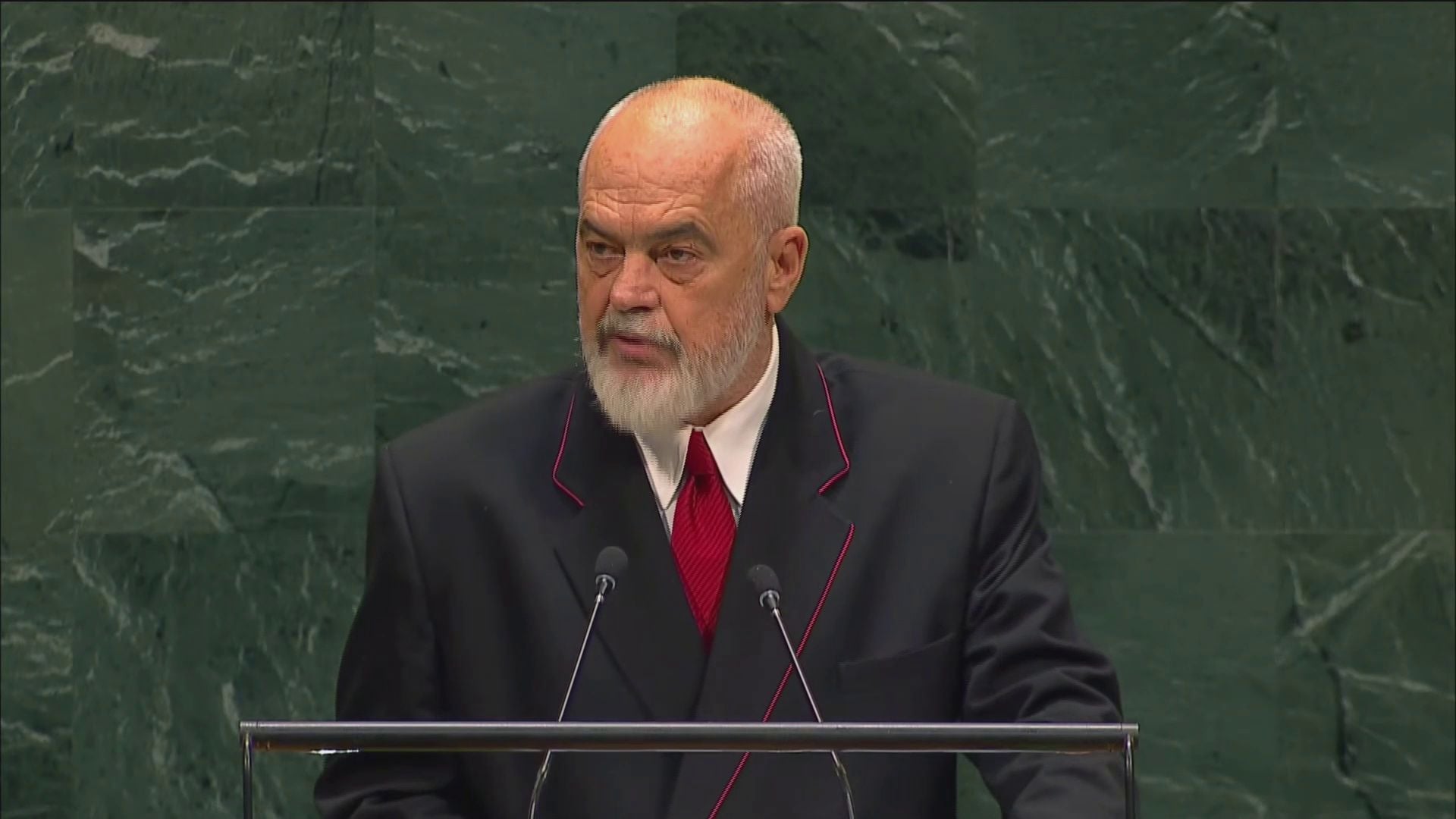
Rama: a moratorium does not stop hostile actors
According to the version presented by the prime minister, a moratorium on the development of artificial intelligence would be respected only by states that act within frameworks of responsibility, while it would not stop hostile powers, international criminal networks or the manipulation industry.
Along these lines, Rama argued that states should not limit themselves to the point where they lose the ability to compete and defend themselves in a field that is increasingly being treated as a strategic issue of security and influence.
Support for Trump’s approach to AI development
In his remarks, Rama went further, saying that the President of the United States is right on this issue and that the development of artificial intelligence cannot be suspended.
His message was that acceleration is inevitable, but not without direction. This shifts the emphasis away from stopping the technology and toward how it is controlled, used and by whom it is administered.
Call for verifiable and transparent AI
Rama said there is a need for artificial intelligence that is verifiable, transparent and accountable, built by free societies and shared among allies.
At its core, he presented a distinction between technology as a tool and technology as an instrument of power: in his view, the problem is not only the speed of development, but who carries legal and political responsibility for its use.
Sovereign AI, not isolation but control over systems
According to Rama, sovereign artificial intelligence does not mean isolation, but the ability of states not to remain powerless in the face of systems they do not understand, do not inspect and cannot challenge.
He listed several functions that, in his view, every country should keep under control: protection of language, authentication of public communications, detection of coordinated manipulation, preservation of evidence and informing citizens without total dependence on the commercial priorities of platforms or distant operations.
Rama’s statement at the UN places the debate on artificial intelligence on clearly political ground: not only as technological development, but as a contest for control, security and sovereignty.
It remains to be seen how this approach will be translated into concrete policies, beyond general formulations on transparency, verification and accountability.